
How to Bet on Rugby — A Beginner's Walkthrough
 Available in US
The first bet I ever placed and what I wish I had known
My first rugby bet was a tenner on England to beat Wales in a Six Nations game in 2016. I lost. I had picked the team I wanted to win, not the team that was more likely to win, and I had paid a price I never bothered to check against any other operator. The bet was, in hindsight, an almost perfect example of how not to begin. Most of what I have learned since is contained in the gap between what that bet was and what a first rugby bet ought to be.
If you are starting from zero, the good news is that rugby betting in the UK is genuinely accessible. The regulated market is competitive, the protections are real, and the learning curve is gentler than it looks. This article is the conversation I would have appreciated nine years ago — what the markets are, how to read odds, what to do first, and what to leave alone until you have more practice.

The three markets that cover 90 percent of starter activity
You can bet on a hundred different things in a single rugby fixture. You should not. The three markets that handle the vast majority of beginner-friendly betting are the match outcome, the handicap, and the total points line. Master those before touching anything else.
The match outcome is who wins. In international rugby, a draw is rare but possible — you usually have three choices: home win, away win, or draw. The handicap gives one side a points start, levelling the contest so the odds are roughly even-money on each side. The total points line — also called the over/under — asks whether the combined score will exceed or fall short of a published number. Premiership 2024/25 averaged 7.9 tries per match, which gives you a starting feel for what total point lines often look like.

How to read odds without overthinking it
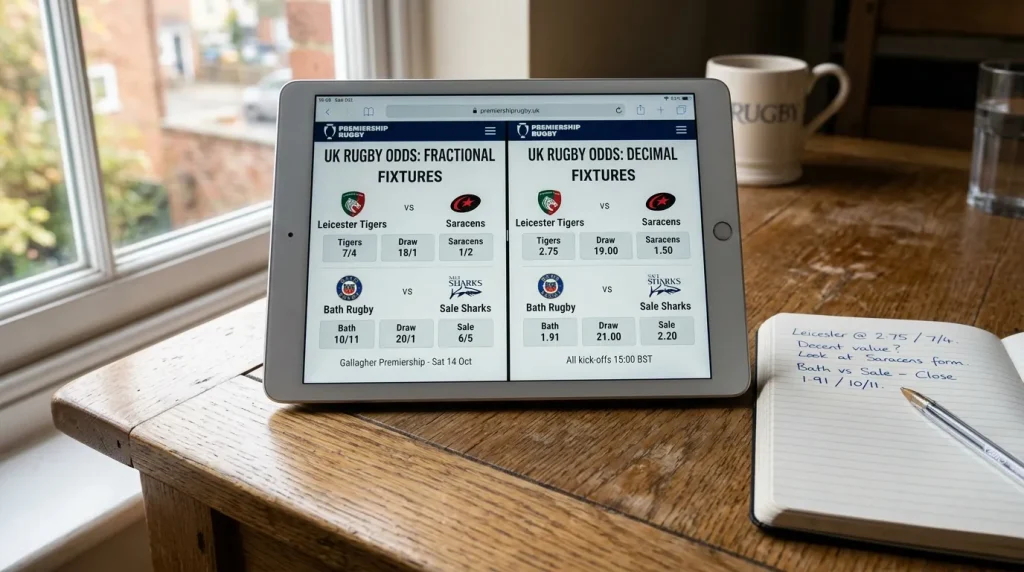
UK books traditionally display fractional odds — 5/2, 7/4, 11/10 — but most platforms now let you switch to decimal format. Decimal is genuinely easier when you are starting out. A 7/4 fractional price is 2.75 in decimal, meaning a £1 stake returns £2.75 total — your stake back plus £1.75 profit. A 5/1 price is 6.0 in decimal — six pounds back for every one staked.
The implied probability is the bit that matters. A decimal price of 2.0 implies the bookmaker thinks the outcome happens half the time. A 4.0 implies 25 percent. A 1.5 implies two-thirds. Divide 1 by the decimal odd and you have the implied probability. If your own view differs meaningfully from the book’s implied probability, you have something to consider. If it doesn’t, you are essentially flipping coins. A fuller breakdown of odds formats is worth reading once and never thinking about again.
The account opening process
Opening a UK regulated betting account takes about ten minutes. You provide name, address, date of birth, email, phone, and either a debit card or bank account for funding. The operator will run an identity verification check, sometimes electronic, sometimes requesting a document upload — usually a photo of an ID and a recent utility bill or bank statement.
This is not optional. Every UKGC licensed operator is required to verify identity before allowing significant activity, partly for anti-money-laundering reasons and partly to prevent underage gambling. Trying to circumvent verification by using inaccurate details is futile and will result in withheld winnings later. Provide accurate information first time. The whole process generally completes within a day, and most accounts are fully operational within minutes of submission.

Stake sizing for someone just starting out
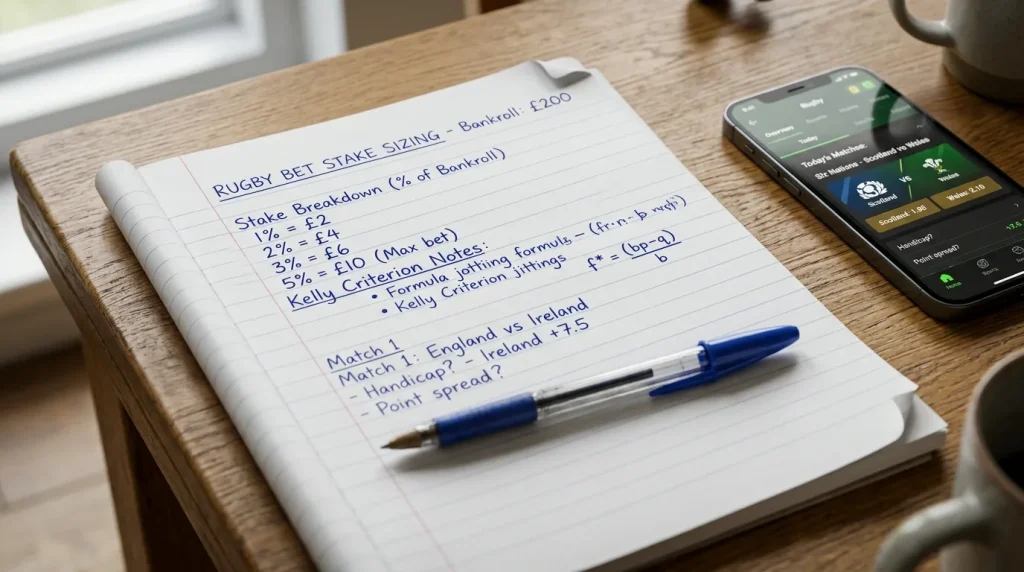
The single most important habit is fixed stake sizing. Decide a unit — a fiver, a tenner, twenty pounds — and stick to it across all your bets. Resist the urge to “chase” by upping the stake on a bet you feel especially confident about, or to “double up” after a loss. Both behaviours destroy bankrolls faster than picking wrong selections does.
A reasonable starting point is to set aside a defined betting bankroll — money you can afford to lose entirely without affecting anything important — and bet 1 to 2 percent of it on each selection. A £200 bankroll means £2 to £4 stakes. This feels small. It is supposed to feel small. The point of the early period is to learn, not to win quickly, and small stakes let you build experience across many bets without ruining yourself when you inevitably get things wrong.
Where to find rugby information that helps
The professional rugby calendar gives you a structured information environment. Premiership matches are previewed in detail by mainstream sports outlets. Six Nations gets blanket coverage. European Champions Cup attracts strong analysis from the European rugby press. Squad announcements land in predictable windows — usually Thursday for weekend fixtures. Team form is straightforward to look up. Weather forecasts are available days in advance.
The information you genuinely need before placing a bet is small. Who is in each squad. How both teams have been playing recently. Where the match is being played and whether the weather affects play style. The head-to-head history if it is relevant. That is enough to make informed early bets. You do not need detailed statistical models, expert prediction services, or paid tipster subscriptions — most of those are noise, and the people selling them rarely have the records they claim.

The single bet versus the accumulator question
Single bets — one selection at one price — are where beginners should live. They are easier to evaluate, easier to track, and the variance is manageable. You either win or lose on a single outcome.
Accumulators combine multiple selections, with all needing to win for the bet to pay out. The headline returns look attractive — a four-fold at modest odds can pay 20/1 — but the probabilities multiply punishingly. A four-fold with each leg at 60 percent has a 13 percent overall chance of landing. The maths is the maths, no matter how attractive each individual leg looks. Accumulators are recreational entertainment with a worse expected return than singles, not a route to consistent profit. Stick to singles until the maths is intuitive.
The first three months of betting
The first three months are about discipline rather than wins. Place bets you can articulate a reason for. Keep a basic record — what you backed, why, the price, the result. Use the deposit limits the operator provides. Resist any urge to chase losses or escalate stakes after wins. Treat the period as data collection rather than profit-seeking.
If you do this honestly, the records will tell you something useful by month three. Maybe you are slightly ahead, maybe you are slightly behind, maybe you have spotted a pattern in what you tend to get right or wrong. That information is more valuable than any individual win. The people who succeed long-term in betting are the people who treat the early period as learning rather than earning, and the learning compounds in ways that pure punting never does.
The mistakes that catch nearly everyone
The classic beginner mistakes are surprisingly consistent. Betting on every match of a weekend because the matches are on rather than because you have a view. Increasing stakes after losses to “win it back,” which never works because the next bet has no memory of the last one. Backing the team you support, which is almost always the team you cannot evaluate clearly. Falling for tipster services on social media promising consistent profits — these are almost universally scams or losing operations dressed up in marketing.
The single most expensive mistake is betting on too many things. The path to learning is doing fewer bets, more carefully. A weekend in which you back two or three fixtures with clear thinking is a far better learning experience than one in which you spray bets across eight matches you barely watched.
Building from the basics
Once the fundamentals feel solid — odds reading, stake discipline, basic market knowledge — there is plenty of room to grow. Bet builders let you combine selections within a single match. In-play betting lets you bet during the action. Ante-post markets let you back tournament winners months in advance. Each of these has its own logic and its own pitfalls, and exploring them one at a time after the basics are second nature is the right pace.
The thing that genuinely matters is that the foundation is built first. People who try to skip straight to bet builders or accas without ever placing a clean single bet on a match outcome are setting themselves up for confusion. The basic building blocks are basic for a reason — they are the conceptual foundation that everything more complex relies on, and bettors who skip the foundation tend to make the same mistakes for years before realising they never learned the underlying maths.
The mindset that makes betting sustainable
The bettors who stay in the game for years approach it as a hobby that occasionally pays for itself rather than as an income stream. The expectation that you will consistently profit from sports betting is the single most destructive belief a beginner can hold. The realistic expectation is that you will sometimes win, sometimes lose, learn over time, and either break roughly even or run a small loss as the price of an engaging hobby.
Within that frame, betting is enjoyable, defensible and sustainable. Outside it — chasing the dream of consistent profits, treating every bet as an investment, getting emotional about wins and losses — it becomes something that consumes more than it returns. The first rugby bet you place is the start of a long conversation with the activity, and the conversation goes better when you start it with realistic expectations and the discipline that follows from them.
What is the best rugby market for a beginner?
Match outcome — who wins — is the simplest and most natural starting point. Once that feels intuitive, total points (over/under) and handicap markets are the natural next steps. Together those three cover most of what beginner-friendly rugby betting actually involves.
How much should I bet as a beginner?
A unit stake of 1 to 2 percent of a defined bankroll you can afford to lose entirely. For a £200 bankroll that means £2 to £4 per bet. The point of small stakes is to let you make many bets and learn from the pattern without risking serious money while you are still learning.
Are accumulator bets good for beginners?
No. Accumulators look attractive because of the headline returns but the probabilities multiply against you, and they are much harder to learn from than single bets. Stick to singles until your sense of odds and probabilities is intuitive, then explore other formats from a foundation that works.
Articles
Created by the "Rugby Betting Sites" editorial team.
