
Rugby Betting Sites in the UK: An Analyst's Field Guide for 2026
Reading the pitch, pricing the line.
 Available in US
Nine seasons pricing rugby, and the thing I tell every newcomer who asks for help choosing a site is the same: rugby is not football with a different ball. A Premiership Saturday looks superficially similar to a Premier League one — same 80-minute frame, same kick-off windows, same in-play counter ticking down — but the underlying market behaves on a different physics. Margins are wider. Liquidity is thinner outside the marquee fixtures. The line moves on different signals, and the books that take real money on rugby are not always the books that lead the football coupon.
The headline UK numbers tell you why the gap between a strong rugby book and a weak one matters. Real-event betting — the regulator's umbrella for sport — turned over £596 million in gross gambling yield across the final quarter of the 2024–25 financial year, and rugby slots into that pool as a smaller but loyal slice. UKGC participation data shows roughly twelve per cent of British adults placing a bet in any given four-week window, and rugby specialists inside that group bet differently to the average punter — older, more analytical, more loyal to a single book once they find one that handles their patterns.
What follows is the guide I wish I had handed my younger self. Not a list of badges and welcome offers. A working map of how the UK rugby betting market is actually shaped right now, which signals matter when picking a site, how the 2025 regulatory reset changed the deal, and where the line is likely to move first across Six Nations, Premiership, Super League, the URC and the long ramp into Rugby World Cup 2027.
From the wider market into rugby's own corner of it
What this field guide will hand you
- A reading of the UK rugby betting market for 2026 against UKGC and HMRC figures, not press-release claims.
- A clear test for any rugby site: licence, market depth, in-play behaviour, settlement transparency and safer-gambling tools.
- The practical difference between Rugby Union and Rugby League at the coupon — totals, handicaps, try patterns.
- What the 2025 regulatory reset means for an active rugby punter, including the £150 vulnerability threshold and slot stake limits.
- Where to focus across Six Nations 2026, the Premiership, Betfred Super League's 14-team era and the Australia 2027 cycle.
The UK rugby betting market in numbers

Let me cut to the figures, because the picture the UK Gambling Commission paints quarter to quarter is the only honest backdrop for any rugby-specific conversation. Online gross gambling yield for Q1 2025 — the heart of the Six Nations window — came in at £1.45 billion across the regulated sector, a seven per cent year-on-year rise. A growing online market means more competition for sport-specific liquidity.
Sport-specific GGY in context
Inside that total, real-event betting — the regulator's bucket for football, rugby, racing, cricket and the rest — produced £596 million of GGY across the final quarter of the 2024–25 financial year, up five per cent year-on-year. By the third quarter of the 2025–26 cycle the same bucket had compressed sharply: total online GGY landed at £1.5 billion, down two per cent, while real-event betting fell eighteen per cent to £530 million. Rugby is a passenger on that trend, and the contraction has real consequences for promotional generosity.
The wider industry sits on top of that. The UK gambling and betting activities sector turned over £17.2 billion in revenue across the 2025–26 period by IBISWorld's reckoning, and HMRC's provisional betting and gaming receipts for April through August of the 2025–26 fiscal year hit £1,786 million, a nine per cent uplift year on year. The tax base is growing even as discretionary stake is tightening at the punter end. Both things can be true at once, and they are, which is why operators running rugby coupons have been quietly reshaping what they offer.
For a rugby specialist the takeaway is this. The era of every site running aggressively wide on outright markets simply to win a customer is fading. Margins on routine match markets — 1X2, two-way moneyline once you exclude the draw, total points — have firmed up across the regulated UK pool over the last eighteen months. The compensation is more depth in micro-markets, smarter in-play windows and richer bet builder coverage, because those are the products where books can recoup margin surrendered on the headline price. If you are picking a site in 2026, this is the lens. Headline lines are similar across the regulated field. The edge is in the second screen.
Across the average month in 2025 the UK regulated market ran roughly 13.5 million active online accounts. Rugby's hardcore audience is a fraction of that, but a fraction that bets more frequently per active month than the all-sport average and skews older — exactly the demographic profile that operators model into lifetime-value calculations.
For a working punter, the practical implication is clear. Stop chasing the £30 welcome bet as the deciding factor. Pick a site on the markets it actually settles cleanly and the in-play behaviour you can verify with your own eyes during a live Premiership match. The architecture of the coupon — what is priced, when, with what depth — is the thing you will live with for years.
How we evaluate rugby betting sites

The fastest way to lose money in this market is to pick a site on the wrong criteria. I have watched punters open accounts on the strength of a £40 sign-up bonus only to discover, three rounds into the Six Nations, that the site does not price first try scorer on the women's Championship at all, suspends in-play after every penalty for ninety seconds and offers cash out at values that consistently lag the implied lay by five per cent. The badge was loud. The product was thin.
Here is the framework I use at the desk, in the order I apply it. Licence first. UKGC remote licence, verified on the Gambling Commission public register by number rather than by trust in the site's footer. If the licence is not there, the conversation is over. If it is there, you have a dispute path that includes an ADR provider and a regulator with teeth — sitting on a regulated GGY that, as Andrew Rhodes put it during the BGC AGM in February 2025, has reached its highest ever level at £15.6 billion.
Second test: market depth on the events that matter to you. Pull up the next Six Nations weekend or the next URC round and count the markets per fixture. A serious rugby book runs forty to seventy markets on a Premiership match including bet builder selections, handicap variants, total bands and a try-scorer column that names twenty-five players minimum. A weak one shows you the moneyline, the handicap, the total and a coin-flip first try scorer slate of ten names.
Third: in-play behaviour. Watch a live rugby match on the site before you bet a penny. How fast do markets resume after a stoppage? Are bonus-point lines available live or only pre-match? Does the bet builder remain open for selections that are not yet decided? These are the everyday workhorse of an active rugby punter.
Fourth: settlement transparency. Read the dead-ball and penalty-try rules in the site's terms before you bet a first try scorer market. A site that buries those rules in a generic football section is signalling rugby is an afterthought. Fifth: safer-gambling architecture. Deposit limits that can be lowered instantly, reality checks that fire at intervals you set, a clean self-exclusion path and GamStop integration. Not optional.
The five-minute site test before your first rugby stake
- Verify the UKGC licence number on the public register, not just in the site footer.
- Count the markets per Premiership and Six Nations fixture — under thirty is a red flag for an active punter.
- Open a live in-play match and time how long markets stay suspended after a card or scoring play.
- Read the rugby-specific settlement rules for penalty try and dead-ball before placing a try-scorer bet.
- Confirm deposit-limit controls and a self-exclusion option are visible from the main account menu.
- Check whether GamStop integration is acknowledged on the responsible-gambling page.
What this framework does not do is rank operators. I do not maintain a personal top-five and I do not think such lists serve a punter well. The right site for a Premiership specialist is not the right site for someone who wants to live-bet Super League and ante-post the World Cup. Match your usage to the architecture. The shape of the product is what matters.
Licensing, UKGC oversight and what changed in 2025

I keep a running file on the desk titled "what the regulator did this year." For 2025 it ran longer than any year before it. The Gambling Act review that began under the previous government finally moved from white-paper rhetoric into operational rules, and the calendar of changes was tight enough that compliance officers I speak to admitted they spent the spring redrawing internal flow charts every fortnight. If you opened a UK rugby betting account in 2024 and have not used it since, the site you log back into in 2026 has a different rulebook running underneath it.
The headline change for slots — and slots are not rugby, but the principle radiates outward — was a hard stake cap. From 9 April 2025 a £5 maximum stake per spin came in for online slot players aged twenty-five and over, with a tighter £2 cap from 21 May for the 18 to 24 age band. Every operator running both products had to redesign account architecture and cross-product safer-gambling messaging in tandem. The downstream effect on rugby betting was operational: more friction at account level, more verification prompts.
Vulnerability check — a regulator-mandated assessment a UK licensed operator must perform when an account's spending pattern crosses a specified threshold, designed to flag financial harm before it escalates. The threshold was lowered from a test value of £500 across thirty days to an operational £150 across thirty days during the first quarter of 2025.
That £150 figure is the change rugby punters actually feel. If your monthly stake into a single site crosses the threshold, expect a request for soft evidence of affordability. The regulator's position, articulated by Andrew Rhodes at the BGC AGM, was that the existing gross gambling yield was already at its highest ever level at £15.6 billion, and that the proportionate response was to lower the operational threshold so early intervention could happen before harm crystallised. Whether you agree with the calibration or not, the operational reality is that a Six Nations specialist staking £50 a weekend across the championship will hit the threshold by round three.
The statutory levy is the other piece. From 6 April 2025 the Gambling Levy Regulations 2025 created a formal contribution from operators to research, prevention and treatment, with the first payments due to the UKGC from 1 October 2025. That money funds the safer-gambling architecture you interact with as a punter — the deposit-limit prompts, the reality-check pop-ups, the affordability messaging — which is why I treat the levy as a positive operational signal.
If you take one practical lesson from the 2025 reset, take this one. Set your own deposit limit before the site sets it for you. A limit you choose at account opening is a tool. A limit imposed mid-Six Nations because you have crossed an affordability threshold is friction at the worst possible moment.
A licensed UK book does three things an unlicensed one cannot. It segregates customer funds, so a balance you cannot withdraw on a Sunday morning has a regulator behind it. It publishes resolved settlement rules and submits to an ADR pathway when a dispute escalates. And it integrates with GamStop so a self-exclusion at one site extends across the regulated estate. None of that exists on an offshore site advertising better headline prices.
Rugby Union vs Rugby League — what changes for a punter

I once watched a friend back what he thought was a routine total-points line on a Super League fixture and lose his stake by half-time, because he had instinctively priced the line as if he were watching a Premiership match. Same word on the tin. Different game underneath. The codes diverge on scoring frequency, possession structure, the substitution model and the pace of restart, and every one of those differences feeds back into how the line is priced.
Union is fifteen-a-side, line-out and scrum restarts, contestable rucks and a possession rhythm that swings on penalty advantage. The 2024–25 Premiership season produced 714 tries across ninety matches, an average of 7.9 per game, with Bath taking the title. League is thirteen-a-side, six-tackle sets, hand-played restarts and a rolling-substitution model. The 2025 Betfred Super League regular season showed a roughly fifty-two per cent year-on-year audience uplift on Sky Sports and BBC.
| Aspect | Rugby Union (Premiership) | Rugby League (Super League) |
|---|---|---|
| Players per side | 15 | 13 |
| Try value | 5 points plus 2-point conversion | 4 points plus 2-point conversion |
| Average tries per match (2024–25 reference season) | 7.9 across the Premiership campaign | Higher run-rate driven by six-tackle structure |
| Typical total-points line | Mid-40s to high-50s depending on fixture | Mid-30s to mid-40s, sharper variance |
| Substitution model | Limited replacements, mostly tactical | Rolling interchange — pace stays high |
| Handicap range on competitive fixtures | Often tighter — penalty cycles compress the margin | Wider spreads — fewer set-piece resets |
| Bonus-point structure for outrights | Four-try bonus and losing-bonus matter to outright pricing | League-table position priced directly without try-bonus weight |
For a punter the practical consequence is that league markets price faster and run hotter in-play. A Super League first-half total moves more often, swings further on a single break and resettles quicker because the six-tackle clock is a constant rhythm. A Premiership match can sit at the same in-play total for three set-pieces because the contest at the breakdown swallows time without generating points.
The codes converge in market type — handicap, total, first try scorer, anytime try scorer, winning margin bands — and diverge in price calibration. A site that genuinely covers both will publish different settlement notes for league and union and run separate bet builder ladders. A site that publishes one rugby coupon across both is treating one of them as filler.
Core rugby markets every site should offer

If I had to compress nine seasons of desk work into a single rule for evaluating a rugby coupon, it would be this. Count the markets that take real money at high turnover, not the markets that look impressive on the landing page. A site can advertise "150 markets per match" and still fail an active punter, because most of those markets are dead air — race-to-five-points, half-time draw inside a three-point band, novelty player props capped at a fiver. Real liquidity in rugby concentrates in a much narrower band.
The headline market is moneyline — two-way win on League and three-way 1X2 on Union, where the draw is priced because international rugby runs ties more often than football. The 1X2 carries the largest stake volume on Six Nations weekends; the two-way moneyline takes the bulk of Super League turnover. Both run with the tightest margin of any rugby market because they are the visible competitive battleground between books.
Handicap is the analytical workhorse. A rugby handicap line is set on expected margin of victory and shifts by half-points or whole points depending on the book's appetite for a push. Tight fixtures get a one-point or one-and-a-half-point line. Mismatches stretch to twenty points or more in international windows.
Worked example of a Premiership match handicap
Suppose the home favourite is priced at -8.5 on the handicap with the away side at +8.5, and both selections sit at 10/11 in fractional odds — that is roughly 1.91 in decimal terms. A £20 stake on the -8.5 returns £38.18 on a home win by nine or more, including stake. The half-point removes the push entirely. If the same fixture were priced at -8 instead of -8.5 and the home side won by exactly eight, the bet would be voided and stake returned.
Total points is the third pillar. UK books typically set a line in the high forties for Premiership matches and the mid forties or below for international Test rugby. The line moves on weather, team news, the referee's penalty profile and the implied pace of the fixture. A serious rugby book offers alternative totals stepped at three or five-point intervals either side of the headline.
First try scorer — a market priced on the player most likely to score the opening try of the match. Pricing inputs include positional bias (wings, fullbacks and outside centres lead the boards), recent try-scoring form, the opposition defence's tendency to leak tries on specific edges, and the kick-off and penalty-kicker selections that shape early field position.
Anytime try scorer runs alongside first try scorer and offers value where the player is on a long-priced first selection but has a credible chance to score at all. Last try scorer is the third axis. The three markets correlate but rarely settle as a clean package, which makes bet builder coverage of try-scorer combinations the most genuinely valuable bet builder use case in rugby.
Beyond the core four — moneyline, handicap, total, try scorer — a serious book runs winning margin bands, half-time/full-time doubles, race-to-X-points, method-of-first-score, bonus point markets on tournament fixtures, exact score on tight matches, and a comprehensive bet builder ladder. Outright tournament markets run separately on a long horizon, and the deepest books also signpost users to dedicated rugby spread betting firms for variable-payout exposure.
The market every active rugby punter should test before opening an account is the bet builder. Open the next Premiership match, select handicap, total over and a try-scorer selection and read the combined price. A book that prices it cleanly with a margin you can verify is doing the work. A book that returns "this combination cannot be priced" is signalling its product team has not invested in rugby.
Event coverage: Six Nations, Premiership, Super League, URC and the road to RWC

There is a calendar discipline to rugby betting that football does not impose. Football runs every weekend with a brief summer pause. Rugby concentrates its biggest stake-driving moments into discrete windows, and a site's strength or weakness in those windows defines how it serves you across a full season. The same site that looks brilliant on a quiet pre-season weekend can buckle on a Six Nations Saturday when three matches run back-to-back across an eight-hour window.
The Six Nations is the absolute peak of the UK calendar. The 2025 tournament opener between England and Ireland on ITV peaked at 5.2 million viewers across all devices, and that audience reach translates directly into in-play liquidity for the half-hour window either side of kick-off. The championship generated approximately $135.24 million in media revenue across its UK, France, Italy and Ireland deals, and the global cumulative audience for the 2025 edition approached 130 million fans — a six per cent uplift on the previous year. The best operators run dedicated tournament hubs with Grand Slam outrights, Triple Crown markets, top try-scorer columns and round-by-round handicap and total ladders. For a deeper dive into championship-specific market mechanics, the cluster on Six Nations betting sites is where I send punters who want round-by-round detail.
The Six Nations Saturday rhythm
A typical Six Nations Saturday opens with a 2:15pm kick-off, rolls into a 4:45pm second fixture and finishes with an evening match. Stake concentration runs heaviest in the forty-minute window before each kick-off and the half-time interval, and books that handle that load without market suspension delays are the ones to keep. The Sunday completion match draws lower live stake but generates outright movement that resets the championship ladder for the fortnight to come.
The Gallagher Premiership is the domestic Union pillar. Ninety regular-season matches across the 2024–25 campaign produced 714 tries and crowned Bath as champions, and the league's combination of competitive variance and try-rich rugby makes it a productive market for handicap and total bettors. Site quality on the Premiership is the single best test of a book's commitment to rugby — it runs weekly, lacks the headline volume of Six Nations, and rewards depth over flash. The Premiership rugby betting odds cluster goes deeper on how UK books price the competition round by round.
Betfred Super League is the Rugby League heartbeat. The competition's title-sponsor relationship with Betfred is the most visible bookmaker presence in rugby, and the 2025 season closed with the twelve clubs voting unanimously to expand to fourteen teams from the 2026 campaign — a structural shift already changing outright pricing on the 2026 championship. The cluster on Super League betting sites covers how the expansion feeds through to match and tournament markets.
The United Rugby Championship spans Ireland, Scotland, Wales, Italy and South Africa and runs across the longest competitive calendar of any rugby tournament aimed at a UK punter. The 2024–25 URC season produced 151 matches and 1,832,138 spectators at an average of 12,133 per fixture, with the Leinster-Munster derby at Croke Park drawing the peak gate of 80,468. That breadth makes URC the test case for a site's mid-tier coverage.
European competition adds a parallel knockout layer. The 2024–25 European Rugby Champions Cup final at the Principality Stadium in Cardiff drew 70,225 spectators across a competition spanning sixty-three matches and a cumulative audience of 1,142,553. Cross-competition correlation matters when pricing outrights for either tournament. The 2024–25 RFU Championship ran across 132 matches with total attendance of 206,008 — figures that tell you the second tier of English Union is a market for sharp money rather than headline stake.
And underneath all of that, the road to Rugby World Cup 2027 is already shaping ante-post books. The expanded twenty-four-team format in Australia and the long pool stage are in play from the moment a UK season opens — and I come back to it in detail further down.
Why Women's Rugby World Cup 2025 reshaped coverage
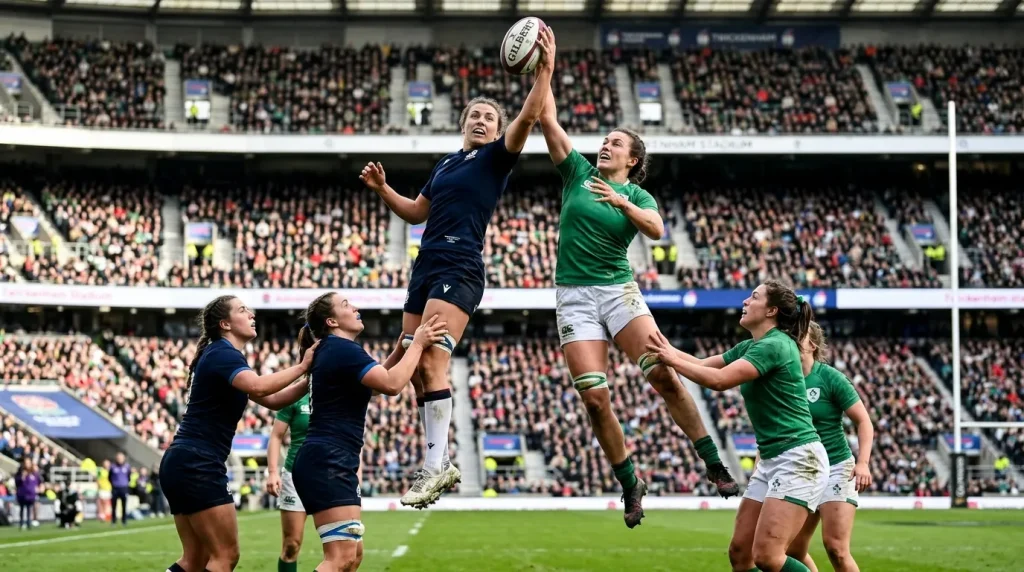
I will be honest. I underpriced what the 2025 Women's Rugby World Cup was going to do to coverage. I had it in my pre-season notes as a building tournament that would crack the audience ceiling, and I expected book engagement to lag the audience by a year. I was wrong. The shift happened in real time, and by the final the entire UK regulated field had recalibrated.
The final at Twickenham drew 81,885 spectators, a world record for a women's rugby match, and the broader tournament shifted 444,465 tickets — roughly triple the previous edition — while generating an estimated £294.7 million in economic impact across the eight host cities. The Red Roses opened as 1/3 outright favourites at the start of the tournament and shortened to 1/5 with Ladbrokes ahead of the final, and the resulting price compression was the cleanest signal I have seen on the rising sophistication of UK women's rugby pricing.
The 2025 Women's Rugby World Cup did not just expand the audience. It expanded the book. Coverage that was previously confined to outright winner and a thin match coupon now routinely includes handicap, total, first try scorer, anytime try scorer and bet builder selections across the Women's Six Nations and World Cup windows. Test women's rugby coverage on the same depth criteria as the men's game before opening an account in 2026.
The audience awareness figures back the shift. According to the Department for Culture, Media and Sport's Participation Survey for 2024–25, thirty-seven per cent of adults were aware of the Women's Rugby World Cup 2025, and twenty-four per cent of that aware group expressed interest in participation rather than just spectating. That is a participation pipeline that will deliver a structurally larger women's rugby audience by the next World Cup cycle, and the books that build coverage now will hold the market share when the volume arrives.
For a working punter in 2026, the practical implication is to give women's rugby weight in the site-selection process. The differentiation between books on women's coverage is currently wider than the differentiation on men's, which makes it one of the cleanest signals you can use to separate operators who take rugby seriously from those who run it as football's auxiliary product.
Bonuses, free bets and price boosts — how to read them

The first welcome bonus I ever claimed cost me thirty pounds. Not the bonus — the bonus was fine. The trap was the wagering condition I did not read, which required me to roll the qualifying deposit through three times at minimum odds of evens before any winnings became withdrawable. I worked it through, eventually, and netted a smaller return than I would have got from simply staking the deposit cold on the markets I actually wanted to bet. I learned the lesson on my own money so you do not have to.
UK welcome bonuses on rugby sites cluster into three structures. The deposit match — increasingly rare in 2026 because the regulator squeezed promotional intensity through the year — gives you a matched bonus credit on your first deposit, typically with wagering of three to five times the bonus at minimum odds. The bet-and-get — the dominant 2026 structure — gives you a free bet token after your first qualifying stake settles, with the free bet running as stake-not-returned and frequently locked to specific markets. The token offer hands you a fixed-value free bet on registration without a deposit requirement, but typically locks the value to a single market or a heavily restricted bet type.
Read the wagering condition before you read the bonus value. A £30 free bet at thirty-times-stake wagering on minimum-evens markets is worth less than a £10 free bet at one-times-stake on any-odds markets. The headline number is the marketing. The condition is the actual product.
Beyond welcome bonuses, the in-life promotional architecture matters more for a serious rugby punter. Best Odds Guaranteed on rugby tournament outrights is one of the cleanest pieces of value a UK site can offer, because it protects you against drift between the price you take and the price that settles when the tournament resolves. Price boosts on Six Nations weekends can offer genuine value if you read them against the implied probability of the underlying market. Super boosts that combine multiple legs need particular scrutiny because the boost is usually applied to the combined odds, not the individual selections, and the result can be a price that looks generous but sits inside the book's normal margin on the standalone markets.
The promo I treat most cautiously is the accumulator-insurance product — money back as a free bet if one leg of your acca lets you down. The instinct is to read this as a generous safety net. The reality is that the free bet is stake-not-returned, capped, and only refunded as a token that has to be wagered again.
Safer gambling tools and the 2025 affordability rules

Every November I write up the Safer Gambling Week figures for my own records. The 2025 numbers were the strongest I have seen in nine seasons. Across the 17 to 23 November window, UK operators sent close to eleven million safer-gambling messages — a seventy-five per cent uplift on the previous year — and 281,000 deposit limits were set or adjusted by 153,960 unique players, a forty-one per cent year-on-year rise on player-level engagement. Safer-gambling messaging moved from box-ticking exercise to genuine operational fact across the regulated UK market.
"These record-breaking figures underline the industry's ongoing commitment to raising standards and ensuring the millions of people who enjoy a regular flutter do so in a safe and responsible environment," Grainne Hurst told the BGC's reporting cycle that week. The infrastructure now exists. The question for a rugby punter is whether you use it.
The toolkit, and what each tool actually does
A UKGC-licensed rugby site is required to give you, at minimum: a deposit limit you can set across daily, weekly and monthly horizons; a loss limit that caps net loss across the same horizons; reality-check pop-ups at intervals you select; a time-out that locks the account for between twenty-four hours and six weeks; and a self-exclusion path that runs from six months to five years and integrates with GamStop across the wider UKGC estate. Downward limit changes apply instantly. Increases are subject to a cooling-off period of at least twenty-four hours.
The £150 vulnerability threshold that came in across the first quarter of 2025 is the piece that touched most actively engaged punters. It replaced a £500 test value with a hard operational £150 across any thirty-day window, and an account crossing the line will trigger a soft check — a question about employment, an income declaration or, at the higher end, a request for soft documentary evidence of affordability. The point is to land the conversation early, before financial harm crystallises.
If a rugby site refuses to let you set a deposit limit lower than your current deposit pattern, or applies a delay longer than twenty-four hours to a downward limit change, that is a regulatory failure. Report it through the site's complaint process, escalate to the ADR provider listed in the responsible-gambling section, and switch books.
The practical advice I give every punter is the same. Set a deposit limit before you place your first bet. Use the reality-check pop-up at thirty-minute intervals during live sessions. Treat the time-out as a tool you reach for proactively. And keep GamStop as the nuclear option you know is available if the account ever stops feeling like a hobby.
Match-fixing risk, RFU Regulation 17 and Sportradar oversight

I have watched a rugby price swing inside ninety seconds on a market that had no business moving and felt the prickle on the back of my neck every analyst learns to recognise. Sometimes the explanation is mundane — a late substitution, team news I missed. Sometimes it is not, and that is when the integrity infrastructure earns its existence.
The numbers from Sportradar's 2025 integrity report are the cleanest snapshot of the global picture. Across more than one million matches monitored in seventy sports, the platform flagged 1,116 suspicious matches — a one per cent decrease year-on-year — and supported 125 sporting sanctions across seven sports on six continents, taking the cumulative count past 1,000. Rugby's exposure inside that frame is real but bounded. World Rugby is one of more than 330 global integrity partners Sportradar serves, and rugby-specific alert volume remains a small fraction of the football-driven total. Andreas Krannich, the firm's executive vice president for integrity services, framed the year by noting the relative stabilisation of suspicious match numbers was encouraging but reinforced the importance of continued vigilance against an evolving threat.
RFU Regulation 17 — the anti-corruption and betting regulation that came into force on 1 August 2025 — sits as the domestic complement to Sportradar's monitoring. It applies to everyone operating at International and Contracted Player level in English rugby and prohibits betting on own match, own competition and related markets. The regulation does not affect ordinary fans, but it does mean that the integrity floor on English rugby is structurally higher in 2026 than it was in 2024.
For the working punter, the regulated UK market sits on multiple layers of integrity oversight. Sportradar's AI-powered Universal Fraud Detection System flagged fifty-six per cent more suspicious matches across 2025 than the previous year — not because corruption surged, but because detection capability widened. When you see a price move you cannot explain, a system is doing the investigation behind the screen.
Looking ahead to Rugby World Cup 2027

Australia 2027 is the longest ante-post horizon any UK rugby punter currently has open. The tournament expands to twenty-four teams from the previous twenty, runs across fifty-two matches divided into six pools of four, and concludes with a final scheduled for 13 November 2027. The structural change is the single most important variable in the pricing model — the knockout path is longer, the pool stage carries more upset potential, and the route from a strong seed to a final is materially different from the twenty-team format that resolved the 2023 cycle.
Where the early ante-post sits, on the Betfair board
After the pool draw concluded in late 2025, South Africa opened as 9/4 outright favourites — defending champions, world number one, and on the shortest price across the market. New Zealand sat at 7/2 in second place, France at 9/2, England at 5/1, Ireland at 6/1 and host nation Australia at 9/1. Sam Rosbottom, the Betfair spokesperson, framed the position by noting that the Boks had cemented their position as World No.1 and were likely to collide with second-favourites New Zealand in the quarter finals.
The 2024–25 European Rugby Champions Cup season produced an average of 7.71 tries per match across sixty-three fixtures, with Damian Penaud the leading try-scorer on fourteen. That kind of try-density carries directly into the early World Cup pricing for the wider top try-scorer market — books are looking at exactly those workloads to set their long-horizon try-scorer columns.
For a working punter the long-horizon question is not which contender to back. It is how to manage exposure across an ante-post position that will sit open for somewhere between fifteen and twenty-four months. Hedge ladders, partial cash-out windows around the warm-up Tests in autumn 2027, and the structural advantage of taking value early before the pool draw fully prices in are all live tools. The detailed treatment lives in the cluster on Rugby World Cup 2027 betting, where I work through contender-by-contender pricing and a sample hedging template. The books running deep ante-post ladders right now are the ones that will hold the volume when the warm-up series begins.
The black-market trap and why UKGC sites still matter

The most uncomfortable number in the UK gambling debate right now is £16.6 billion. That is the H2 Gambling Capital estimate for the volume of bets placed through the unregulated black market in 2025 — roughly triple the figure recorded in 2019, when the same researchers put the black-market pool at around £5 billion. Rugby punters are not exempt from the temptation that drives that growth.
Grainne Hurst, chief executive of the Betting and Gaming Council, has been blunt about the trajectory. "What we are seeing is a harmful black market scaling up at pace. Illegal operators are becoming more sophisticated, more visible and more aggressive in how they reach UK customers." If your social-media feed is showing you offshore bookmakers with welcome bonuses that look implausibly generous and odds that look two or three per cent better than the UK regulated market, that is the architecture Hurst is describing — and it has no consumer protection behind it.
The 2019 baseline had ninety-seven per cent of UK bets running through licensed operators. Six years later, H2 Gambling Capital research shows offshore operator stakes and margins doubled between 2023 and 2025, eroding the regulated share at exactly the moment the regulated market took on heavier compliance obligations. The trap for a rugby punter is specific. An offshore site offering a Six Nations price two per cent better than the UK market looks like value. The price is real. The protection is not. No UKGC dispute path, no segregated customer funds, no GamStop integration, no ADR provider. The two per cent edge on the headline price is a rounding error against the structural risk underneath it. Stay regulated.
Closing the field guide from the desk
Nine seasons in, the discipline that separates profitable rugby bettors from the rest is not market intuition. It is site selection. The book under your account is the operating environment in which every analytical edge you build either compounds or evaporates, and 2026 is the year that distinction has become sharpest. The regulated market is tighter, the promotional landscape is leaner, and the integrity infrastructure underneath the visible coupon is genuinely working. A punter who picks a site on the criteria laid out here is operating on a different footing from one who clicked through a welcome-bonus banner.
The cluster pages take it from here
The clusters cover the work I have only summarised here. The Six Nations market mechanics, the Premiership pricing model, the Super League expansion effect, the Australia 2027 ante-post ladder and the FCA-regulated spread layer all live in dedicated treatments. Read the ones that match how you actually bet.
Frequently asked questions about rugby betting sites
Which rugby betting sites are considered the best in the UK for 2026?
There is no single best site, and I do not maintain a personal top-five. The right book for a Premiership specialist is not the right book for a punter focused on Super League and ante-post Rugby World Cup. The framework that matters more than any ranking is the five-test sequence outlined earlier: verify the UKGC licence on the public register, count the markets per fixture on the events you care about, watch in-play behaviour during a live match, read the rugby-specific settlement rules and confirm that safer-gambling controls are visible from the main account menu.
What bet types are available on Rugby Union and Rugby League?
The core market set is consistent across both codes: moneyline or 1X2, handicap, total points, first try scorer, anytime try scorer, last try scorer, winning margin bands, half-time/full-time, method of first score and a comprehensive bet builder ladder. Where the codes diverge is in pricing calibration — League runs hotter and faster in-play because of the six-tackle structure, Union compresses around penalty cycles and set-piece resets — and in tournament-specific markets like Union's four-try bonus point on outrights.
How does a UKGC licence change what a rugby bettor can expect?
Three things. Customer funds are segregated, which means a balance you cannot withdraw on a Sunday morning sits behind a regulator with enforcement teeth. Settlement rules are published, with an Alternative Dispute Resolution provider listed if you cannot resolve a complaint at site level. And the operator integrates with GamStop, so a self-exclusion at one site extends across the whole UK regulated estate. None of those protections exist on an offshore site.
What promotions are typical for rugby betting in the UK?
Welcome bonuses cluster into three structures: deposit match (now rare under the 2025 promotional reset), bet-and-get (the dominant 2026 structure, paying a free bet token after your first qualifying stake settles), and registration tokens (fixed-value free bets locked to specific markets). In-life promotions include Best Odds Guaranteed on tournament outrights, refreshed price boosts during championship windows, super boosts on combined-leg products and accumulator insurance refunded as free-bet tokens.
What is spread betting and how does it differ from fixed odds in rugby?
Spread betting is a variable-payout product where the size of your win or loss scales with the difference between the actual match outcome and the spread quoted by the firm — the "make-up" value. A fixed-odds market settles at a known multiple of stake on a binary outcome. Spread products on rugby cover supremacy, total points, performance indices and tournament totals, and they sit under FCA regulation rather than UKGC because they are classified as financial derivatives. Losses can exceed the original stake on uncapped positions.
How do live betting and cash out work on rugby matches?
Live betting opens the moneyline, handicap, total and a curated set of micro-markets across the eighty-minute window, with markets suspending briefly during major stoppages — kicks at goal, red cards, video reviews — and resuming once the situation resolves. Cash out lets you close a position before the match ends at a value calculated from the current implied odds, with the book taking a margin that typically sits between three and seven per cent below the implied lay price. Partial cash out lets you crystallise a portion of the position while leaving the remainder live.
Articles
Created by the "Rugby Betting Sites" editorial team.
