
Rugby Free Bets UK — How New-Customer Offers Actually Work
 Available in US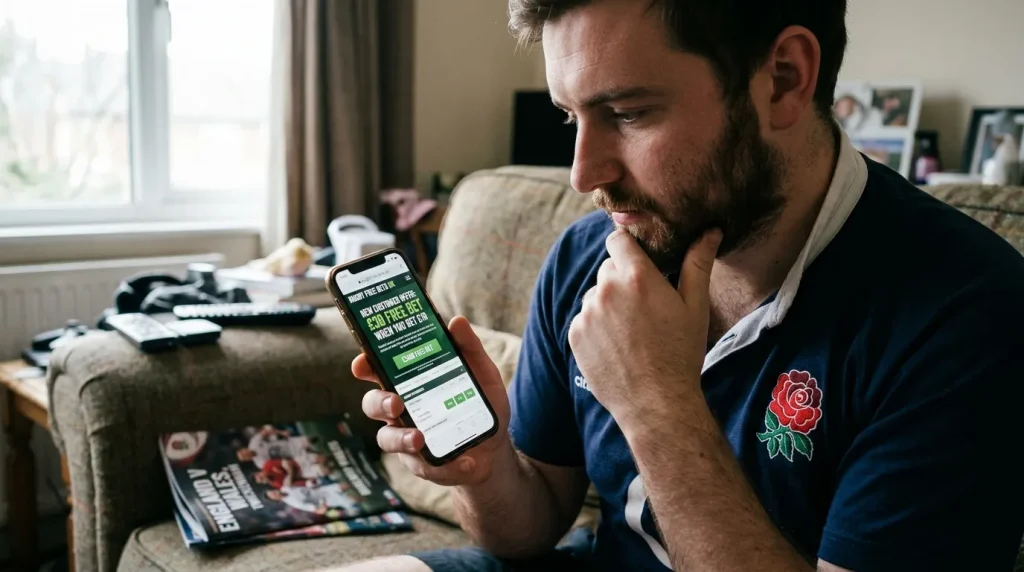
What “free” really means in a UK rugby free bet
The word “free” works very hard in betting marketing. When a UK site advertises a £30 free bet for new rugby customers, the offer is not what it sounds like. It is a structured promotional product with terms that limit how the money can be used, what odds qualify, how winnings are paid, and what happens if you try to convert it to cash too quickly. Once you understand the structure, free bets become a useful piece of the rugby punter’s toolkit. Misread them, and you spend a Saturday afternoon discovering that “free” had a great many footnotes.
The shape of the UK rugby free bet market is shaped by who is using it. Around 10 per cent of British adults bet on sport online, and a meaningful share of those punters opened their first account using a new-customer free bet offer. The product exists because acquisition cost matters to bookmakers, and the cheapest way to acquire a customer is to give them a token worth less than its face value and let them discover the gap.
Typical structures: stake-not-returned, matched, token
UK rugby free bets come in three structural variants, and the difference between them affects the cash equivalent of the offer.
The stake-not-returned free bet is the most common. You place a £10 free bet at 2/1, the bet wins, and you collect £20 in winnings. The £10 stake itself is not returned because it was a token rather than your money. The effective cash value of a stake-not-returned bet is roughly 70 per cent of its face value at typical odds, because you collect winnings only, not stake plus winnings.
The matched free bet matches your first cash deposit or first qualifying bet up to a limit. Deposit £20, get £20 in free bets. Place a £20 qualifying bet at minimum odds, get £20 in free bets. The free bet itself is usually stake-not-returned, so the underlying value is the same as a token offer, but the requirement to first stake real money is the trade-off.
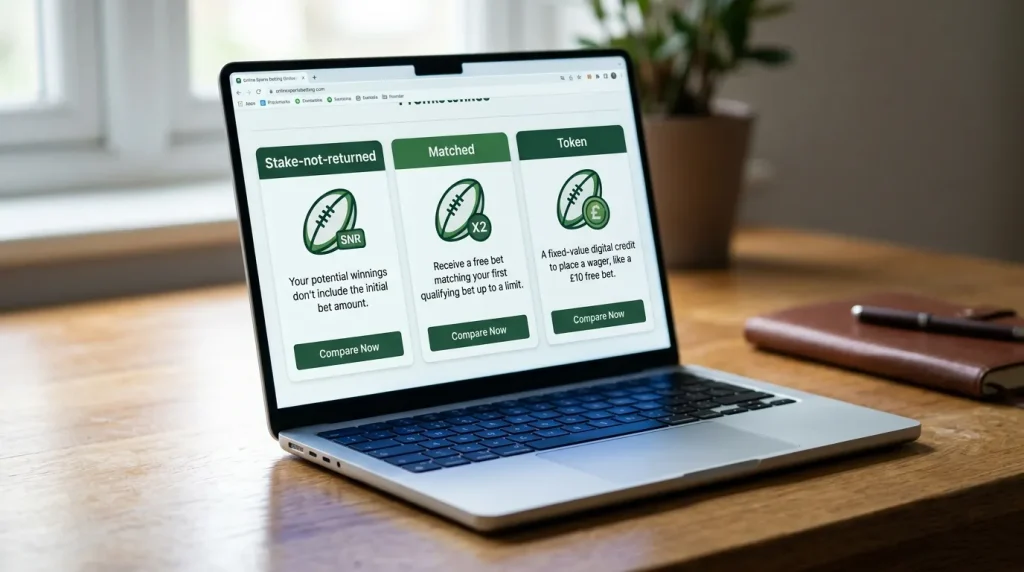
The token free bet is the simplest form. You receive a fixed amount — say £30 — to wager on a specific market or any market that meets the qualifying conditions. No deposit-match requirement, just the token. Token offers are rarer in the UK than they used to be because the bookmaker bears the full acquisition cost rather than sharing it through a deposit-match.
The real-event betting market in the UK generated £596 million in gross gambling yield in the first quarter of 2025, and free bets are a meaningful acquisition mechanism into that market. Every UKGC-licensed site offers some version of a rugby free bet during the major tournaments, and the structure of the offer tells you how the site is targeting its customer acquisition spend.
Wagering conditions and minimum odds
The wagering conditions on a UK rugby free bet are where the cost shows up. The standard conditions are: minimum odds (usually 1/2 or evens, sometimes higher), eligible markets (often restricted to single bets or specific rugby markets), expiry window (usually seven to 30 days), and stake structure (whole free bet must be staked on a single slip; no partial stakes).
Minimum odds at 1/2 means you cannot park the free bet on a strong favourite priced shorter than 1/2 to convert it cheaply. The bookmaker has thought about this; you are required to take a meaningful price for the bet to qualify, and that meaningful price comes with meaningful risk of losing. The implied probability of a 1/2 selection is 66.7 per cent. Two out of three free bets at minimum odds will land. That is the expected loss rate the offer is priced around.
Eligible markets matter for rugby because some free bet offers exclude in-play markets, exclude bet builders, exclude accumulators, or restrict the bet to specific competitions. A free bet usable only on Six Nations 1X2 markets is structurally less valuable than one usable across any rugby market on the site. Read the eligible-markets clause carefully; it determines what you can actually do with the offer.

Expiry windows are short. The free bet sits in your account for seven, fourteen or 30 days, and then it expires. If you do not stake it inside that window, the offer evaporates. Some sites send reminder emails. Most do not. The fastest way to lose a free bet to expiry is to assume you will get to it next weekend.
Event-locked offers: Six Nations, World Cup, finals
Major rugby tournaments are when UK sites push the deepest free bet offers. The Six Nations in particular triggers structured campaigns that run across the six weeks of the tournament, with offers tied to specific rounds and specific matchups.
The typical Six Nations free bet campaign opens a week before round one with a deposit-match welcome bonus, then layers in round-by-round enhanced offers — bet £10 on the England match, get a £5 free bet for round two; place an acca across all three Saturday fixtures, get a £20 free bet for the Sunday match. The structure is designed to keep the punter engaged across the full tournament rather than just placing one bet and leaving.
Rugby World Cup free bets follow a different rhythm because the tournament runs for six to seven weeks with knockout matches creating natural promotional pivots. The 2027 tournament in Australia, with 24 teams expanded from 20, will produce more matches than the 2023 cycle and will likely see a wider free bet promotional window. UK sites usually open Rugby World Cup acquisition campaigns three to four months before kickoff, then ramp up promotional intensity in the final fortnight before the opening match.
Final-weekend offers — Six Nations finale, Premiership final, World Cup final, Challenge Cup final — are usually price-boost driven rather than free-bet driven. The promotional energy of the bookmaker shifts in the final weekend toward enhancing existing customers’ bets rather than acquiring new ones, because the acquisition window for the tournament has closed.
When a “free bet” is not worth the registration
I have opened accounts at UK sites for free bet offers I never converted into cash. The opening process — verification, deposit, qualifying bet, wagering the free bet, withdrawal — takes meaningful time, and not every offer is worth it.
The honest break-even on a UK rugby free bet offer is something like £20 of real cash value after wagering, after expected losses on the qualifying bet, after the friction of opening and verifying the account. A face-value £30 free bet with a 70 per cent conversion rate is worth about £21 in expected cash. If that £21 is the difference between bothering with the registration and not, the offer is worth taking. If it represents less than the time you spend on the verification process, the offer is not worth bothering with.
The exception is when the free bet unlocks features you would have used anyway. If the site has a rugby product you want access to — better in-play streaming, deeper bet builder market depth, a competitive cash-out structure — the free bet is a discount on the cost of opening that account, not the reason for opening it. The decision-tree shifts entirely when the account itself has value.
The other situation where a free bet is not worth claiming is when it locks you out of a better offer later. Some UK sites run “new customer only” offers that are only available on your first deposit or first bet. Burning that one-shot offer on a smaller free bet means you cannot claim a more generous offer the site might run during the Six Nations or World Cup. If a £10 free bet today blocks you from claiming a £50 enhanced offer in three months, hold off.

One specific point about welcome bonuses versus free bets — they are often presented as the same offer but have structurally different mechanics. The detailed comparison of how welcome bonuses are constructed and what their true value looks like sits in welcome bonuses for rugby bettors, and is worth reading before you commit to any one site’s acquisition campaign.
How to maximise the value of a free bet once claimed
Once the free bet is in your account, the goal is to convert it to withdrawable cash with the smallest expected loss. The mechanics are simple: stake the free bet on a single selection at minimum-qualifying odds, accept the variance, and aim to convert the winnings to cash with the lowest possible holdback.
The optimal odds for a stake-not-returned free bet sit just above the minimum qualifying odds, usually somewhere between 4/5 and 6/5. Below that range, the implied probability is too high relative to the stake-not-returned structure and the expected value is poor. Above 5/1, the implied probability is too low and the variance dominates. The sweet spot is where the win probability is plausible and the price is decent.
The market choice matters too. Single-match win lines are the cleanest because they settle within 80 minutes. Top try-scorer markets settle the same day and produce decent value at qualifying odds. Outright markets are slow and you cannot withdraw cash until they settle, which can be weeks. Use slow markets only if you would have placed the bet anyway.
The withdrawal step is where some sites add friction. Most UK sites apply wagering requirements only to the qualifying bet, not to the free bet’s winnings. The winnings are usually cash, withdrawable immediately. A minority of sites require the free bet’s winnings to be wagered once more before withdrawal — the “1x rollover” clause — which is more conservative than it sounds and meaningfully shrinks the offer’s real value. Read the rollover clause before staking.

The honest place free bets occupy
UK rugby free bets are not a path to long-run profit. They are an acquisition tool the bookmaker uses to bring in new customers, and the structure of the offer is calibrated so that the bookmaker recovers their cost on the customers who keep betting after the free bet is gone. If you treat the free bet as a way to test a site, sample its rugby product, and walk away with a modest cash conversion if the bet lands, the offer is genuinely useful. If you treat it as an income stream, the next few months will be expensive.
The customers who get the most out of UK rugby free bets are the ones who use the offer to fund a single, well-considered bet they were already going to place. The free bet absorbs the risk of that bet; the conversion is a bonus on top of a bet that had its own expected value. That is the right way to think about a free bet.

Does stake return on a UK rugby free bet?
Most UK rugby free bets are stake-not-returned. You receive only the winnings if the bet lands, not the stake plus winnings. A few promotional structures return the stake on settled wins — usually presented as "cash free bets" rather than "token free bets" — but the standard product across UKGC sites is stake-not-returned, which makes the effective value of the offer roughly 70 per cent of its face value.
Can I withdraw winnings from a free bet immediately?
In most cases, yes. Winnings from a stake-not-returned free bet are usually credited as cash and are immediately withdrawable, subject to the site"s standard identity verification. A minority of UK sites apply a one-time rollover requirement to the winnings before withdrawal — meaning the winnings must be wagered once at minimum odds before they can be withdrawn. Check the free bet"s terms before staking.
Articles
Published by the Rugby Betting Sites team.
