
Rugby Union vs Rugby League — Betting Differences
 Available in US
The night I confused a play-the-ball with a ruck and cost myself a tenner
Early in my betting life I placed an in-play bet on a Super League match thinking the rules were essentially the same as union. They aren’t, and the bet relied on an understanding of break-down play that simply does not exist in league. The match unfolded in patterns I could not read, the bet went sideways, and I came away realising I had been treating two genuinely different sports as if they were variations on a theme.
Rugby union and rugby league share a heritage, a vocabulary and a few outward similarities, but for betting purposes they are different products. The markets work differently because the games work differently. Anyone serious about betting on both — or about switching from one to the other — needs to understand where the differences actually live, and most of this article is about exactly that.
The structural game differences that drive everything
The basics first. Union has 15 players a side, league has 13. Union has lineouts, scrums for almost every restart, and contested rucks; league has play-the-balls, scrums that are essentially uncontested, and a six-tackle limit before possession changes. Tries are worth five points in union and four in league. Conversions are worth two in both. Penalty goals are worth three in union and two in league. Drop goals are worth three in union and one in league.
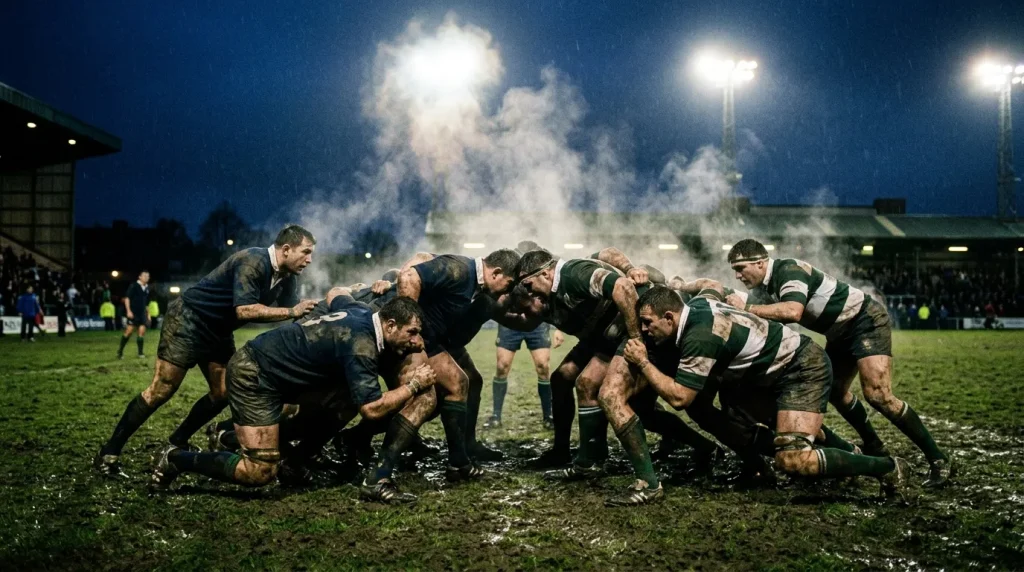
Those scoring differences add up. League matches tend to be higher-scoring than equivalent union matches even though they last 80 minutes too, because the ball is in play more, the six-tackle rule manufactures attacking opportunities, and the defensive structures are pressure-tested constantly. Union has more set-piece play and stoppage, which changes the rhythm and shape of scoring meaningfully.
Implications for handicap markets
Union handicaps cluster around different numbers than league handicaps. A 12-point handicap is moderate in union, with most Premiership and Six Nations matches settling within a 10 to 20 point range. League handicaps run higher on average because final scores are typically larger. A 16-point handicap in Super League is a roughly comparable spread to a 12-point handicap in Premiership, give or take.
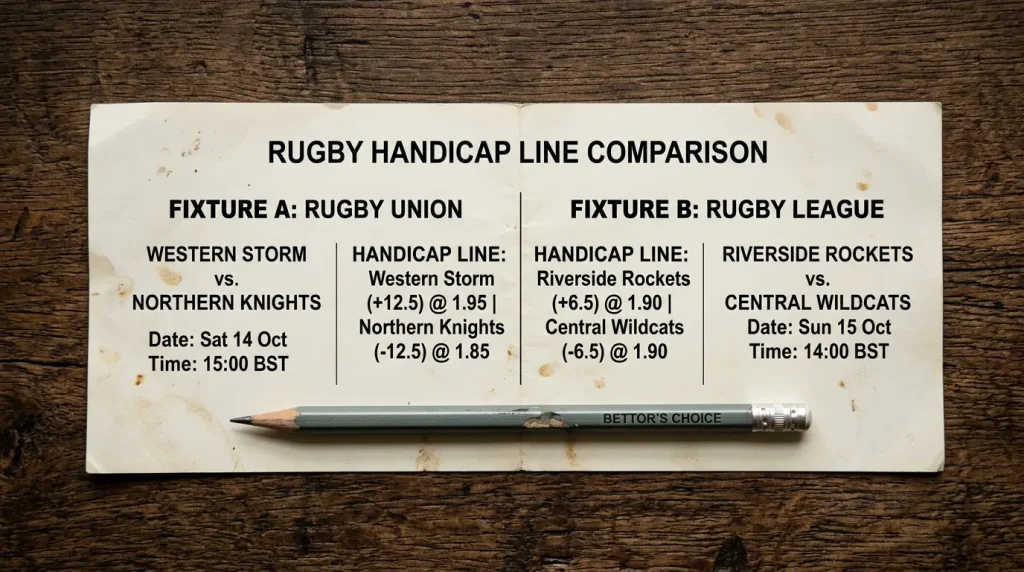
Bettors who switch between codes without recalibrating tend to misjudge the handicaps. A 14-point favourite in league is not the same proposition as a 14-point favourite in union, even though the line looks identical. The expected variance is different, the rate at which the line is covered is different, and the relationship between match-day form and final margin is different. Treating the numbers as transferable is a beginner mistake that takes a season to unlearn.
Total points lines and the league inflation
League over/unders tend to run higher than union over/unders for the same calibre of fixture. Premiership 2024/25 averaged 7.9 tries per match, which translates to typical points totals in the 40 to 50 range. Super League regularly produces matches with 40 plus points to one side alone, and total points lines of 50 to 60 are common.

The variance distribution is also different. Union has occasional grinding low-scoring matches where weather, kicking exchanges and defensive systems suppress scoring entirely. League produces these much less often because the structural features of the game manufacture attack regardless of conditions. Backing the under in league requires either specific reasons or accepting that you are fighting the game’s natural shape, while under bets in union sometimes ride the natural rhythm of a defensive battle.
The integrity culture across both codes
Both codes operate under formal integrity frameworks with strong betting prohibitions for players. As the chief executive of the Rugby Football Union put it bluntly, “If players, coaches or anyone within the sport gets involved in betting, they will face strict sanctions.” The framing applies equally to league, where the Rugby Football League and the international governing bodies maintain parallel codes covering equivalent prohibitions.
The practical implication for bettors is that both codes are well-monitored, with operator-side suspicious activity reporting feeding governing-body integrity units the same way it does in union. The compact league market structure — fewer teams, more frequent fixtures — actually makes patterns easier to spot in some respects, and the integrity record in Super League and the NRL has been correspondingly strong.
Try-scorer markets and the position difference
Try scorer markets work differently because positional try distribution is different across the codes. In union, wingers and centres lead try-scoring numbers, with back-row forwards contributing meaningful volume and props occasionally scoring from close-range pick-and-drives. In league, full-backs and wingers dominate the try counts, with the half-backs and the loose forward chipping in. The structural defensive shapes mean the typical scoring opportunity differs noticeably between codes.

Bettors familiar with union who back wingers and centres in league as if the patterns transfer will usually do reasonably well, because the wide try sources are common to both codes. The mistake comes the other way — backing league-style attacking ball-carriers in union markets where the equivalent position is different. The half-backs in league are not the half-backs in union, and treating them as if they were leads to repeated small mispricings. The competition-specific patterns are worth their own examination, particularly for the URC and other union-specific markets where the positional dynamics differ further still.
The in-play differences
In-play betting works differently across the codes. Union in-play markets pause for set-pieces, which creates natural windows for line adjustments and trader interventions. League runs more continuously, with the play-the-ball rhythm making the game’s flow more predictable in cadence but also more relentless. The pace difference shows up in how quickly in-play lines move and how often they suspend.
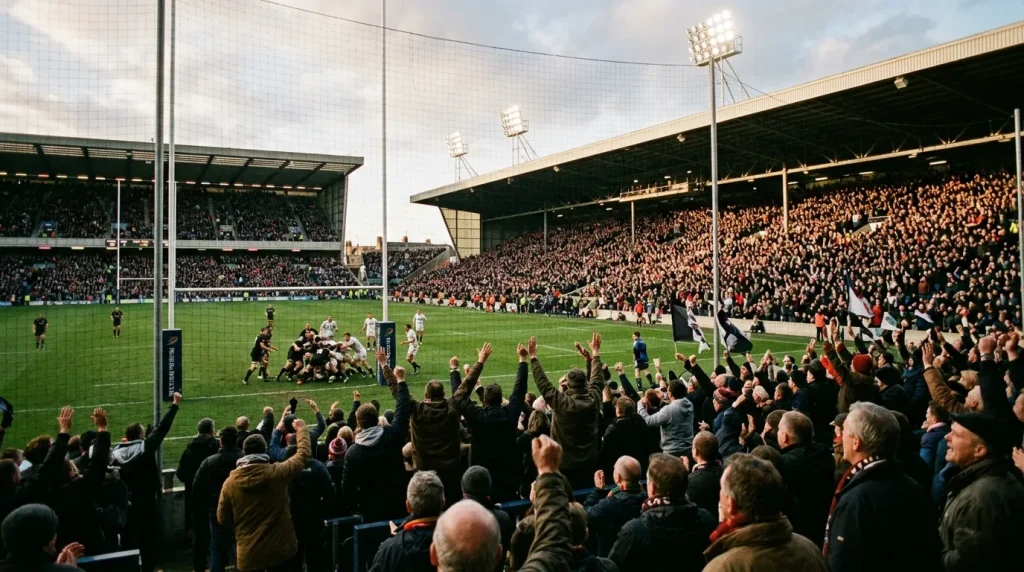
League in-play lines also tend to recalibrate faster after big plays. A 60-yard try in league rarely changes the match probability hugely because the six-tackle structure ensures both teams will get equivalent attacking sets afterwards. A 60-yard try in union is more meaningful because possession can be retained for extended periods through the breakdown, and the team that scores is harder to claw back from. Lines reflect this — union swings more on individual tries, league swings less.
Outright tournament differences
The two codes have different competition structures, which changes how outright betting works. Union has the Six Nations, the Rugby Championship, the World Cup every four years, the Premiership and the URC in club rugby, the European Champions Cup as the continental club tournament. League has the NRL in Australia, Super League in the UK and France, the international Rugby League World Cup, the European Championship and various national competitions.
The structural concentration is different. League’s elite club game is heavily dominated by the NRL — Super League and the European competitions are meaningful but secondary in global league terms. Union’s elite club game is genuinely multi-polar, with the Premiership, the URC, the French Top 14 and the European competitions all carrying significant weight. Outright betting in league concentrates around fewer tournaments with deeper analyst coverage; outright betting in union spreads across more tournaments with more specialised expertise required to read each one.
Player rotation and squad depth
Squad management differs because the games tax players differently. League rotates squads heavily across season, with first-grade players regularly cycling through reserve grades depending on form, freshness and tactical needs. Union has more stability in match-day 23s through a season, but the back-row and front-row rotation is significant due to the physical demands of those positions.
The betting implication is that team news matters in slightly different ways. Union team news arrives in named match-day 23s with backup at each position spelled out, and a single change at fly-half can move a match line meaningfully. League team news involves more rotation but at less critical positions on average, so the line impact of individual changes tends to be smaller. Following the team news routines of each code requires slightly different attention patterns.
Weather and conditions sensitivity
Both codes are weather-sensitive but in different ways. Union is acutely sensitive to wet conditions because the breakdown becomes a lottery, lineout throwing accuracy collapses, and kicking exchanges dominate. A union match in heavy rain might see total points drop by 15 to 20 from its dry-weather expectation. League is less sensitive to rain because the six-tackle structure forces attack regardless of conditions and the lineout does not exist as a failure point.
Wind affects both codes through goalkicking accuracy and kick-pass strategy. Cold affects neither dramatically, though sustained cold across a winter affects player conditioning more in league because the season runs through summer in the NRL and bridges seasons in the UK. The weather inputs to a betting decision are therefore meaningfully different by code, and applying union weather instincts to league markets — or vice versa — produces consistent small losses over time.
The bettor who works both codes well
The handful of bettors I know who work both codes successfully treat them as separate disciplines. Separate analysis routines, separate stake disciplines, separate spreadsheets. They do not assume that an edge in one transfers to the other, and they invest the time to build genuine fluency in each independently. The reward for that work is access to two competition calendars with overlapping seasonal windows, which gives more total betting opportunities than either code alone.
The bettors who do badly across both are usually the ones who treat league as “union with fewer players” or union as “league with more set-pieces.” Both formulations miss the actual structural differences and lead to the same handful of repeated mistakes — misjudged handicaps, miscalibrated totals lines, misapplied positional analysis. Respecting that they are different sports for betting purposes, even though they share a name and a few rules, is the foundation for working either one well.
Are betting markets the same for rugby union and rugby league?
The market structures look similar — match outcome, handicap, total points, try scorers — but the typical numbers and the underlying dynamics differ. League handicaps run higher, totals lines are higher, try-scoring distributions favour different positions, and in-play movement responds differently to scoring events.
Why are total points higher in rugby league?
The six-tackle rule manufactures attacking sets regardless of field position, scrums are uncontested and quick, and there are no contested breakdowns slowing the game. The structural design produces more ball-in-play time and more attacking opportunities per match, which translates to higher scoring on average.
Can I use union betting knowledge to bet on league?
Some of it transfers — basic stake discipline, odds analysis, weather effects on goalkicking. Most of it does not — handicap calibration, totals expectations, positional try distribution, in-play rhythm. Treating the codes as separate disciplines is the approach that works.
Articles
Published by the Rugby Betting Sites team.
