
Premiership Rugby Betting Odds: How UK Bookmakers Price the Gallagher Premiership
 Available in US
What makes the Premiership a different pricing animal
I have a folder on my desktop labelled “Premiership 2018”, and inside it sits a spreadsheet with every match I priced that season alongside what the books closed at. The reason I still open that folder, eight years on, is to remind myself how dramatically the way UK bookmakers handle the Gallagher Premiership has changed. Back then, lines drifted by entire points overnight because liquidity was thin. Today the Premiership trades like a serious domestic competition. The 2024-25 season produced 714 tries across 90 matches — an average of 7.9 per fixture — and Bath were crowned champions in a final whose handicap moved no more than half a point in the closing forty-eight hours.
Density of action and density of liquidity have caught up to each other. That is the single most important thing to understand about Premiership pricing today. The book is doing serious risk modelling on every match, and the punter who treats it like a second-tier rugby market is going to pay for that assumption. The flip side is that there is real, identifiable value here for anyone who does the work. Across the rest of this guide I want to show you where I have consistently found that value, and where the obvious-looking edges turn out to be traps.
Shape of the league and how it informs outright odds
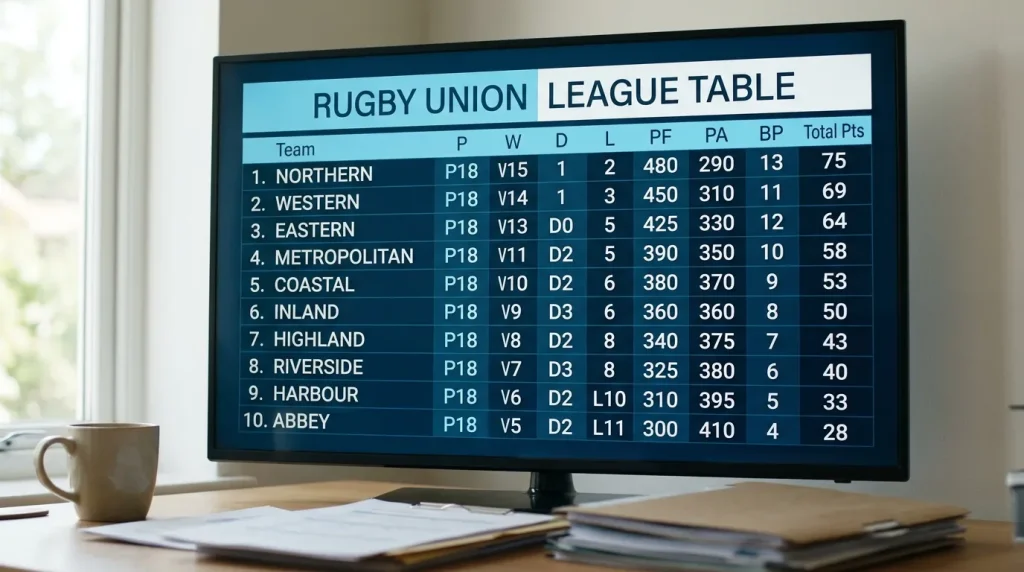
You cannot price a Premiership outright sensibly without understanding two structural things about the competition. First, the regular season is brutal. Ten clubs play eighteen matches each, home and away within the round-robin format. There is no soft middle stretch. Second, the play-off pathway compresses the title race into a top-four mini-tournament where seeding matters disproportionately because the first-place finisher gets a home semi-final.
That two-stage structure has clear implications for outright pricing. Books that simply project regular-season win percentage forward and call it an outright probability are systematically wrong, and the better Premiership operators know it. The right approach weights regular-season performance against play-off form, recent injury data, and the home-field edge that a top-two finish guarantees. In 2024-25 Bath finished top of the regular-season table and converted that seeding into a Grand Final win — exactly the outcome a properly weighted model would have projected.
What this means in practice is that early-season outrights — say, opened in September after two rounds — are usually priced too tightly for the play-off favourites and too generously for the bottom-four sides. Books leave wider margin on the futures market because they know few punters will hold a position from September to June. If you have a strong view on a contender before October, the outright price often beats the equivalent end-of-November price by a meaningful margin, even after squad and injury updates land. The trade-off is that you tie up capital for nine months.
The other structural quirk is that the Premiership has run with a smaller league than competitors like the URC, which means a higher share of fixtures involve genuine title contenders rather than dead rubbers. The RFU reported revenue of 228 million pounds in 2024-25, a thirty per cent rise on the previous cycle and the second-highest in its history. That financial uplift is feeding through to clubs, and squad depth is on the way up across the top half of the league. The implication for outright betting is that the field is widening, and the four-five-team race that historically characterised the Premiership outright market is becoming a five-six-team race. Adjust your priors accordingly.
Try rate and the case for total-points markets
Seven-point-nine tries per match across an entire ten-team domestic season is a number to sit with for a moment. It is comfortably higher than the equivalent international average, which sat closer to 6.5 in the 2025 Six Nations. It is meaningfully higher than the URC average. And it is the single most important pricing input for the totals market on every Premiership fixture.
Here is what that try rate translates to in points terms. With conversions, drop-goals and the occasional penalty try, a 7.9-try average implies a combined points total of roughly fifty-three to fifty-five per match across the league. The over/under line published by UK books tends to sit slightly below that, usually in the range of forty-eight to fifty-two, depending on the matchup. That gap between the historical mean and the published line is not an accident. Books shade lines low because the variance on rugby points totals is high, and a slightly low line attracts more over money, which is the market’s preferred betting side. Understanding that bias is the first step to fading it when conditions support a true over.
Three factors push a Premiership total above the central line. Two of them are obvious: warm weather (anything after mid-April) and an attacking matchup featuring two of the top-three try-scoring sides. The third is less obvious. End-of-season fixtures involving a side already qualified for play-offs versus a side already eliminated almost always run hot, because the eliminated side has no defensive incentive to grind and the qualified side often field a near-full squad to maintain rhythm. I went back through the closing five rounds of the 2024-25 season and found that “dead rubber” fixtures cleared the line by an average of nine points. That is significant.
Two factors push a total below the line. Cold-wet weather, particularly in the December-January block, brings totals down by an average of four to seven points compared to dry conditions. And the play-off semi-finals, when they are held in May at Twickenham-style stadiums but the wind is up, often come in five to ten points below the regular-season average for the same two sides. The reason is partly conditions, partly that play-off rugby tightens up. Both sides are wary of conceding the bonus that the league removes in knockout matches.
The trade I have made most consistently over the last three Premiership seasons is on team-totals — the over/under on a single side’s points — for visiting underdogs in attacking matchups. The home-away handicap absorbs the implied weather and form view, but the visiting team-total is often priced as if the underdog will play conservatively, which away sides in the Premiership rarely do. The full conceptual treatment of when handicap, total and team-total give different answers belongs in the standalone guide to reading the handicap line, and I refer back to it whenever I am building a multi-market position.

Handicap markets in the Premiership
The Premiership handicap market is the most consistently sharp market in domestic UK rugby. By “sharp” I mean that the closing line tracks final settlement remarkably closely across a full season, and the book’s margin on the headline two-way handicap is among the lowest available in any rugby market.
Typical opening lines sit between -3.5 and -12.5. The range is narrower than the Six Nations because matchups within a ten-team league have less variance in quality than national-team matchups. Saracens at home to Newcastle in the worst of Newcastle’s seasons might open at -22, but those extreme lines are rare. The bread-and-butter Premiership handicap is somewhere between -5 and -8, and that is where most informed money goes.
The interesting structural feature of Premiership handicaps is the alternative-line ladder. The good books quote handicap lines in two-point increments — -5, -7, -9, -11 — alongside the standard line, with prices that imply the marginal probability of each two-point band. By stacking two alternative lines, you can construct a “buy” or “sell” position that approximates a spread bet without the spread firm’s wider mechanics. This is occasionally how I take a view on a match where I think the favourite will win by a specific amount rather than by a vague “comfortably” or “narrowly”.
One technical trap. The 0.5 differential matters more in rugby than in football, because rugby scores naturally land on three, five, six, seven, eight and ten point combinations. A line of -3.5 versus -4 against the favourite is the difference between a push and a loss when the side wins by exactly four — and Premiership matches finish on a four-point margin more often than statistical chance would suggest, partly because converted tries and penalties combine to that exact figure. If you are taking a favourite on the handicap, the half-point matters. Always check whether the book is pricing -3.5 or -4 as the standard, and look for the more favourable variant.
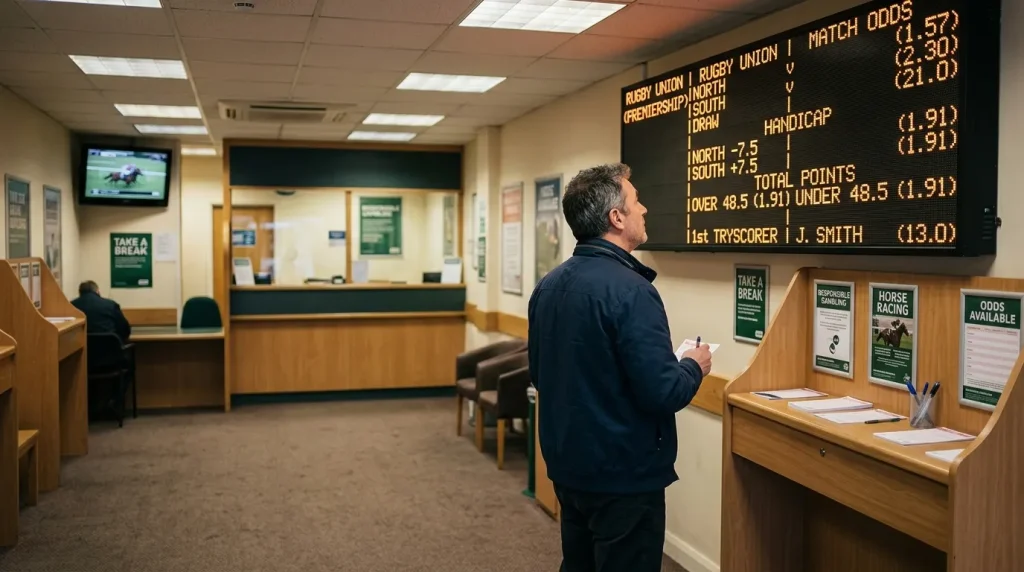
Live handicap repricing is one of the strongest indicators of book sharpness in the Premiership. A good operator updates the in-play handicap every three to four phases, not every minute. That means the line is responsive to actual on-pitch evidence — territory, possession, the run of momentum — rather than being driven by clock decay. If you watch a Premiership match with a live handicap visible and the line never moves between scoring events, you are watching a weak feed.
First try scorer pricing in the Premiership
This is the market where casual punters lose the most money in the Premiership, and it is worth explaining why. The first try scorer market on a domestic round of rugby looks superficially generous — wingers at 7/1, centres at 11/1, even back-rowers at 16/1 — but the implied probability across the full board, summed up, typically gives the book a fifteen to twenty per cent edge. That is double what you pay on the headline match market.
The reason it can stay that wide is psychology. First try scorer feels like a fun bet. Punters take 14/1 on a winger they like the look of without doing the maths on what 14/1 actually implies. To break even at 14/1 you need that specific player to score the opening try one time in fifteen. Across a Premiership winger’s season — even a top try-scoring one — first-try strikes happen maybe three times in eighteen matches. So 14/1 is roughly fair on a top wing, and a heavy under on a winger who is not a top finisher.
The genuine value in first try scorer in the Premiership tends to sit in two places. Centres of top-four sides, when their wings have been disrupted by injury or rotation, are often priced as if the wings will still be the primary first-try threat — but possession patterns shift toward inside backs in those weeks. And eighth-men or open-side flankers in matches expected to feature heavy maul defence are sometimes priced at long odds when the pick-and-go from a five-metre lineout is the most probable opening score. Both of those plays require homework on the preceding week’s team announcement, which most casual punters skip.

Anytime tryscorer is the better-value first cousin of the first try scorer market. The implied margin is lower because the market is more frequently active, and the variance across the full eighty minutes is more forgiving than betting on a single play in the first ten minutes. If you like a player’s chance of scoring in a match, take the anytime market and accept the shorter price.
One book-specific issue. Some UK operators settle first try scorer markets with a “Stake Returned” clause for late changes — if a named player is not in the starting line-up at kickoff, your stake is refunded. Others settle with no protection if you bet before the team is announced. That distinction can swing the expected value of an early bet by several percentage points. Confirm the operator’s rule before committing.
Playoff and final pricing dynamics
Play-off pricing in the Premiership is its own ecosystem, and it diverges from the regular-season pricing in three important ways. First, the home-semi-final edge is substantial. Across the last five seasons, the top-seeded side has won its home semi-final more than seventy-five per cent of the time. Books price that home edge into the semi-final handicap at roughly four points. If your model gives the top seed more than four points of home advantage, the favourite is the play. If you think the underdog has caught fire in the closing rounds of the season, you fade the implied home edge and take the visitor on the handicap.
Second, the final at Twickenham is functionally a neutral-venue match, and the handicap is built around squad fitness and recent form rather than league position. The 2024-25 final, won by Bath, illustrated this cleanly — the line moved fractionally in the week before the match as injury news landed, but the closing handicap reflected pre-existing form rather than the regular-season ladder.

Third, the totals market in play-off rugby is consistently mispriced low. Both semi-finals and the final, on average, produce more tries than the corresponding regular-season fixtures between the same teams. The reason is intensity — top-four sides bring full squads and intense attacking rhythm, and the bonus point removal does not seem to dampen the try rate as much as the line implies it should. Take the over on play-off totals as a default position and lay it only when conditions or injury news genuinely warrant.
The outright market resolves three or four matches early. By the time semi-final pairings are set, the price on the Grand Final winner usually involves only the four play-off sides. That late market is heavily liquidity-driven, and the closing odds tend to be sharp. If you have not yet placed an outright bet by the play-off weekend, the better trade is usually a single-match handicap or a head-to-head between two play-off sides, rather than entering the outright with two weeks to go.
Sites with the strongest Premiership market depth
Now to the practical question. What separates a serious Premiership operator from a tourist? Five things, in my experience.
The first is the quoted-runner list on first try scorer and anytime tryscorer. The strongest UK operators quote every named matchday player — including the front-row replacements who occasionally rumble over from close range — alongside a “No Try Scorer” option. Weaker operators publish the starting fifteen and stop there. That difference is enormous when injury news lands in the last hour before kickoff and a replacement is promoted to starter.
The second is in-play depth on side markets. A site that suspends first try scorer at half-time without offering “Next Try Scorer” replacement, suspends the handicap during every reset, and suspends the bet builder entirely is fundamentally not a Premiership-ready operator. The strong ones keep around fifteen markets running through full-time, including team-totals, race-to-points, and exact-margin bands. The 2025 Champions Cup average of 7.71 tries per match across European fixtures gives you a baseline for what to expect from English clubs in continental competition too, and the operators who price both competitions consistently usually handle the in-play feed best.
The third is settlement responsiveness. Premiership matches end on the eighty-minute mark but ball-in-play continues past that if a phase is live. Side-market settlement on tries scored after the eightieth minute requires the operator to interpret the laws correctly. Sloppy operators settle inconsistently — a try scored in stoppage time might count for “tries in the match” but not for “winning margin” depending on how their feed is configured. The good ones settle predictably and within the hour.
The fourth is the cash-out offer curve. I have observed that the strongest UK Premiership operators price cash-out at roughly ninety-three per cent of the implied lay value during minutes thirty to sixty, dropping to around eighty-eight per cent in the final twenty minutes. Weak operators price cash-out consistently below eighty-five per cent across the full match. Over a season that gap eats into expected value materially.
The fifth is breadth of antes and futures markets. A Premiership-serious operator runs futures on top try scorer, top points scorer, relegation, top four, top six, exact play-off seeding and exact final pairings. The thin operators stop at outright winner and “to make top four”. The depth of the futures market is a reliable proxy for how seriously the operator takes the competition, and by extension how sharp the match-level pricing is likely to be.
One non-Premiership note. The broader UK betting market continues to trade at real volume. Real-event betting Gross Gambling Yield in the Q4 financial period of 2024-25 hit 596 million pounds, up five per cent year-on-year. That growth filters down into the resources operators are willing to commit to domestic rugby pricing. The Premiership is, in 2026, getting more pricing attention than it has at any point in the last decade.
In-play and bet-builder behaviour on Premiership matches
In-play Premiership is where the modern bookmaker proves it is serious. The pace of a Premiership match — averaging around thirty-five minutes of ball-in-play across an eighty-minute slot — means the in-play feed has to update prices around thirty-five times in a typical match, not counting penalty kicks and lineouts. That is a heavy compute load, and feed quality varies dramatically between operators.
The patterns to watch live are two. First, the way handicap moves around scoring events. After a converted try, the handicap line should shift by exactly seven points minus the implied probability of a similar response. So if the line was -4.5 before a converted try for the favourite, you would expect it to move to roughly -10.5 immediately, possibly tightening to -9 or -10 over the next two minutes as the book adjusts for the time remaining. If your operator shows the handicap moving cleanly through those steps, the feed is sharp. If the line jumps to -11.5 and stays there, the operator is over-correcting.

Second, the way bet builder repricing works in-play. Bet builder on the Premiership is a relatively recent feature — most operators only added it in the last three years — and the in-play repricing is where the weaker operators show their hand. A correctly built live bet builder should let you combine, say, “over 47.5 points” with “tries for both teams” with “Bath winning bonus point” and produce a single price that genuinely reflects the conditional probability after the current phase of play. Weaker implementations multiply the individual prices without conditioning on game state, which produces nonsense numbers — sometimes too long, sometimes too short.
One operator-specific feature worth tracking is whether the site offers “instant cash-out” on live bet builders. The strongest implementations offer a clean cash-out number that updates with each phase. The weakest ones either disable cash-out on bet builders entirely or quote prices so far below fair value that nobody takes them. If you build a serious Premiership bet builder portfolio across a season, the implementation quality of cash-out is a meaningful determinant of your closing balance.
Where this leaves the Premiership punter
The Premiership in 2026 is a tighter, more competitive market than it has been at any point in the modern era — both on the pitch and on the betting screen. As Bill Sweeney, the RFU’s Chief Executive, put it in the recent annual report: “This has been a year of progress amid challenges. We’ve made genuine advances on and off the field, yet we know parts of the game remain under real pressure.” The book applies that same calculus. The pricing is sharper than it used to be, the markets are deeper, and the operators who have committed resources to domestic rugby are increasingly hard to distinguish from each other on the surface. Identify the value on the side markets — totals, team-totals, anytime tryscorer — keep your in-play discipline tight around the scoring events, and treat the play-off weekend as a distinct mini-tournament with its own pricing logic. The Premiership rewards work, and the more work you do, the more the market reveals.
FAQ on Premiership betting
How do bookmakers calculate a handicap line for Premiership matches?
The starting point is each side"s recent attacking and defensive numbers — points scored and conceded per match, weighted toward the last six fixtures. The book then applies a venue adjustment, a fatigue adjustment for sides coming off European weekends, and a market-shaping adjustment based on early money. The final line typically clusters in the -5 to -8 range for matchups between top-half sides and the -10 to -15 range when a play-off contender meets a relegation-zone club.
Why are total-points lines higher in the Premiership than in international rugby?
Two reasons. First, the Premiership averaged 7.9 tries per match in 2024-25, materially above the international average. Second, league points-scoring structure rewards bonus-point attacking play, which encourages teams to keep ball alive in periods where international sides would settle for penalties. Combined, this lifts the typical Premiership total above fifty points, while a typical Six Nations total tends to sit in the high forties.
Which Premiership market has the widest selection of try-scorer odds?
Anytime tryscorer typically has the widest priced field, with strong operators quoting all twenty-three named players plus a no-tryscorer option. First try scorer markets are usually narrower, with some operators quoting only the starting fifteen plus selected replacements. For depth, anytime tryscorer is the place to look, and it usually carries lower implied margin than first try scorer.
How does the final-series format influence outright settlement?
The regular season decides play-off seeding and home semi-final advantage, but the title is decided by the four-team knockout series — semi-finals followed by the Grand Final at Twickenham. That means outright bets settle on the Grand Final result regardless of regular-season standing. A first-place regular-season finisher who loses the semi-final is not the champion. If you are betting outright, you are effectively betting on the play-off bracket, not the league table.
Articles
Created by the "Rugby Betting Sites" editorial team.
