
Rugby Accumulator Betting — Stacking Multiple Matches
 Available in US
The maths of stacking rugby outcomes
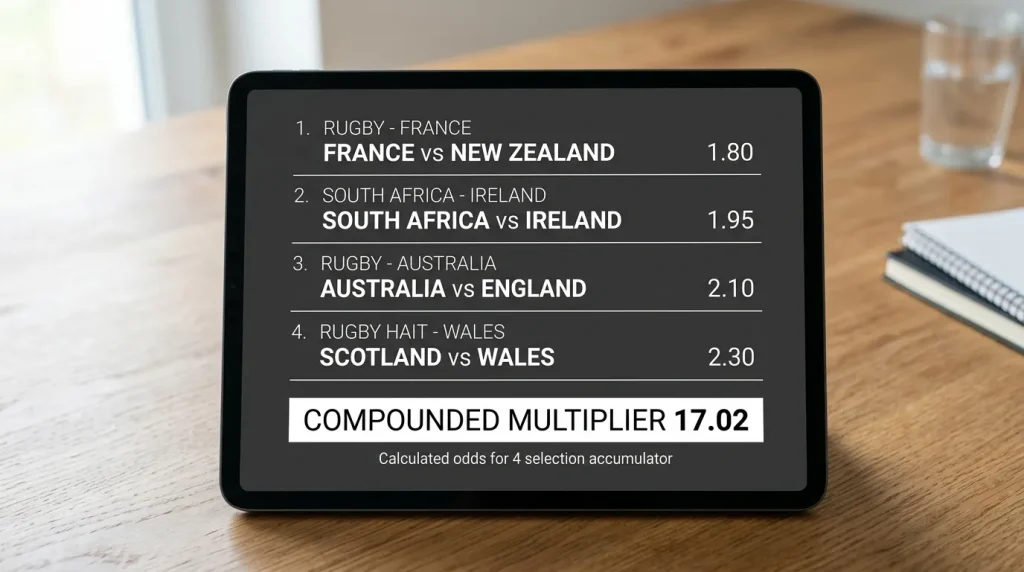
An accumulator is the rugby punter’s lottery ticket. Stake a small amount, pick four or five winners, watch the multiplier compound, and dream of a Sunday morning that pays for a holiday. The maths is what makes accumulators feel generous and what makes them hard to win. A four-leg acca on selections priced at evens compounds to 15/1 — sixteen times your stake on a £5 slip. That sounds like a wonderful deal. The implied probability of all four legs landing is the product of their individual probabilities, which on four 50 per cent shots is 6.25 per cent. Roughly one in sixteen. The maths is mostly fair, and the small overround the book takes is what guarantees they win long-term while you, on a good week, beat them on a Saturday.
Andrew Rhodes, chief executive of the UK Gambling Commission, noted that “recent data published shows that total gross gambling yield (GGY) is at its highest ever level at £15.6bn.” A meaningful fraction of that figure comes from accumulators, and rugby accas are a growing slice of the rugby betting product mix at UK sites. The 2025-26 fiscal year’s first reporting period showed provisional Betting and Gaming total receipts of £1,786 million across April to August — a 9 per cent year-on-year climb that is partly powered by exactly the kind of multi-leg slips this article is about.
Typical rugby accumulator structures
Rugby accas come in three structures, and the choice between them matters more than punters realise. The full accumulator is the standard: you pick four, five or six matches, all selections must win, and the multiplier compounds. The simplest version. The hardest to land.
A multiple-style structure — doubles, trebles, four-folds within a single slip — is where you take four selections and the slip is split into all possible combinations of pairs, triples and the four-fold itself. A four-selection multiple slip gives you six doubles, four trebles and one four-fold, for eleven separate bets at higher total stake. The advantage is that you can lose one selection and still collect winnings from the doubles and trebles that did not include it. The disadvantage is that the upside is much smaller than the equivalent total-stake four-fold accumulator.
The system bet is a structured version of the multiple. A 2-from-4 system places bets on every possible double from four selections — six doubles total — and pays out on any double that lands. A 3-from-5 places bets on every possible treble from five selections. System bets sit between the multiple and the straight acca in terms of risk and reward. They are most useful when you have a high-confidence read on a slate of matches but want to mitigate the risk of one selection dragging the whole slip down.
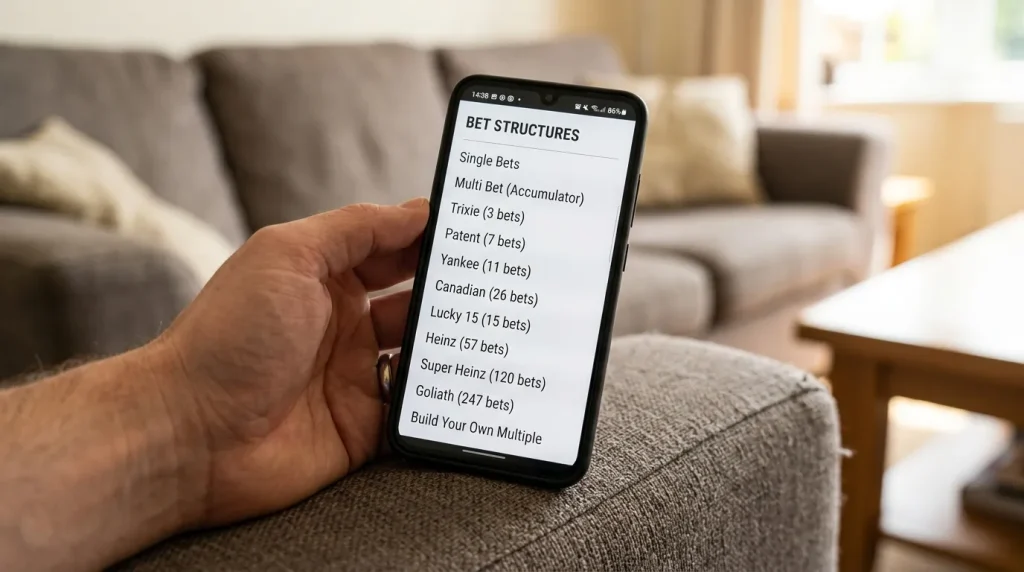
Real-event betting on UK regulated sites generated £596 million in gross gambling yield in the first quarter of 2025, with multi-leg products including rugby accas representing a growing share of that figure. The structures available depend on the site; not all UK books offer system bets in their rugby coupons, and some require a manual workaround to construct one.
Accumulator insurance and what it really covers
Accumulator insurance is a promotion offered by most UK sites where one losing leg is refunded as a free bet if the rest of your acca lands. The standard offer is “one leg lets you down, get your stake back as a free bet” on accumulators of five or more selections at minimum odds.
The catch — and there is always a catch — is in the small print. Most accumulator insurance offers require minimum odds per selection (usually 1/2 or higher), a minimum number of legs (often five, sometimes six), a maximum refund amount (typically £25 or £50), and refund as a free bet rather than cash. The free bet itself usually has its own wagering conditions: stake not returned, must be used within seven days, restricted to certain markets.
The real value of accumulator insurance is smaller than the headline suggests. A £25 free bet refund on a £25 losing acca looks like a refund. It is not. It is a free bet with stake-not-returned terms, which means the effective cash value is roughly 70 per cent of the face value at typical price points. A £25 free bet is worth about £17.50 in expected cash value to a competent punter. If you would have placed the acca anyway, the insurance is free upside. If the existence of the insurance pushes you toward larger or longer accas you would not otherwise have placed, the bookmaker has correctly identified you as a customer and you are paying for the insurance through the slips you would not have placed without it.

One specific point about rugby. Accumulator insurance terms often exclude certain markets and certain competitions. Rugby Sevens, women’s rugby outside the Six Nations, and some second-tier competitions are sometimes ineligible. Read the rules before you assume the offer applies.
Single-fixture multis vs cross-match accas
A bet builder, which I covered separately, is a single-fixture multi — all legs from one match. An accumulator in the strictest sense is cross-match — legs from different matches. The pricing logic for the two is fundamentally different.
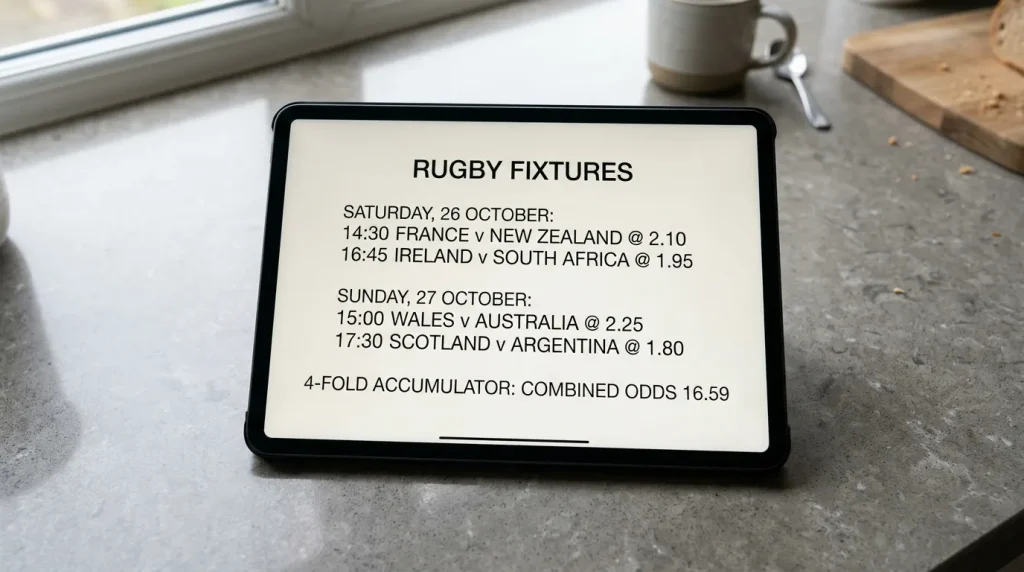
A cross-match accumulator compounds the individual prices straight up, with no correlation discount. The legs are statistically independent because they happen in different matches involving different teams. If Bath beat Saracens is one leg and Munster beat Glasgow is another, the outcome of one does not affect the outcome of the other. The multiplier you see is close to a clean compounding of the individual prices, minus the small overround on each leg.
A single-fixture multi has correlation. The legs depend on the same underlying match outcome, so the book applies a correlation discount to the multiplier. The price you see is smaller than the naive compounding would suggest, and the multiplier is intentionally less generous to account for the correlation.
The practical implication is that cross-match accas pay more aggressively for the same number of legs than bet builders do. A four-leg cross-match acca on selections priced at evens pays 15/1. A four-leg bet builder on the same prices in the same match might pay 6/1 or 8/1 because of the correlation tax. Punters who do not know the difference assume the larger acca multiplier is always better. It is not, because the legs of the bet builder are less independent and therefore the implied probability of them all landing is higher than the implied probability of four independent matches all going the way you predicted.
What happens when one leg is voided
This is the part of acca rules that catches even experienced punters out. A void leg in a rugby accumulator is treated differently from a losing leg, and the treatment depends on the site’s rules.
The standard UK rule is that a voided leg is removed from the slip and the accumulator continues with the remaining legs at the new compound price. If your four-leg acca had one leg voided because the match was postponed, the slip becomes a three-leg acca with the remaining selections settled on their original prices. The total return depends on how the remaining three legs settle.
The minority rule, used by a few sites on specific promotions, is that the whole slip voids if any leg voids. This is uncommon and would typically be flagged in the promotion’s terms. Standard accumulator betting on UKGC-licensed sites does not work this way. The leg drops out, the slip continues.
Postponed and abandoned matches in rugby are rare but they happen. Snow at the Stoop, frozen pitches in Glasgow, a Six Nations fixture rescheduled because of strike action — all real events of the past five seasons. The acca handles these gracefully if you understand the rule.

A more interesting case is a match that is abandoned mid-game. The rule depends on whether the match is completed for betting purposes. UK rugby fixtures are usually considered complete if more than 70 minutes have been played, with the result standing as it was at the moment of abandonment. Below that threshold, bets are voided and the leg drops out of the acca.
How to structure a sensible Saturday acca
I have backed enough rugby accumulators to learn that the four-leg slip is the sweet spot for most punters. The multiplier is meaningful at four legs but not absurd; the probability of all four landing is small but not vanishing; and the slip is short enough to follow comfortably across a single afternoon.
The way to structure a four-leg rugby acca that actually has expected value is to pick matches where the price you are taking is wider than the implied probability suggests. That is a tall order — bookmakers do not usually leave four obviously mispriced selections on a single weekend coupon — but the closer you get, the better the long-run return.
The other rule I have learned the hard way is not to mix competitions you do not understand. A Saturday acca of two Premiership matches, one Top 14 fixture and one URC game is a slip across four leagues with different scoring patterns, different home-advantage profiles and different injury-time conventions. The probability of being well-informed across all four is low. A slip of four Premiership matches, or three Premiership and one Six Nations, is a slip you can actually price. Discipline on the competitions you bet beats reach across competitions every time.

If you want to use a new-customer offer to fund the cost of an acca slip while you are still calibrating, the rules of UK free bets are worth knowing before you click, and the full breakdown is in rugby free bets UK.
The acca’s place on the betting calendar
Accumulators are a Saturday product. They do not work well on midweek single fixtures, they do not work at all on long-dated ante-post outrights, and they are at their most natural on a slate of weekend matches across the same competition. The product is built for the weekend punter who wants a single slip to follow across an afternoon, and used in that spirit it can be genuinely enjoyable as well as occasionally profitable.
The temptation to add a fifth, sixth or seventh leg “for the multiplier” is the temptation to turn the slip into a lottery ticket. Every leg added compounds the implied probability downward and the multiplier upward. By six or seven legs you are betting on something with a single-digit per cent chance of landing, and the expected value is dominated by the overround the book takes on each leg. The four-leg slip is the discipline. The seven-leg slip is the dream that does not pay for itself.
Does Best Odds Guaranteed apply to rugby accumulators?
Most UK sites apply BOG only to single bets on win and place markets, not to accumulators. The exceptions are a few sites that extend BOG to win-only accumulators on specific competitions, usually as a promotional feature rather than a standing offer. Read the BOG terms before assuming the price you took on the slip is locked in.
What happens to a rugby acca leg if a match is postponed?
The voided leg drops out of the slip and the accumulator continues at the new compound price with the remaining selections. If the match is rescheduled within the betting window, some sites apply the original bet to the rescheduled fixture; most do not. Check the postponement clause in the site"s rugby rules.
Articles
Prepared by the Rugby Betting Sites editorial staff.
