
Each-Way Betting on Rugby Tournaments
 Available in US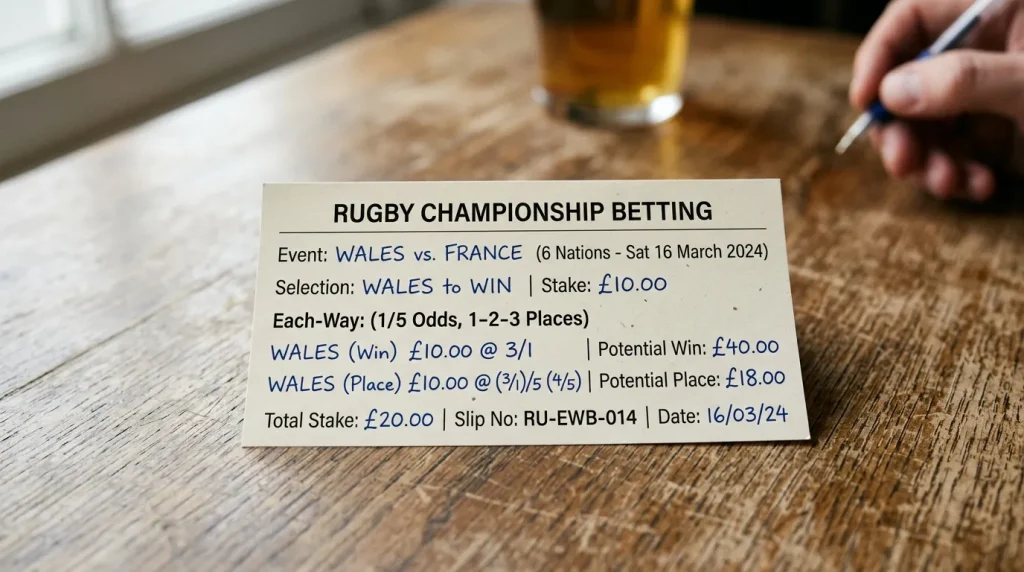
Each-way structure adapted to rugby
I have always found it strange that each-way betting in rugby gets so little attention from punters and so much grumbling about its place terms. Football each-way barely exists. Horse racing each-way is the structural backbone of the sport’s betting. Rugby each-way sits in the middle, with serious money flowing on tournament outright markets where the each-way side genuinely pays out, and almost nothing on match-level markets where it does not.

An each-way bet is two bets in one. Half your stake goes on the selection to win; the other half goes on the selection to “place”, meaning to finish within a specified number of positions. If your pick wins, both halves pay out. If your pick places but does not win, only the place half pays — usually at a fraction of the win odds. If the pick neither wins nor places, the whole stake is lost. The structure was built for horse racing fields of fifteen runners and adapted, with some friction, to other sports.
Place terms used by UK sites on rugby
The place terms are the part of each-way that matters most and the part punters read least. They define how many positions count as a “place” and what fraction of the win odds applies to the place half of the bet.
For Rugby World Cup outright winner, UK sites typically offer two places at a quarter of the win odds. Some sites stretch to three places at one-fifth odds during the tournament itself. The Six Nations is more variable — usually three places at one-third or one-fifth, depending on the site and the proximity to kickoff. The Premiership outright is normally three places at one-quarter odds for the bulk of the season, sometimes extending to four when sites run special promotions ahead of the play-offs.
The place terms tell you what the bookmaker thinks the field looks like. A Six Nations outright with three places at one-third odds is a generous offer; the bookmaker is signalling that they think the tournament has three or four genuine contenders and they are happy to pay out on a side that finishes near the top. A World Cup outright with two places at one-quarter is conservative; the bookmaker is signalling that the field has a small number of genuine contenders and they are not going to extend the place pool generously.

Top tournament try-scorer markets follow their own place terms. Most UK sites offer three places at one-quarter odds on top try-scorer in major tournaments. Some sites extend to four places during specific promotional windows. The fraction matters because the win odds on top try-scorer are often in the 10/1 to 25/1 range, so the place half — at one-quarter of those win odds — still pays a meaningful return.
Tournaments where each-way actually pays
The honest read on rugby each-way is that it earns its keep on tournament outrights with deep fields and modest place fractions. The Rugby World Cup is the obvious case. The 2027 tournament will run 52 matches across six pools of four teams plus a 24-team format that expands the contender pool noticeably. With more teams in the field, the each-way side is more likely to pay than it would on a tighter Six Nations field. The 2027 final is scheduled for 13 November in Australia, and ante-post each-way markets are already trading for that event.
The Six Nations is the trickier case. Six teams means each-way place terms of two or three places out of six are a smaller field share than they would be in a fifteen-runner horse race. The mathematics still works on each-way if the place fraction is generous enough, but punters need to be aware that the structural payout is tighter than it looks. Two places out of six is one-third of the field, which is a lot in horse-racing terms; the place half is more likely to land than the win half by exactly the ratio you would expect.
The Premiership outright benefits from more competitive depth in recent seasons. The Premiership in 2024-25 ran 90 matches across the season with 714 tries scored — 7.9 per match on average — and the eventual champion was Bath. The wider competitive shape of the Premiership means each-way places land on different sides each year, which is the right structural condition for each-way value.

The other tournament where each-way is a meaningful market is the Six Nations Championship prize fund, which sat at £18 million for the 2025 edition. That sponsorship and prize money underwrites the broadcaster interest and the betting volume, and each-way markets benefit from the resulting price liquidity.
Reading the fraction — 1/3, 1/4, 1/5 of the win price
The fraction on the place half of an each-way bet is the most important number on the slip after the win odds. It tells you what each pound of place stake will return if the place lands but the win does not.
One-third of the win price is the most generous fraction commonly offered on rugby. If your pick is 12/1 to win the Six Nations and the place fraction is one-third, your place half pays at 4/1 if the pick finishes in a paid position. A £10 each-way bet — £20 total stake — returns £50 on a place: £10 stake on the place half plus £40 winnings at 4/1. The win half is lost.
One-quarter is the standard fraction for major tournament outrights. The same 12/1 pick with one-quarter terms returns at 3/1 on the place half. A £10 each-way bet returns £40 on a place: £10 place stake plus £30 winnings at 3/1. The mathematics is straightforward; the impact on expected value is significant. The difference between one-third and one-quarter places is roughly the difference between a 10 per cent return and a marginal loss on the same average tournament.
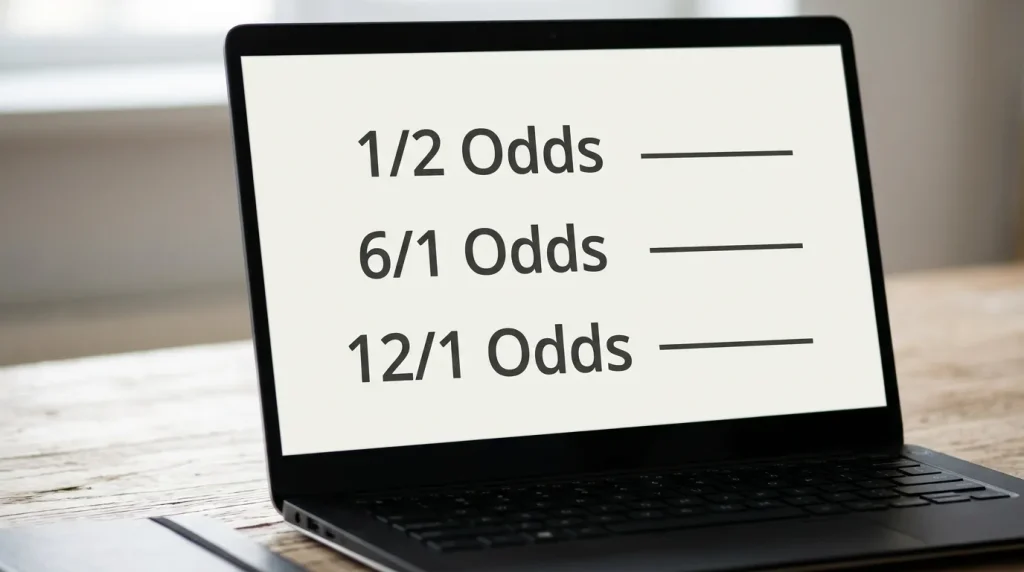
One-fifth is the tightest fraction commonly seen. It usually appears on shorter-priced tournament favourites where the win half is already implied at high probability. A 7/2 favourite to win a tournament might be offered each-way at one-fifth, which gives a place return at 7/10. Each-way on a strong favourite at one-fifth is rarely worth taking; the win half dominates the bet and the place half adds little.
Why each-way rarely fits a rugby bet builder
Each-way is a tournament-level product. Bet builders are single-match products. The two do not naturally combine, and most UK sites do not allow each-way selections inside a bet builder for structural reasons.
The reason is that each-way settles on a different scale to the rest of a bet builder’s components. A handicap settles in 80 minutes. A first try scorer settles in the first ten minutes. A top try-scorer market settles over the whole tournament. Combining an 80-minute settlement with a six-week tournament settlement in a single multi is not a product UK sites can clean up easily, and where they do allow it, the pricing is hostile.
The exception that proves the rule is “match each-way” on rugby sevens tournaments, where pool-stage matches sit inside a one-day tournament structure and each-way bets can be placed on pool-stage winners with the place half paying on second. This is a niche product. Most rugby punters never see it.
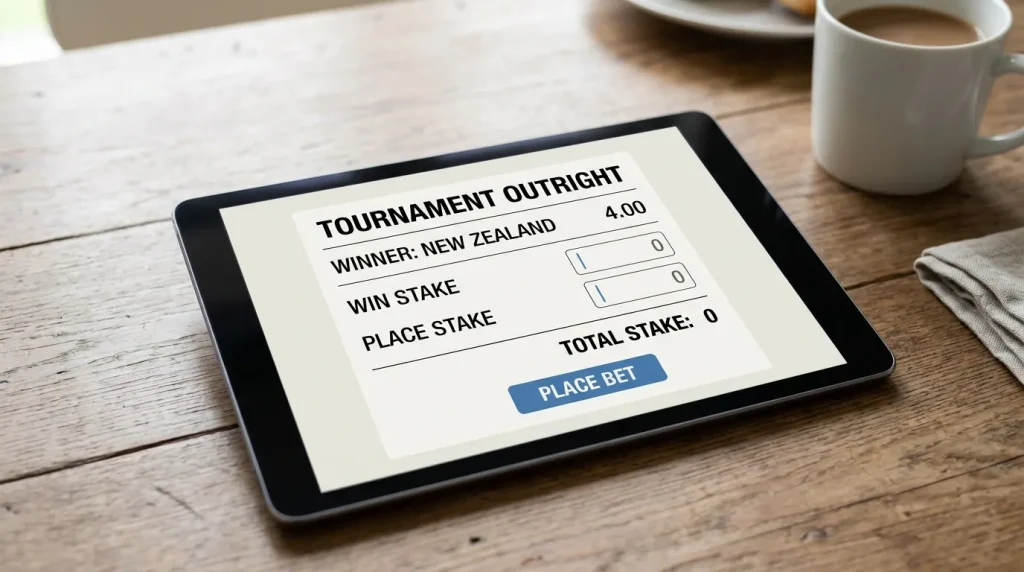
The clean way to use each-way is on its own slip, on a tournament outright market, with a clear-eyed view of the place terms and the place fraction. Combining it with other products tends to introduce settlement complications without adding expected value, and you are usually better off treating the each-way bet as a stand-alone exposure to the tournament. The same logic applies to ante-post outrights with each-way settlement, which is the larger frame for these bets and where the detail on hedging and stake-sizing lives, in rugby ante-post betting.
Where each-way earns its place on a punter’s coupon
Each-way is not a high-frequency product. You will place each-way bets a handful of times a year — once on the Six Nations outright, once or twice on Rugby World Cup markets, occasionally on top try-scorer for a major tournament. The volume is low. The decision-quality required is high.
The best each-way bets I have placed have been on second-tier contenders at attractive win prices with generous place terms. A side priced at 14/1 to win a tournament, with three places at one-third odds, is the structural shape that works. The win half is a long-shot but plausible; the place half pays at a meaningful fraction and lands more often than the win half by the margin the price implies. The expected value calculation favours the punter if you can find the right combination of price and place terms.
The worst each-way bets are on heavy favourites at short prices with one-fifth place terms. The win half dominates, the place half is a low-fraction insurance, and the structural payout when only the place lands is barely above the original stake. If you are going to back a favourite at short odds, back them straight on the win line. Save the each-way for the contenders one or two tiers down.
One last note. Each-way is not a hedging tool. It is its own bet, with its own settlement logic. Treating it as half-a-bet to soften the variance of an outright pick is a common mistake; the place half has its own expected value, and the right way to think about an each-way slip is as two parallel bets that happen to share a stake size. Read them that way and the each-way coupon makes sense.
What place terms does Coral offer on rugby outright markets?
Coral typically offers three places at one-quarter odds on Six Nations and Premiership outright markets, with extended four-place terms appearing during specific promotional windows. Rugby World Cup outright sits at two places at one-quarter for the bulk of the cycle, expanding to three places at one-quarter or one-fifth during the tournament itself. The specific terms displayed on the slip are the ones that apply at the moment of placing the bet.
Is each-way available on Six Nations top try-scorer?
Yes, with three places at one-quarter odds being the standard offer on most UK sites. A few sites stretch to four places during the tournament. The top try-scorer market in the Six Nations is one of the few rugby player markets where each-way structurally makes sense, because the leading try-scorer is rarely a runaway choice and the placed half pays at a meaningful fraction.
Articles
Published by the Rugby Betting Sites team.
