
Rugby World Cup 2027 Betting: Odds, Pool Maths and the Australia Cycle
 Available in US
Why a 24-team World Cup re-prices everything
The last time I held a Rugby World Cup ante-post position from before the pool draw through to the tournament itself was 2019. I had backed Wales at 12/1 in the immediate aftermath of the 2018 autumn series. By the time I cashed out three weeks before the tournament kicked off, the price was 6/1. I made money on the trade and not on the bet, and that distinction is the whole point of how you should approach the 2027 World Cup right now.
This is a fundamentally different World Cup from anything we have seen since the early professional era. The tournament expands from twenty to twenty-four teams. The schedule grows to fifty-two matches across six pools of four. The final is set for 13 November 2027 in Australia, with the host nation building toward home advantage in a way they have not enjoyed since 2003. Each of those structural changes — the larger field, the new pool maths, the host effect — does something distinct to the ante-post market. If you are placing a position now, in the early months of 2026, you are pricing a tournament whose probability distribution looks unlike any World Cup the books have priced before.
That is both an opportunity and a trap. There is identifiable value to be had in a market this far out from the event, but the value only crystallises if you understand the structural maths underneath the pool format. The rest of this article walks through that maths, the current contender pricing, and the hedging template I use to manage a multi-year ante-post position.
The 24-team format and the pool draw maths
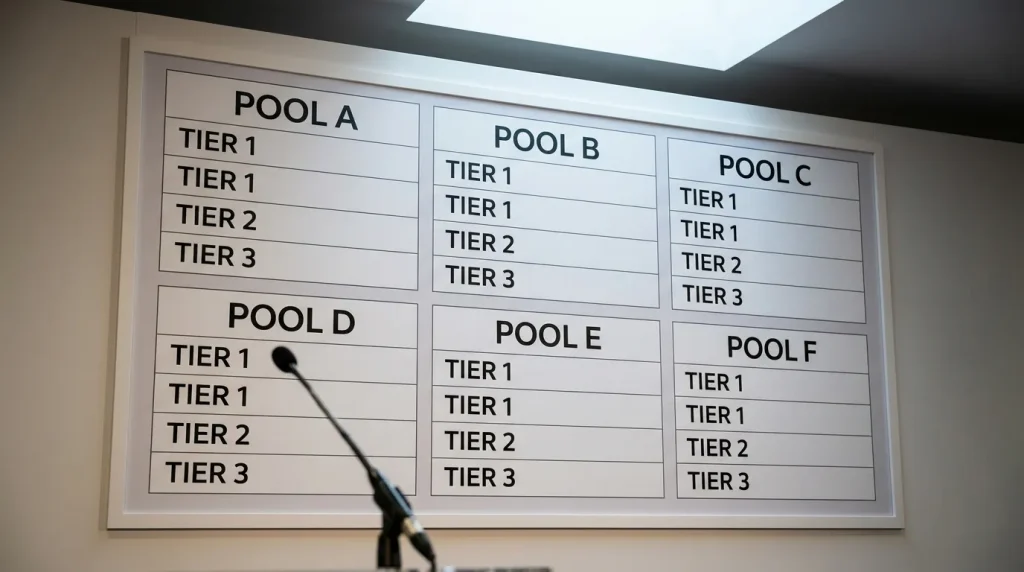
Twenty-four teams in six pools of four. Each pool sends two teams forward into a round of sixteen knockout bracket, with the four best third-placed sides also progressing. From there it runs as a standard single-elimination tournament — sixteen down to eight, eight to four, four to two, then the final and the third-place play-off.
The first thing to understand is that this format changes the probability of a top-tier side making the quarter-finals. Under the old twenty-team, five-pool format, the top two pool finishers progressed directly to the quarters. The round of sixteen now interposes one knockout round between the pools and the quarters, which means a top seed has to win one more knockout match than they used to. That additional round costs a contender something. If a tier-one side projects at, say, ninety-two per cent to win a typical round-of-sixteen match, the expected quarter-final probability drops by eight per cent purely from the new structural step. Spread across the favourites, this is a meaningful pricing shift.
The second thing is the pool draw effect. With six pools of four, the seeding bands are wider and the within-pool variance is lower than it was in five-pool format. The host nation Australia and the top-three seeds will generally not meet each other before the quarters, but the second-band seeds — sides ranked four through nine in the world — can land in a pool with any of the top three, depending on draw luck. The implications for ante-post pricing are direct: a tier-one side drawn into a benign pool gets a small but real price compression in the futures market, while a tier-one side drawn into a “group of death” sees their price drift.
The third structural feature is the addition of four new pool nations. The expansion brings in qualifiers from emerging rugby regions who would not have made a twenty-team field. Their inclusion does not change the title probability of the favourites materially, but it does enlarge the field of pool-stage variance. An emerging nation pulling off an upset on round one — the way Japan beat South Africa in 2015 — has a higher probability simply because there are more opportunities for that style of result to occur. That feeds into the pool-stage betting markets, where the early-round handicaps on tier-one favourites against tier-three opposition are sometimes wider than the historical match data justifies.
The fourth and possibly most important structural element is the schedule density. Fifty-two matches across roughly six weeks puts strain on the squads of even the best-prepared nations. The shorter recovery windows between knockout matches mean that depth of squad — not just first-fifteen quality — becomes a tournament-deciding factor. Tier-one sides with proven thirty-three-man depth (South Africa, France, New Zealand, England) project better in this format than sides whose quality drops off sharply after the starting line-up. The futures market is, as of early 2026, partially pricing this depth premium, but I would argue not fully.
Where the early ante-post prices sit
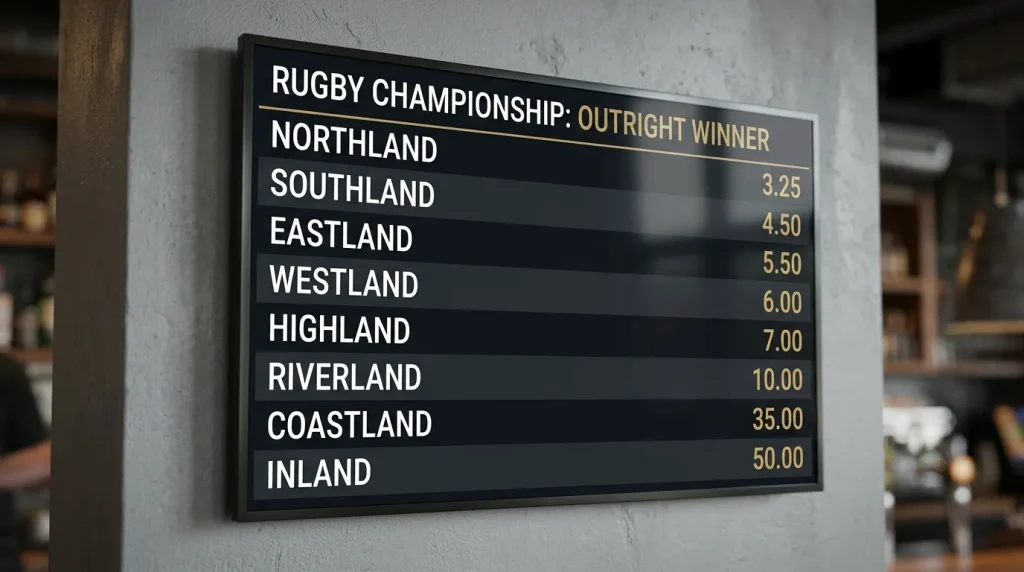
Let me put the current contender pricing in front of you, then unpack what it implies. After the pool draw landed in late 2025, Betfair quoted South Africa at 9/4 to win the tournament. New Zealand were 7/2, France 9/2, England 5/1, Ireland 6/1, and the hosts Australia 9/1. Sam Rosbottom of Betfair summarised the position: “South Africa are 9/4 favourites to win the Rugby World Cup for a third successive time in 2027. The Boks have cemented their position as World No.1 and are likely to collide with 7/2 second-favourites New Zealand in the quarter finals.”
That quarter-final collision projection is the most important piece of analysis in the current pricing. If the bracket math forces South Africa and New Zealand into the same half of the draw, one of them is eliminated by the semi-finals. That dramatically thins the field of viable winners. The implied probability of the South Africa price (roughly thirty-one per cent) plus the New Zealand price (roughly twenty-two per cent) gives a combined fifty-three per cent — but if they meet in the quarters, the combined probability of one of them lifting the trophy cannot exceed the probability that the winner of their match goes on to win. That winner has roughly a fifty per cent chance of making the final and roughly fifty per cent of winning it from there, so the joint probability of a Southern Hemisphere winner from the South Africa-New Zealand half is closer to thirty per cent than fifty-three.
This is where book margin and bracket reality diverge in ways the punter can exploit. If you believe the bracket projection — that South Africa and New Zealand meet in the quarters — then either both prices are too short, or one of them is too short and the other is appropriately priced. The way I read the market in early 2026 is that South Africa at 9/4 prices an outright probability that already assumes the New Zealand collision is in the draw, and the price reflects the resulting fifty per cent semi-final probability discount. New Zealand at 7/2 may not fully reflect the same discount, because the public weight on the All Blacks remains historically high. There is a small but real edge in laying New Zealand and backing France or England at the current prices, if you believe the bracket math holds.
The host effect is the other piece worth examining. Australia at 9/1 — the host nation, building toward what would be a third home World Cup since 1987 — looks short for a side that is rebuilding through a long-cycle squad development project. Home advantage in rugby is real but is worth approximately five to seven per cent in win probability per match, not the twenty per cent compression the current Australia price implies relative to their global ranking. Australia at 9/1 prices an outright probability of around ten per cent, which strikes me as generous to the host effect and stingy on actual squad strength.
Contender by contender
Let me work through the top six contenders one at a time, because each has structural strengths and weaknesses that the headline price compresses into a single number.
South Africa at 9/4 are the world’s best team coming into the cycle. Two consecutive World Cup wins is a foundation that no other tier-one side can match, and their squad depth in the front row and back row remains the best in the world. The concerns are age and the trans-cycle squad refresh that every champion has to navigate. The 2027 squad will be roughly forty per cent different from the 2023 squad, and the rebuild has gone well to date but is not yet complete. Their projected route to the final almost certainly involves a quarter-final against either New Zealand or France, which is a knife-fight neither side wants. The price of 9/4 is fair value rather than great value, in my read.
New Zealand at 7/2 have the strongest pedigree but also the most uncertainty. Their recent form has been competitive without being dominant, and their loss column over the last eighteen months includes more matches than any All Blacks side of the modern era. The 7/2 price reflects pedigree more than current form, in my view, and would be a sound lay at most ante-post books if the structure of those markets allowed it. As a back, 7/2 is short for what the squad is currently producing.
France at 9/2 are the most interesting contender. Squad continuity from the 2023 cycle is strong, the Top 14 is producing front-line international talent at a pace no other rugby nation can match, and the side has an attacking pattern that translates well to the larger field of an expanded World Cup. The path to the final almost certainly involves South Africa or New Zealand in the semi-finals if the draw breaks as projected, but France have proven they can beat either on a given day. I rate France at 9/2 as the best value among the headline contenders.
England at 5/1 carry the home-nations engineering benefit. The Premiership has tightened over the last two seasons, the RFU’s revenue of 228 million pounds in 2024-25 reflects a structurally improving English club system, and the international squad has more depth than it has had at any point since 2007. The challenges for England are a softer pool draw making them seeded but untested, and the perennial concern about peak timing — England often arrive at World Cups in the rebuild phase of their cycle. 5/1 is fair value if you trust the current Steve Borthwick squad.
Ireland at 6/1 face the structural problem they have always faced at World Cups — getting past the quarter-finals. Pool dominance is essentially guaranteed for Ireland; quarter-final breakthrough remains the unfulfilled ambition. The 6/1 price implies a thirteen per cent winning probability, which on my model is generous. Ireland’s pool form is rarely the issue, and the same brittle quarter-final pattern would have to break for the price to crystallise.
Australia at 9/1 are the host nation, and as discussed earlier I think the implied probability is too generous to the host effect and too thin on current squad strength. The Wallabies are in a generational rebuild, and home advantage in pool play is real, but the gap between their best-fifteen and the top contenders’ best-fifteens is still significant.
Beyond the top six, the field thins quickly. Scotland and Argentina are the next pricing band, typically at 33/1 and 40/1 respectively. Wales, Italy and the emerging nations are further out. The 2025 Six Nations reached close to 130 million global fans, which gives you a sense of how much pre-tournament attention the European sides will absorb in 2027. That attention drives money to recognisable names, which compresses prices on the European tier-one sides further than the underlying probabilities justify.
Dark horses in a wider field
The twenty-four-team format opens a small window of value at the medium-range prices. Sides in the 25/1 to 80/1 band are now competing in a tournament where one unexpected result can carry them through the round of sixteen into a quarter-final, where the variance of a single knockout match can deliver a semi-final berth. The compounding effect of that bracket math is small but real, and it suggests the medium-range prices should be slightly shorter than they would be in a twenty-team format.
The two dark horses I have been watching are Scotland and Argentina. Scotland’s recent form against tier-one opposition has been competitive — they have beaten England and given France close matches — and their attacking shape is among the most coherent in the European tier. At 33/1 the price implies a three per cent winning probability, which strikes me as marginally cheap. Scotland will not win the tournament, on any reasonable projection, but at 33/1 with a structurally favourable bracket they offer a small positive expected value as a long-shot.
Argentina at around 40/1 are the unpredictable element. The Pumas have shown they can beat tier-one opposition when fully prepared and well-coached, and their style — physical forward play combined with attacking back-line ambition — translates well to the demands of a World Cup. The price implies two and a half per cent winning probability, which I think is reasonable rather than generous. As a hedge against a Northern Hemisphere upset run, Argentina makes some sense in a portfolio context.
The emerging-nation prices — Fiji, Samoa, Tonga, Georgia, Uruguay — are all 200/1 or longer for outright winner. The realistic ambition for those sides is a quarter-final appearance, and that market is priced separately at most operators. Fiji at 5/1 to make the quarter-finals is a position I will likely take, because the 2027 format provides one extra knockout round of pathway variance and Fiji’s recent form against tier-one sides justifies the implied probability.

Top try-scorer and stage-of-elimination markets
The outright winner market gets the headlines, but the side markets for a World Cup are where serious ante-post punters often find the cleanest value. Two markets stand out.
Top try scorer of the tournament is a market where pool-draw effects compound heavily. A high-strike winger from a tier-one side drawn into a benign pool can rack up six or seven tries in the group stage alone, which is sometimes enough to win the market outright. Damian Penaud of France scored fourteen tries in the 2024-25 Champions Cup season, leading the competition — that kind of strike-rate suggests his name should appear high in any 2027 top try scorer ante-post market. The match-level Champions Cup average of 7.71 tries across the 2024-25 season gives you a useful benchmark for what to expect at international level once you adjust for tighter defences. A pool stage with three matches at that intensity for a top winger easily produces five tries.

The market is typically priced with the obvious wingers in the 10/1 to 16/1 range, and the value tends to sit one tier down — backs at top sides whose attacking pattern produces multiple try-scoring opportunities per match but who are not the headline name. Worth a position in the early ante-post market before the pool draw effects are priced in.
The stage-of-elimination market is the other side market worth considering. Tier-one sides are priced at long odds to be eliminated in the pool stage and short odds to make the quarter-finals. The interesting prices are on the second-band seeds — sides ranked four through nine — whose stage-of-elimination market offers a wider range. A second-band side at even money to be eliminated at the quarters is a clean hedge against having backed a higher-band rival to win.
Pool-stage handicap markets become tradeable from roughly six months before kickoff. By 2027 spring, the handicap on a tier-one side against tier-three opposition typically opens at -35 or wider. The relative value here is on the under for “winning margin under thirty-five” — even when tier-one favourites win, the margins in pool play often come in under the publicised line because of the World Rugby rotational squad usage in early pool matches.
A simple hedging template for a multi-year ante-post position
Here is the template I have used for two previous World Cup cycles, with adaptations for the 2027 structure. It is not the only approach, but it is robust to the kinds of price drift you actually see across a two-year holding period.
Step one. Take your primary outright position now, between January and August 2026, when the prices reflect pre-Six Nations form and the pool draw is freshly absorbed. Size this position at a quarter of your total intended ante-post allocation. The remaining three-quarters are deployed later.
Step two. After the 2026 Autumn International Series — typically completed by the end of November 2026 — reassess your position. If your selected contender has performed strongly, take a second position of one quarter of allocation at the new, shorter price. If they have struggled, do not chase the drift; instead, take a hedge position at the same size on the new favourite or the second-favourite. By the end of November 2026 you have half of your total allocation deployed.

Step three. After the 2027 Six Nations or Rugby Championship — depending on which is more relevant to your contender — reassess again. The remaining half of your allocation is deployed at this point, either continuing to back your primary side at the prevailing price or splitting it between two contenders to hedge.
Step four. In the final eight weeks before kickoff, when the ante-post market becomes a live market, the hedging decisions get more granular. Each pool-stage match is its own pricing event, and you can use the in-event match markets to hedge or release portions of the outright position. The classic case is when your contender wins their opening pool match comfortably — the outright price drops noticeably, and you can release ten or twenty per cent of your position at the new shorter price, locking in some profit while retaining most of your exposure to the tournament outcome.
This template requires patience and discipline, and the longer-term mechanics of ante-post — particularly around non-runners, withdrawals and the way different operators handle late squad announcements — are best worked through in my standalone guide to ante-post rugby betting. The mechanics matter as much as the pricing, particularly for a multi-year hold.
UK sites best set up for RWC 2027 ante-post
The operator landscape for ante-post World Cup pricing is uneven. A handful of UK sites take ante-post seriously, with deep market trees, clear non-runner rules and consistent pricing across the full contender list. Others publish a top-six outright market and stop there.
What I look for in an ante-post-serious operator is fivefold. Depth of priced runners — the strong ones quote all twenty-four nations once the qualifiers are confirmed, alongside the dark-horse contender prices. Clear non-runner rules — what happens if a team withdraws between when I place the bet and the tournament starts? The best operators settle as stake-returned plus reinvested on the new market. The weak ones leave you with a void bet and no protection.
Best Odds Guaranteed application — does the operator apply BOG to ante-post markets? Most do not. The operators who do apply BOG on ante-post World Cup markets are rare, and the protection is worth real money if your selected side drifts in late.
Cash-out availability on ante-post — does the operator allow cash-out at any point in the ante-post holding period, or only once the tournament is live? The flexibility to cash out partially or fully in the year before the event is a meaningful feature for any multi-year position.
Maximum payout limits — does the operator have a stated maximum payout on World Cup outright markets? Most do, and the cap is usually high enough that it does not affect normal punting, but if you are building a substantial ante-post position you want to know whether your potential win can actually be paid out in full.
What to do with this market between now and kickoff
The Rugby World Cup 2027 is the most structurally different tournament in modern rugby history, and the betting markets are still adjusting to that reality. South Africa lead the pricing for a reason, but the field is genuinely open in a way that the previous three cycles were not. France at 9/2 is, in my read, the cleanest single-side back available in the current market. The expansion to twenty-four teams creates side-market value across pool stages and the new round of sixteen, and the hedging template above gives you a framework for managing a multi-year position through the cycle. Place your early position now, do your work through the autumn and the spring before the tournament, and you will have built the most informed ante-post book you have ever held.
FAQ on RWC 2027 betting
Why do RWC 2027 ante-post odds drift this far from the tournament?
Ante-post markets in early 2026 reflect pre-tournament uncertainty, squad rebuild cycles, schedule fatigue and pool-draw effects that are not yet fully absorbed by the betting public. The price you see now is the operator"s best estimate plus a margin, with limited public liquidity to compress it. As the tournament approaches and more information arrives — autumn results, Six Nations or Rugby Championship form, pre-tournament friendlies — the prices tighten toward consensus, which is why ante-post values can compress by forty to sixty per cent between early-cycle and tournament eve.
How does the 24-team format change knockout probability?
The expansion adds a round of sixteen between the pool stage and the quarter-finals, which means a top seed has to win one additional knockout match to reach the final. That additional match costs a contender roughly five to ten per cent in expected probability of reaching the quarters, depending on the strength of opposition. The pool dynamics also change because six pools of four allows for benign and brutal pool draws across the field. The net effect is that the top contenders" outright probability is slightly lower than it would have been in a twenty-team format.
What is the value play among the four newly added pool nations?
The expansion nations are unlikely to win the tournament — their realistic ambition is one pool-stage upset and a possible round-of-sixteen appearance. The value play is on individual matches, where the handicap lines for a tier-one favourite against a newly qualified side are sometimes wider than historical match data justifies. The pool-stage handicap-under or the underdog plus-thirty markets are where the value sits, not the outright winner ante-post.
Should I keep or cash out an RWC 2027 ante-post in the months before kickoff?
It depends entirely on price drift. If your contender has shortened materially from the price you took — say, from 9/2 to 3/1 — partial cash-out captures a portion of the value while retaining tournament exposure. If the price has drifted out, holding through to the tournament gives you full upside on a result. As a general rule, taking ten to twenty per cent of the position in cash-out in the final four weeks before kickoff is a reasonable risk-management approach, particularly for higher-stakes positions.
Articles
Prepared by the Rugby Betting Sites editorial staff.
