
Rugby Bet Builder Explained — Stacking Markets on a Single Match
 Available in US
What a bet builder is in rugby and why correlation matters
The first bet builder I ever placed on a rugby match looked, in retrospect, like a man trying to win an argument with himself. England to win, England minus 12.5, England team total over 27.5, an England wing first try scorer. Four selections that were essentially the same bet wearing four different coats. It landed. I felt clever. I was not clever. I had stumbled into the central trap of bet builder construction, which is that selections that all depend on the same outcome do not give you four independent shots at the same price the multiplier suggests.
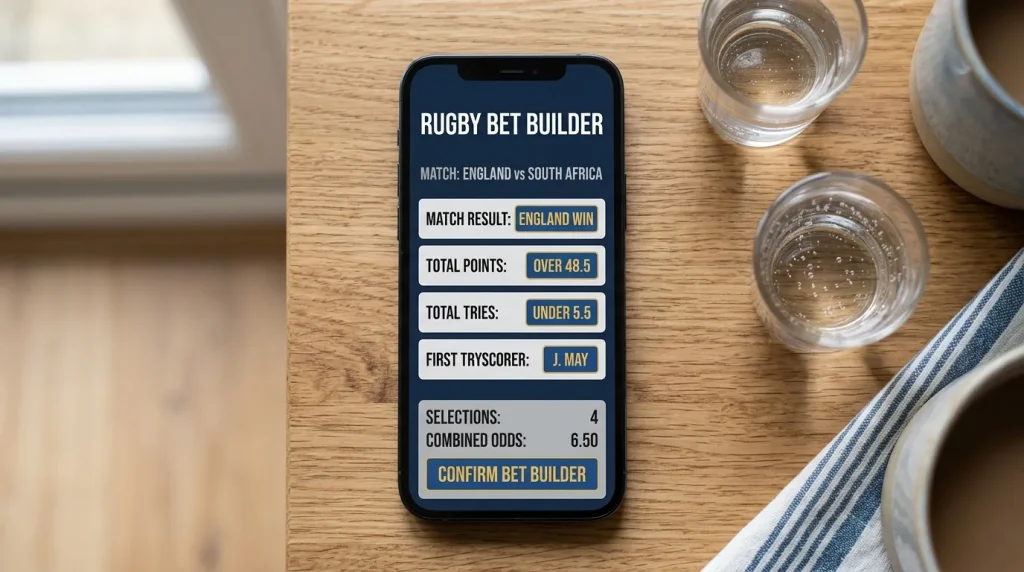
A bet builder is a single-match accumulator where you pick multiple markets from the same fixture and combine them into one bet at one price. The price reflects the implied probability of all selections landing together. Where football bet builders are the dominant product in UK sportsbooks, rugby bet builders sit just below them in popularity but are growing fast — real-event betting on UK regulated sites generated £596 million in gross gambling yield in the first quarter of 2025, and bet builders are quietly responsible for a meaningful share of that figure.
Markets that combine cleanly on a rugby card
Not every market is available in every bet builder, and the menu varies between UK sites. Most allow you to stack match result, handicap, total points, first try scorer, anytime try scorer, team totals and player-specific tries-and-points props. A few will let you mix card markets, half-time results and bonus-point markets in the same slip.
The selections that combine cleanly are the ones that bet on different aspects of the match rather than reinforcing the same view. A bet builder pairing the favourite at minus 9.5 with the underdog’s outside centre at 8/1 anytime try is a real bet — you are saying “I think the favourite covers comfortably, but I expect the underdog to cross at some point.” Those two outcomes are not the same outcome, and the multiplier you get is fair value for that combination.
By contrast, stacking match result on the favourite, handicap on the favourite and team total on the favourite is three legs of the same opinion. The price multiplier will look generous but the implied probability is wildly overstated. If the favourite wins comfortably, all three legs land. If the favourite stumbles, all three fall together. You have not built a bet; you have built an expensive way to back a win.
The clean combinations I keep coming back to are: handicap plus first try scorer (different scoring distribution), match result plus total points (one is about who, the other is about how many), and anytime try scorer plus team-to-win-half (one is about a specific moment, the other about a specific 40-minute window). Each pair holds its multiplier honestly because the second leg is not just a restatement of the first.
Correlation traps that quietly cap value
The bookmakers know about correlation. They model it. The price they give you on a stack of correlated selections is not the raw multiplier of the individual prices — it is adjusted downward, sometimes severely, to account for the fact that the legs are not independent.
What this means in practice is that even when a bet builder lets you combine legs that look correlated, the price you see is already discounted. If England minus 12.5 is 10/11 alone and England team total over 27.5 is also 10/11 alone, the naive multiplier would be roughly 7/2. The bet builder price the book offers will be closer to 7/4 or 2/1. That is the correlation tax, and it is invisible.
The trap is not that correlation exists. The trap is that correlation is silently capping your value, so the bet builder that “looks like good value” because it pays 5/1 might be paying you 5/1 on something the book has internally priced at evens. You are not getting a fair deal. You are getting a heavily-discounted deal dressed up as a multiplier.
The defence is to combine markets that are genuinely uncorrelated, where each leg expresses a different view of the match. Total points is loosely correlated with both sides’ team totals and with the match result, but it is far less correlated with first try scorer or with a specific player’s anytime try. Build with that in mind and the multiplier you see is closer to the multiplier you would compute by hand.

A second trap is the false-uncorrelated combination. Backing both a high total and a high winning margin sounds like two different views, but a high total in a one-sided match is structurally correlated with the favourite running away with it. The book will discount this just as aggressively as the obvious cases. Read the price the book offers against the price you would compute, and if the gap is huge, the legs are more correlated than you thought.
Bet builder boosts and how to value them
Most UK sites now offer boosted bet builder prices on selected rugby fixtures, especially during the Six Nations and on Premiership weekends. A bet builder boost takes the price the book calculated and increases it by a percentage — typically 10 to 25 per cent — for a limited time before kickoff or in a specific promotional window.
The honest truth is that bet builder boosts are sometimes worth taking and sometimes worth ignoring. A boost on a bet builder you would have placed anyway is free value. A boost that nudges you toward a bet builder you would not have considered is the bookmaker doing their job correctly — pulling you into a market you do not understand at a price that still has their margin baked in.
The test I use is whether I can re-compute the underlying value at the boosted price. If the boosted bet builder pays 4/1 on three selections I would have priced at roughly 7/2 independently, the boost has brought the offered price to slightly above fair. That is a real boost. If the boosted price pays 9/4 on three selections that, when their correlation is properly accounted for, were always worth about 2/1, the boost is cosmetic and the bet builder is still margin-positive for the book.

Maximum stake limits on boosted bet builders are universally low — usually £5 or £10. The book offers the boost because the small maximum stake caps their exposure. That is fine, but it also means a boosted bet builder is not a stake-sized bet. It is a small flutter with a slightly improved price, and treating it as a larger position will frustrate you when the bookmaker declines to take £200 on it.
Live bet builder during a rugby match
Live bet builder is one of the more interesting products UK sites have added to their rugby offering in the past two seasons. You can build a multi-leg bet builder during a match, with prices that reflect the current state of play. A flying start by one side will inflate their handicap price and crush their match-result price, opening up combinations that did not exist pre-match.
The technology underneath live bet builder relies on real-time odds feeds and pricing engines that can repivot prices in seconds. Live streaming and real-time odds have improved engagement metrics in the UK betting market by around 25 per cent over the past year, and live bet builder is the most visible expression of that integration.
The catch with live bet builder is suspension. Every time the referee calls a TMO or a scrum collapses, the bet builder freezes. You cannot place the bet during the suspension and you cannot adjust your selections until the markets reopen. If the suspension turns into a try, the prices reopen at new levels and your selections may now be priced very differently — sometimes better, often worse.
The legitimate use case for live bet builder is the early-match shift. The favourite has just gone behind in the seventh minute and the book has overreacted; you build a bet builder anticipating the favourite’s recovery, getting prices on handicaps and totals that would have looked impossible pre-match. The illegitimate use case is the late-match desperation bet, where you have lost on your pre-match wagers and are looking for a way to get level via a live bet builder that requires three things to happen in fourteen minutes. Both are available. One is a strategy. The other is an expensive way to ruin a Saturday.

If you want to understand how the in-play machinery beneath bet builder pricing actually moves, the closest read is on in-play rugby betting markets, where the same suspensions and reprices play out at the level of individual markets rather than multi-leg slips.
Where bet builder stops working and where it starts
I have settled enough bet builder slips to know the shape of the product. The big multipliers that ride on three or four legs are not where bet builders earn their keep. The genuine value is in two- and three-leg builders that combine legitimately uncorrelated selections, accept the discount the book applies, and produce prices a few points longer than the legs would yield separately.
The bet builder is a sharpening tool, not a multiplier. Use it that way and it pays. Use it as a way to turn a £5 stake into £500 because you stacked seven legs of the same view and got lucky, and you will discover, over a hundred slips, that the book always wins.
Can I combine handicap and total in one rugby bet builder?
Yes, and it is one of the cleaner bet builder pairings because the two markets bet on different scoring distributions. The handicap is about the margin between the sides, the total is about combined points, and the price you see should already reflect the modest correlation between them. Most UK sites allow this combination on Premiership, Six Nations and Super League fixtures.
Does a bet builder boost ever erase the margin advantage of the book?
Occasionally, but rarely. A boost large enough to push the offered price above fair value would only appear on a heavily promoted fixture, and it would carry a low maximum stake. Most bet builder boosts move the price closer to fair value but stop short of crossing the margin line. The way to verify is to compute the independent prices and compare the boosted price against your calculation.
Are correlated picks blocked in rugby bet builders?
Most UK sites permit correlated selections but discount the price aggressively to account for the correlation. A few sites will refuse certain combinations outright — for example, a heavy favourite at short odds combined with a very small underdog handicap. Where combinations are blocked, the site usually displays a message rather than silently rejecting the slip.
Articles
Written by the editors at Rugby Betting Sites.
