
Rugby Winning Margin Betting — Pricing the Exact Gap
 Available in US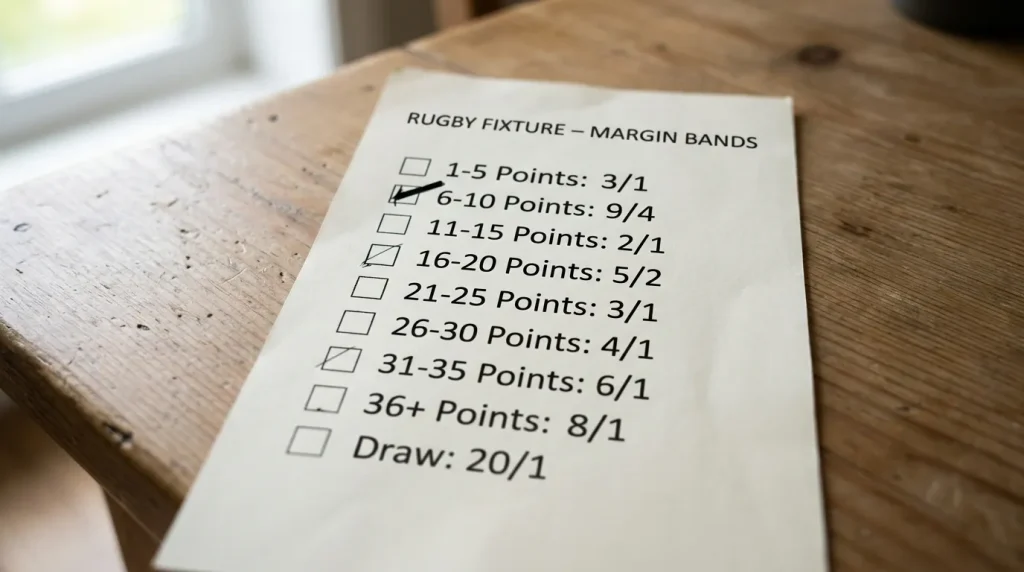
Why winning margin sits between handicap and exact score
If the handicap line is rugby betting’s broad brushstroke and the correct-score market is its surgical scalpel, the winning margin market is the screwdriver in the middle of the toolkit. It does a specific job that neither of the other two does well. It asks you to pick not just who wins, but roughly by how much, and the prices it pays are noticeably better than the equivalent handicap because the question is harder.
I have used the margin market most often when I have a strong directional view on a match but cannot quite commit to the handicap. A favourite I think will win comfortably but not crush the underdog, an underdog I think will keep it close but probably lose by single digits — these are the spots where the margin bands let me price the bet to my view rather than to the bookmaker’s preferred line.
How margin bands are structured
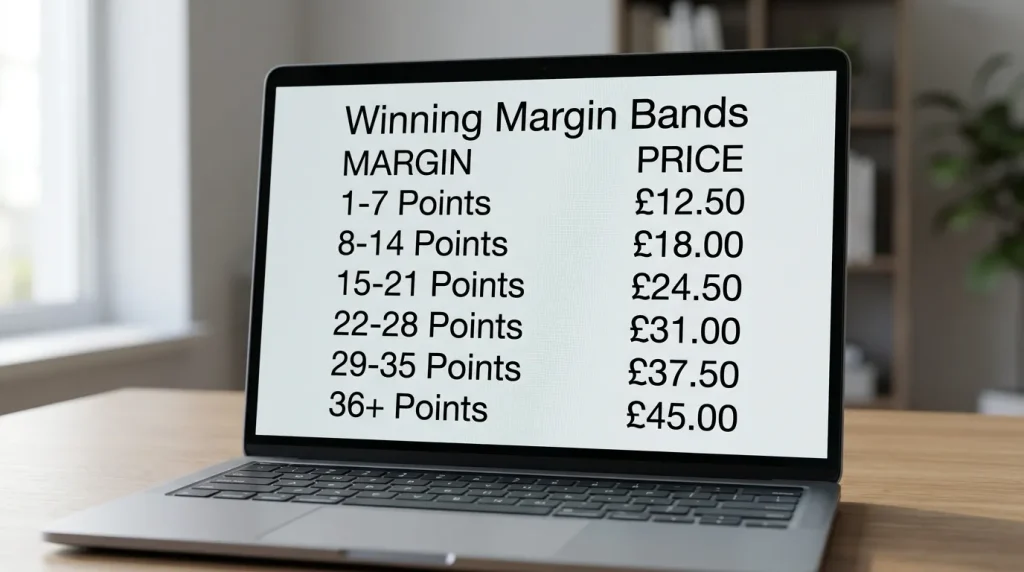
The margin market is divided into bands rather than exact numbers. A typical UK rugby winning margin coupon shows ranges like “Team A by 1-12”, “Team A by 13-24”, “Team A by 25-plus”, and the mirror image for the other side. Some sites slice the bands more finely, with three- or five-point intervals at the close end and wider ones further out.
The bands cluster around the bookmaker’s projected margin. If the trader’s model spits out a 12-point expected margin for the favourite, the priciest band — the one most likely to settle — will be the one straddling 12, typically “favourite by 8-16” or similar. The bands either side of that one are less likely but still meaningful. The bands way out at the extremes are long-shot prices that only land in blowouts or upsets.
Pricing the bands is mathematically harder than pricing a handicap line because the book has to assign probability mass to each interval, and the probability has to sum to one across the whole market. That accounting is why margin bands pay better than handicaps. The bookmaker is breaking a single binary outcome into seven or eight intervals and has to overround across all of them. Some bands end up overpriced relative to their true probability, particularly the middle ones, and those are where the value lives.
Margins in union vs league: typical bands
Rugby union and rugby league use different band structures because their scoring patterns differ. Union margins are usually banded in increments of about 6-7 points because each converted try is worth 7. League margins are banded in increments of about 6 because each converted try is worth 6.
The practical effect is that union margin bands cluster around try-multiples. A Premiership match priced with the favourite at “1-12” is asking whether the favourite wins by zero, one, or two converted tries’ worth of margin. The “13-24” band asks for between two and three converted tries of margin. The boundaries are not arbitrary; they sit on the natural scoring intervals of the sport.
The Premiership in 2024-25 ran 90 matches with 714 tries between them — 7.9 tries per match on average. That high try volume means most matches settle within bands that go up to 24 points. Margins above 24 are unusual in week-to-week Premiership rugby and only become common in big mismatches.
The Champions Cup in 2024-25 averaged 7.71 tries per match across 63 fixtures, with top finisher Damian Penaud crossing for 14 tries across the season. The variance is wider than the Premiership because Champions Cup matchups can be between top French sides and second-tier visitors. Margin bands in the Champions Cup spread wider than in the Premiership for the same reason. The big bands — by 25-plus, by 35-plus — pay better in the Champions Cup than they would on a domestic-league weekend.
Finding value in mid-range margin bands
The middle bands are where I look first. The narrow extremes — “by 1-7” and “by 25-plus” — are well-priced because they are the bands punters reach for: the close-game band and the blowout band. Bookmakers know punters love both of those scenarios and price accordingly.
The mid-range bands — “by 8-14” or “by 15-21” — are often relatively overpriced because they are emotionally unsatisfying to bet. They do not pay the long-shot odds of the blowout and they do not have the romance of the upset. They sit in the boring middle, and punter money does not flow to them at the same rate. The trader still has to balance the book, so the middle prices end up slightly more generous than the model strictly requires.
The way to test this is to take the mid-band price, compute its implied probability, and compare it against your own estimate of where the match will settle. If the mid-band on the favourite is paying 3/1 — implied probability around 25 per cent — and you think the most likely outcome is the favourite winning within that band, you are getting a bet at the modal outcome of the match priced as a long shot. That is the spot where margin betting earns its keep.

The honest caveat is that you need a strong view on the match to bet margin bands profitably. The bands are narrow enough that being roughly right is not good enough; you need to be specific. A view that says “the favourite wins comfortably” is not enough to pick a band. A view that says “the favourite wins by two converted tries, probably 14 to 17 points” is the kind of specificity the market rewards.
Settlement edge cases — penalty try, dead-ball
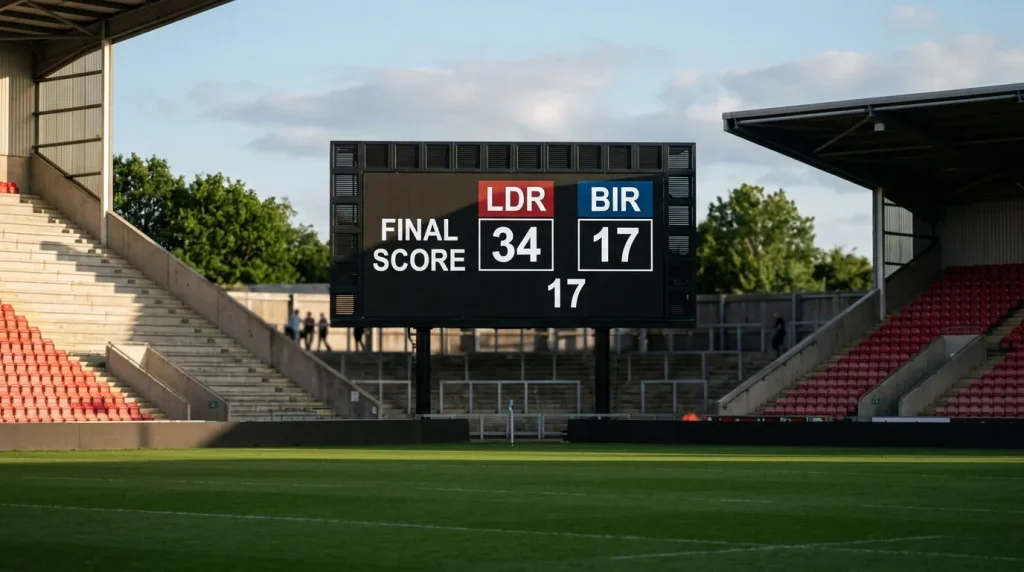
The margin market settles on the final scoreline. Whatever appears on the scoreboard at the final whistle is the margin used to determine the winning band. That sounds clean. It mostly is, but rugby produces edge cases.
A penalty try is awarded by the referee and credited to the attacking team as seven points in union or six plus an automatic conversion in league. The points count toward the margin in the normal way. Unlike the first try scorer market, where penalty tries cause settlement quirks, the margin market does not care who scored the try. It cares only that the points are on the board at the final whistle.
A draw is its own settlement question. Most UK sites offer a specific “draw” option in the margin market and you have to back it explicitly. A “favourite by 1-12” bet does not settle as a winner if the match ends level. If the site does not show a draw option, the market is settled by the rules of the underlying competition — usually the draw is treated as no-margin and bets on either side’s margin bands settle as losers.
Stoppage-time scores are the trickiest. Rugby allows play to continue until the ball goes dead after the 80 minutes have elapsed. A try in the eighty-third minute is a legal try and counts toward the final scoreline. Margin bets settle on the actual final score, including any stoppage-time scores. If your bet on “favourite by 8-14” was looking good at the 80-minute mark with the favourite leading by 11 and the underdog scores a late try to close the gap to 4, you have lost the bet on the score being outside your band.

Settlement timing on margin bets is usually within minutes of the final whistle once the result has been confirmed by the competition’s official record. Stake is returned only if the match is abandoned without an official result.
Building margin reads into a Saturday coupon
The way I use margin most often now is as a sharpener on a view I would otherwise express through the handicap. If I think the favourite is going to win by between 8 and 14 points and the handicap line is set at minus 9.5, the handicap pays roughly even money for what I expect to be a fairly likely outcome. The margin band for “favourite by 8-14” pays 3/1 or so on the same matches. The trade-off is real — I am betting a narrower outcome and accepting more variance — but the price uplift makes the calculation easier than the handicap.
Once you start reading margin bands fluently, the handicap stops looking like a stand-alone bet and starts looking like one slice of a broader margin distribution. You can use margin to express views the handicap cannot reach, and you can use the handicap to express views the margin cannot price cleanly. Together they are a stronger toolkit than either alone, and a Saturday coupon that uses both will pay more reliably than one that bet the handicap on every fixture.
The margin market is a thinking punter’s bet. It rewards specific reads on matches and punishes vague directional views. The bands themselves carry information about where the bookmaker thinks the match will settle, and reading the prices across the bands gives you a probability map of the match that the handicap line cannot match. For punters who want to keep pushing into score-specific reads beyond margin bands, the next step in the same vein is the bonus-point market and totals interplay, which is where rugby total points over under picks up the story.
Are margin bands wider for league than union?
They tend to be slightly narrower in league because league scoring increments are 6 points versus 7 in union, so the structural scoring intervals are tighter. The total variance of league scores is also tighter for closely matched sides, which means league margin coupons usually offer more bands within the typical 0 to 30-point range than union coupons do.
Does a draw settle as the smallest band or as a separate market?
A draw is treated as a separate market on most UK rugby sites. You have to back the draw explicitly; the closest margin bands for either side do not settle on a level scoreline. If the site does not show a draw option, bets on either side"s margin bands settle as losers when the match ends level.
Articles
Prepared by the Rugby Betting Sites editorial staff.
