
Welcome Bonuses for Rugby Bettors — Reading the Small Print
 Available in US
Welcome bonuses framed by what they cost the punter
The first welcome bonus I ever claimed was £200 deposit-match on a site that no longer exists, on a Saturday in 2014, ahead of an autumn international. I went through the motions of placing qualifying bets, watched £200 in bonus credit appear in my account, and discovered over the following month that the bonus could not be withdrawn without satisfying a wagering requirement that would have taken me through the entire rugby calendar. The bonus expired with most of it still locked behind the rollover. I got the lesson everyone gets.
Welcome bonuses are not gifts. They are structured promotional products with measurable costs to the punter — costs that include the time spent satisfying wagering requirements, the risk of losing the qualifying stake before the bonus pays out, the friction of identity verification, and the opportunity cost of capital tied up in a site where you might not stay long. The right way to evaluate a welcome bonus is to compute its real cash value to you, not its headline face value. Grainne Hurst, chief executive of the Betting and Gaming Council, has argued that “raising taxes further now on regulated betting and gaming through a new single tax would be utterly self-defeating for the Government, while making a mockery of their growth strategy,” and the welcome bonus market is part of how the regulated UK sector competes for the customers who fund that growth.

Deposit match vs bet-and-get on rugby
There are two structural shapes a UK rugby welcome bonus can take, and the difference between them is the difference between an offer that scales with how much you deposit and an offer that pays a fixed amount for a fixed action.
Deposit-match offers match your first deposit up to a published limit. Deposit £100, get £100 in bonus credit. The bonus credit usually carries a wagering requirement — typically 5x to 10x the bonus amount — that must be cleared before any bonus or bonus-derived winnings can be withdrawn. The maths is unforgiving. A £100 bonus at 8x wagering requires £800 of qualifying bets at minimum odds before withdrawal becomes possible. Across rugby coupons, that is several weeks of moderate-sized betting, and the expected loss on £800 of qualifying bets at typical bookmaker margins is around £40 to £50. So the £100 deposit-match has an underlying real cash value closer to £50 than £100, before you factor in any losing bets that eat into your starting stake.
Bet-and-get offers pay a fixed reward for a fixed qualifying action. Place a £10 bet at minimum odds, get £30 in free bets. The qualifying bet is real money that can be won or lost. The free bets are stake-not-returned tokens with their own conversion rate of roughly 70 per cent. So a “£30 in free bets” offer has an underlying real cash value closer to £21, less the expected loss on the £10 qualifying bet (around 50p at fair odds, but often more because punters tend to place qualifying bets at conservative prices).
The real-event betting market in the UK generated £596 million in gross gambling yield in Q1 2025, and welcome bonuses are part of how UK sites compete for that volume. Both deposit-match and bet-and-get structures are common, with bet-and-get becoming the more dominant structure in recent years because it is simpler to communicate and easier for punters to understand.

Qualifying odds, eligible markets and rugby-specific limits
The terms of a welcome bonus are usually published clearly but are rarely read closely. The terms that matter most are qualifying odds, eligible markets, and any rugby-specific restrictions.
Qualifying odds are the minimum price at which your qualifying bet must be placed. The standard UK minimum is 1/2 (1.5 in decimal), with some offers requiring evens (2.0) or higher. The minimum is set to prevent punters from satisfying the wagering requirement on heavy favourites at trivial prices. A £10 qualifying bet at minimum 1/2 odds is a bet with an implied probability of 66.7 per cent — it loses one time in three. The minimum odds are not arbitrary; they are calibrated to make the qualifying step a meaningful risk.

Eligible markets restrict which bets count toward the qualifying requirement. Some welcome bonuses exclude in-play markets, exclude bet builders, exclude accumulators, or require single bets only. Rugby-specific restrictions are rarer but they exist — a few UK sites exclude rugby Sevens from their welcome bonus qualifying markets, and a minority exclude women’s rugby. Read the eligible-markets clause for your specific site before you assume any rugby bet qualifies.
Time windows on welcome bonuses are usually generous compared to free bets. Qualifying bets must usually be placed within 14 to 30 days of account creation, and bonus credit must be wagered within 30 to 60 days of being credited. Both windows can be tight if you are not actively using the account, and bonus credit that expires unspent does not roll over.
How to compare two welcome bonuses on true value
Two welcome bonuses with the same face value are not the same product. The comparison that matters is real cash value to you after the friction.
The framework I use is straightforward. Start with the headline value. Apply the structural conversion rate — 70 per cent for stake-not-returned free bets, lower for deposit-match offers with significant wagering requirements. Subtract the expected loss on the qualifying bets. Subtract a fixed friction cost for the time spent verifying and setting up. The number you arrive at is the real cash value of the offer.
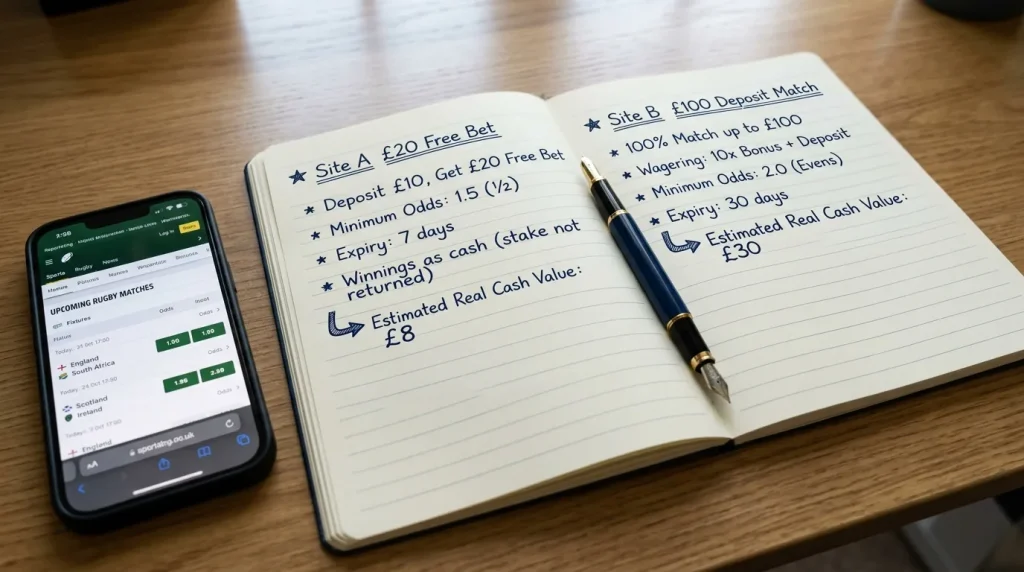
Worked example. Site A offers a £20 free bet for a £10 qualifying bet. The free bet is stake-not-returned, so its conversion value is about £14. Subtract the expected loss on the £10 qualifying bet (around £0.50 at fair odds). Real cash value: roughly £13.50. Site B offers £100 deposit-matched. The bonus has 6x wagering. The implied conversion value is around £40 after expected losses on the wagered amount. Real cash value: roughly £40. Site B has higher real value but requires more capital and more time to extract. The decision depends on whether you have the capital and the time.
The other axis is what happens to your money in the meantime. The £100 you deposited at Site B is locked in the wagering cycle until you clear it. If you would have used that £100 elsewhere — at a sharper site with better margins, on a specific bet you wanted to place — the opportunity cost is real and should be subtracted from the bonus value.
Rebate-style offers and “money back as a free bet”
Rebate offers are a third category of welcome promotion that has become more common at UK sites in recent years. They are not strictly welcome bonuses but they are often presented alongside welcome bonuses and combine well with them.
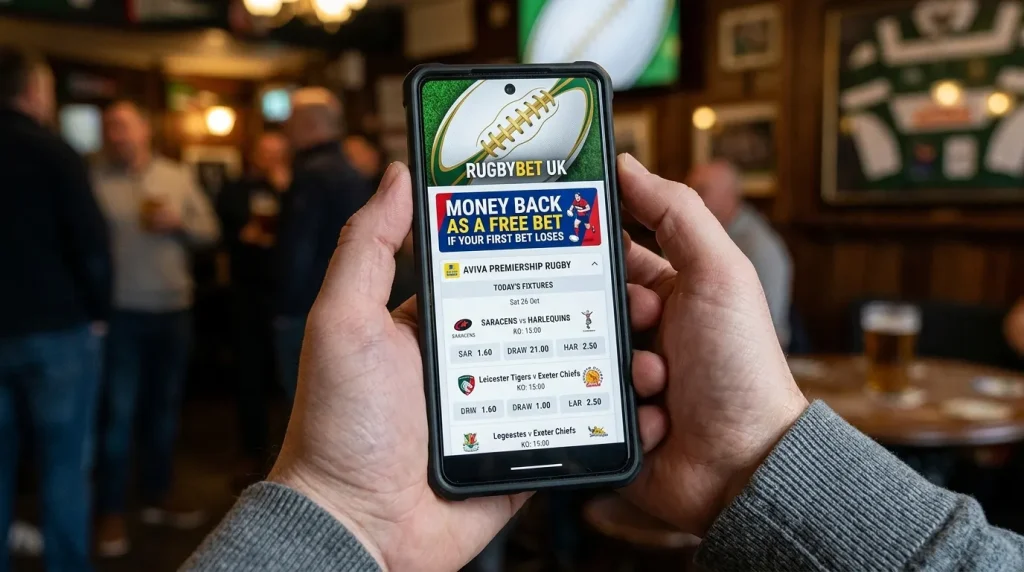
The standard rebate is “money back as a free bet if your first bet loses.” You place your first bet for real cash. If it wins, you collect the winnings as cash. If it loses, the stake is refunded as a free bet up to a published limit. The structure favours punters who are confident in their first selection because the upside is real money and the downside is a free bet rather than a total loss.
The economics work because the free bet has the standard stake-not-returned conversion rate of 70 per cent. A £20 rebate offer has a real value of around £14 if your first bet loses, plus the full winnings if your first bet wins. Across a sample of first bets at typical UK rugby prices, the expected real value of the offer is somewhere between £4 and £8 depending on the price you take.
Some sites combine rebate offers with a deposit-match welcome bonus, layering one on top of the other. The combination can produce real cash values noticeably higher than either offer alone, but the wagering and time costs also stack. Layered offers are worth taking only if you would have used the account anyway.
A useful frame for comparing layered offers is to think of each component as a separate decision. The rebate is one bet’s worth of insurance. The deposit-match is a capital allocation with a wagering requirement. The free bet token is a small bonus on top. Add them up, subtract the costs, and compare against the next best alternative.
If you have already evaluated the free bet half of these offers and want to compare them against price-boost promotions instead, the cleanest comparison sits in enhanced odds and price boosts on rugby, where the same valuation logic applies but the trade-offs are different.
The discipline welcome bonuses demand
Welcome bonuses are at their most useful when they fund a single bet you would have placed anyway. They are at their most destructive when they pull you into wagering volumes you would not otherwise have considered, on markets you do not know well, at sites you do not intend to use beyond the bonus.
The discipline I recommend, drawn from too many years of seeing it ignored, is to plan the welcome bonus before you claim it. Pick the bet you would place anyway. Identify the site whose welcome bonus best matches that bet’s qualifying odds. Open the account, place the bet, and treat the bonus credit as a one-off windfall to be used and forgotten. The trap is treating the bonus as a reason to bet, rather than as a discount on bets you were going to place.
The bonuses I have actually converted to meaningful cash over the years are the ones where I planned the qualifying bet a week before opening the account. The ones I have lost have been the spontaneous ones, where I claimed the offer because the offer existed. The discipline is in deciding the bet first and selecting the bonus that fits it, not the other way around.

Why are deposit-match bonuses rarer in the UK now?
Deposit-match bonuses with significant wagering requirements have come under regulatory pressure as UK sites have moved toward simpler, more transparent promotional structures. Bet-and-get offers are easier for punters to understand and easier for the bookmaker to communicate, and the UKGC has been clearer about what counts as misleading promotional language. The result is that deposit-match offers are still available but are positioned alongside bet-and-get offers more often than as standalone welcome products.
Are welcome bonuses restricted from rugby markets at any UKGC site?
Most UKGC sites allow welcome bonuses to be used across rugby markets including Union and League, with the standard market-eligibility restrictions applying — usually excluding bet builders or in-play depending on the site. A small number of sites exclude rugby Sevens from welcome bonus eligibility, and a minority exclude women"s rugby. Read the eligible-markets clause for your specific site before staking, since the restrictions are published per offer rather than per site as a whole.
Articles
Created by the "Rugby Betting Sites" editorial team.
