
Enhanced Odds and Price Boosts on Rugby Markets
 Available in US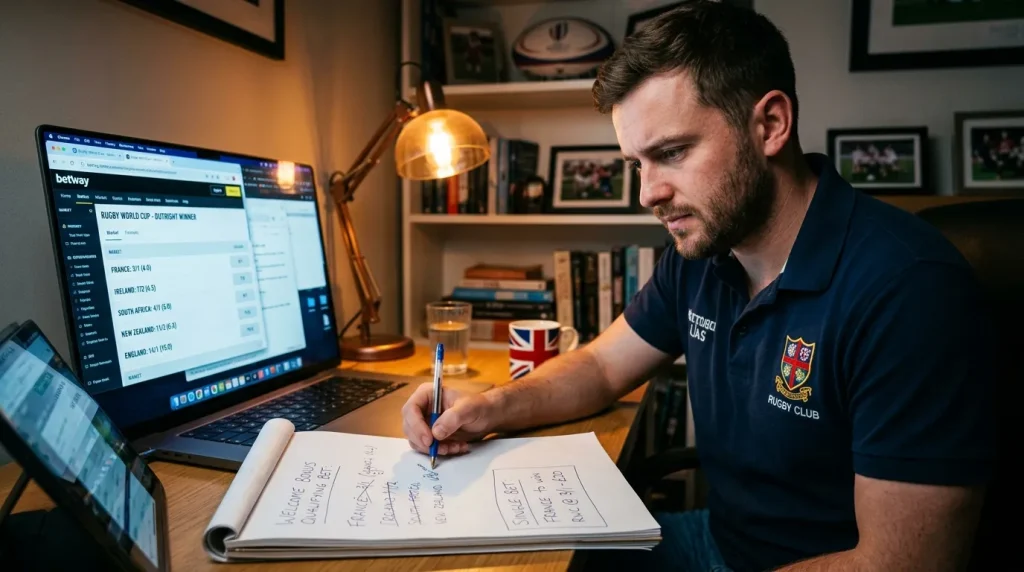
The promotion that convinced me boosted prices are not always a gift
The first time I clicked an enhanced odds tile I felt smug. A 7/4 line on Bath to beat Saracens had been pushed up to 5/2 with a red flame icon next to it, and I stuck a tenner on without checking anything else. Bath lost by twelve. The lesson I took from that Saturday was simple — a boost is a marketing tool first and a value indicator second, and the people who win consistently treat it that way.
Nine years of staking has taught me that price boosts and enhanced odds work brilliantly when the underlying selection is already a sound bet. They are dangerous when they are the reason for the bet. The difference between those two scenarios is the entire game, and most of this article is about how I tell them apart in under sixty seconds.

What an enhanced price actually is
A price boost is an operator lifting a market above its true probability for promotional reasons. The maths is straightforward. If a flat 7/4 implies roughly a 36 percent chance, a boosted 5/2 implies 28 percent. The operator has handed back about eight percentage points of margin on that single selection — which, if you had already decided the selection was worth backing at 7/4, is genuinely free value.
The catch is that boosts cluster around heavily marketed fixtures. Six Nations Super Saturday, the Premiership final, England-South Africa autumn tests — these draw promotional spend because they draw stakes. Quieter fixtures with thinner liquidity rarely get boosted, and those are often where the sharpest non-promotional prices sit. So boosts skew your attention towards the loudest fixtures rather than the ones where you have a genuine edge.
How I check a boost before I touch it
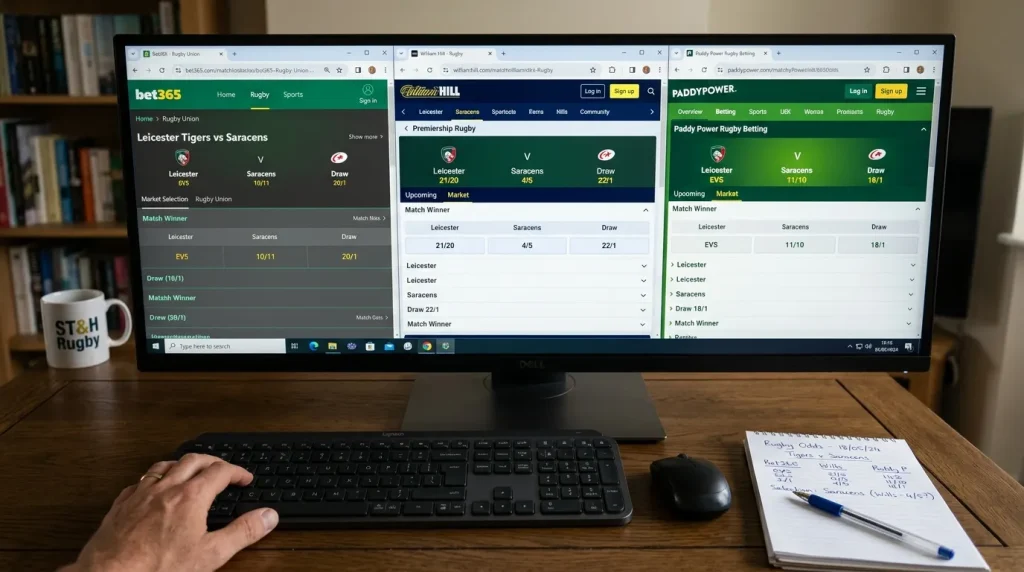
My routine takes maybe forty seconds per offer. First I open two other operator pages side by side and check the flat market on the same selection. If the boosted price is meaningfully above the best non-promotional alternative across three or four books, the boost is real value. If it is only a fraction above, the operator has just inflated their own slightly shaded line back to fair value — which is fine, but it is not a giveaway.
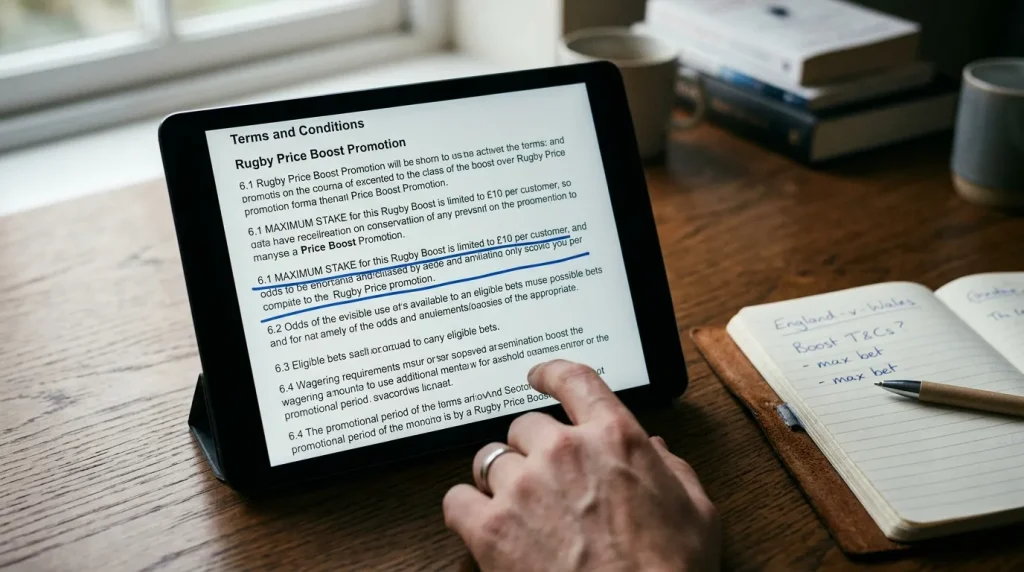
Then I look at maximum stake. A 5/2 boost capped at five quid returns twelve fifty profit, which is a poor reward for the time spent verifying it. A boost capped at fifty or a hundred is worth a proper look. Stake caps tell you how confident the operator is about the price — generous caps usually mean they have priced it close to where they think it should be anyway.
Finally I ask whether I would have backed the underlying selection at the flat price. If the answer is no, the boost does not matter. A bad bet at 5/2 is still a bad bet. A boost is not a reason — it is a bonus on top of a reason that already existed. This same logic applies to best odds guaranteed promotions, which I rate as one of the more useful concessions UK books offer.

The seven try threshold and where boosts cluster
Premiership rugby produced 714 tries across 90 matches in 2024/25 — an average of 7.9 tries per game. That single number is responsible for an enormous share of all rugby boost activity. Books boost over 6.5 tries lines, over 7.5 tries lines, both teams to score three tries, hat-trick scorer markets, anything that touches the try count. They do it because casual punters look at a 7.9 average and see over 6.5 as money in the bank.
It is not money in the bank. The 7.9 average hides huge variance. Some Premiership weekends throw up four matches with 35 points apiece. Others see Saracens-Sale grind out 18-14 in pouring rain. A boost on over 7.5 tries in Round 14 of the league is essentially a weather and team-news bet, not a statistical layup. I rarely take try-count boosts without checking the Met Office and the team sheets.
Acca boosts and the percentage trap
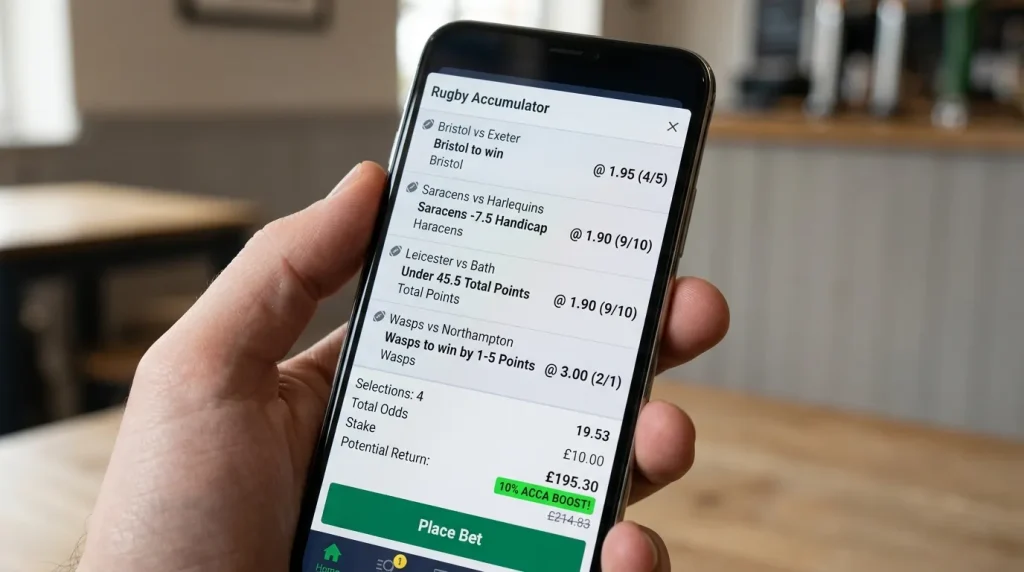
Accumulator price boosts are a different animal. The standard offer is a percentage uplift on the final payout — five percent for a four-fold, ten for a five, fifteen for a six, scaling up to forty or fifty percent for eight-plus selections. The numbers look generous and the percentage stacking creates the impression that bigger accas equal better value.
This is the trap. An eight-fold acca with a fifty percent boost still needs all eight legs to land. If each leg has a 70 percent chance, the overall hit rate is around 5.8 percent. The fifty percent boost lifts your expected return, but it does nothing to make the bet hit. I treat acca boosts as a small bonus on accas I would have placed anyway — usually two or three legs, occasionally four, almost never more.
The free bet token versus cash boost question
Some operators pay boosts as cash. Others pay the standard price in cash and the boost portion as a free bet token. The distinction is important. If a 7/4 selection wins at a boosted 5/2 and the boost is cash, a tenner returns thirty five quid in withdrawable funds. If the boost is a free bet token, you get twenty seven fifty in cash plus a seven fifty token that you have to stake again and probably lose half of.
The effective value of a free bet token is usually 65 to 75 percent of its face value, because you cannot withdraw the stake and you tend to use tokens on longer-shot punts. So a free bet boost is worth meaningfully less than a cash boost of the same headline number. Always check the terms before the click — the smallprint difference can wipe out the entire boost.
Where boosted prices genuinely help me
The cleanest use case is when I have already done the work on a selection and I am about to bet at the best flat price I can find. If a boost takes that price up another tick or two and the cap is reasonable, I take it. The work is already done — the boost is a tax-free uplift on a decision I would have made anyway.
The second use case is correcting an operator who has shaded a line. Sometimes a book will price a clearly underrated team at 9/5 when the consensus elsewhere is 13/8, then boost it back to 7/4. That boosted price matches the market, and it is the same operator essentially admitting they had it slightly wrong. Taking the corrected price is sensible — just do not pretend it is generosity.
The temptation discipline angle
The genuine downside of boost culture is that it manufactures urgency. A red flame icon, a countdown timer, an “ends in 2 hours” banner — none of these features exist to help you make a better decision. They exist to make you act before you have thought. Every boost I have placed reflexively over nine years has lost money in aggregate. Every boost I have placed deliberately has at least broken even.
I keep a single rule for this. If I cannot say in one sentence why the underlying selection is worth backing, the boost does not get clicked. Not after waiting, not after thinking, not at all. The urgency is the signal — when an operator wants you to act fast, slowing down is almost always the right response.
When I deliberately ignore boosts
I skip boosts on first try scorer markets nearly all the time. The variance is too high and the boosted price still implies a probability that does not survive a quick check against the actual try-scoring distribution at the position involved. I skip boosts on Six Nations outright markets entirely — those prices move on team news in the 24 hours before kick-off, and a boost set on Wednesday is often stale by Saturday.
I also ignore any boost that requires a specific minimum stake. A boost at 5/2 with a five quid minimum is not a boost, it is a hook. The minimum stake exists to make sure the operator gets enough action to justify the price. Real value does not need a floor.

Reading the boost landscape over a season
Promotional spend ramps up around the same fixtures every year. Six Nations launches in early February, the European Champions Cup quarter-finals in April, Premiership semi-finals in early June, autumn internationals from late October. If you map a year of UK rugby boosts you will see clear clusters around those windows and gaps in between.
The gaps are where I find non-promotional value. Round seven of the URC on a wet Friday in March attracts almost no boost activity, which means the flat prices have to compete on their own merits. Books that want action there have to offer a sharper line by default. The boost season is loud, but the quiet season is where the real edges live.
Sustaining a boost discipline through a full year
I track every boost I take in the same spreadsheet I use for normal bets. Stake, flat price elsewhere, boosted price, outcome. After two years the pattern was unmistakable — boosts I researched returned slightly positive expected value, boosts I clicked impulsively returned slightly negative. The total volume balanced out to roughly break even, which is what most promotional offers are designed to achieve from the operator’s side.
The point of the tracking is not to optimise the boosts themselves. It is to make sure I am not lying to myself about whether they are working. Most punters who think they win on boosts have not actually checked. Most who check are surprised by the answer. Either way, knowing where you stand is worth far more than any individual boost ever pays out.
Are enhanced rugby odds genuinely better value than standard prices?
They are when the boosted price sits clearly above the best non-promotional alternative across multiple books and the stake cap is meaningful. They are not when the boost only matches or marginally beats the flat market — that is the operator correcting their own shaded line rather than handing back value.
Should I always take a price boost if it is offered?
Only if you would have backed the underlying selection at the flat price. A boost is a bonus on a good decision, not a reason to make a decision. If the boost is the only thing making the bet attractive, it is almost certainly not value.
What is the difference between a price boost and best odds guaranteed?
A boost lifts a price above its standard line before the event. Best odds guaranteed protects you against the starting price moving against you between bet placement and the off — you get the higher of your taken price or the SP if the selection wins.
Articles
Written by the editors at Rugby Betting Sites.
