
Rugby Handicap Betting Explained — Reading the Line on Mismatched Sides
 Available in US
What a handicap solves when one side is heavy favourite
The first rugby handicap I ever bet on was an England side travelling to Rome in the early days of my career, and the price on the win was so short it barely covered the trip to the bookies. The handicap line, though, was alive. That was the moment the concept clicked for me, and it is the moment I want to start with for anyone reading this with the same suspicion that 1/14 on an outright is a trap dressed up as a certainty.
A handicap exists because the bookmaker has a problem. When one side is dramatically stronger than the other, the straight win market collapses into prices nobody wants to back — short for the favourite, useless for the underdog. So the book invents a virtual scoreline. The favourite starts the bet on minus points, the underdog on plus points, and your wager is settled against that adjusted total rather than the real one on the screen. The match itself does not change. The maths around it does.

For UK rugby punters this is bread and butter. Real-event betting on UK sportsbooks generated a £596 million gross gambling yield in the first quarter of 2025, and a sizeable chunk of that comes from handicap lines on union and league fixtures that would otherwise produce dead-money win markets. If you bet rugby on a UKGC-licensed site, the handicap is often the most interesting line on the coupon.
How a bookmaker builds the rugby handicap line
I once asked a trader from a UK firm how he arrived at a handicap number. He said it was equal parts model, market and gut, then refused to elaborate. The honest answer is that a handicap line is built from three layers stacked on top of each other, and once you see the layers you can read any line on any coupon.
The base layer is the projected scoring margin. The trader runs a model that estimates how many points each side will score, factoring in attack and defence ratings, recent form, home advantage and the strength of the bench. Subtract one from the other and you have a projected margin. If England are forecast at 32 and Italy at 14, the projected margin is 18 points. That is the centre of gravity for the line.
The second layer is liquidity and risk. Bookmakers do not set the line at the projected margin; they nudge it half a point or a full point toward the side that will attract less money. On a high-profile match, that nudge can shift a line from minus 17.5 to minus 18.5 simply because they expect heavy backing on the favourite. The third layer is overround — the margin baked into both sides of the price so the book makes its cut regardless of which way the bet goes.

The Premiership in 2024-25 ran 90 matches with 714 tries between them, an average of 7.9 tries per game, and that scoring rate is what gives club rugby its tighter handicap profile than internationals. When sides know each other twice a season and the gap between top and bottom is narrower than in test rugby, the model spits out smaller margins and the line follows.
Reading the numbers — pluses, minuses, the .5 trick
Here is the part where people who have never bet rugby get nervous and people who have bet football get cocky and lose money. The numbers look simple. They are not.
A minus number sits next to the favourite. If the line is England minus 12.5, your bet on England wins only if England win the actual match by 13 points or more. A plus number sits next to the underdog. Italy plus 12.5 means your bet on Italy wins if Italy lose by 12 points or fewer, draw, or win outright. The handicap is added to the real score at settlement, then the book checks who is in front on that adjusted scoreline.

The half-point — the .5 trick — is doing serious work. A line of minus 12 is not the same animal as minus 12.5. If the line is a whole number and the favourite wins by exactly that margin, the bet pushes and your stake is returned. If the line is .5, no push is possible. Every fixture settles with a clean win or a clean loss for your bet. UK bookmakers usually default to .5 lines on rugby precisely because they hate the messiness of returned stakes on big fixtures.
When you see two prices that are not 10/11 and 10/11 on either side of the line, it tells you something. A line of England minus 12.5 priced 4/5 / 1/1 says the book is slightly more wary of England covering than not. That is not an invitation to back England. It is an admission the book is nervous, and that nervousness is usually informed.
Alternative handicaps and asian-style lines on rugby
The first time I saw alternative handicaps on a Premiership coupon I assumed they were a gimmick. They are not. They are the most useful tool a thoughtful rugby punter has for shaping a bet to a specific scenario.
An alternative handicap shifts the line away from the main quote and adjusts the price to compensate. If the main line on a fixture is Bath minus 14.5 at evens, you might find Bath minus 9.5 at 1/2, Bath minus 19.5 at 6/4 and Bath minus 24.5 at 5/2. You are buying a different scenario at a different price. A short, certain Bath win pays less. A blowout pays more.
What looks like an Asian-style line on rugby is usually a quarter line — minus 13.0 split between minus 12.5 and minus 13.5 so half your stake goes on each. If the favourite wins by exactly 13, half your bet wins at the 13.5 line and the other half pushes at the 12.5 line. UK sites that come from spread-betting heritage tend to offer these. Most mainstream books do not. The presence of quarter lines is a quiet signal that a site takes rugby seriously enough to invest in pricing detail.
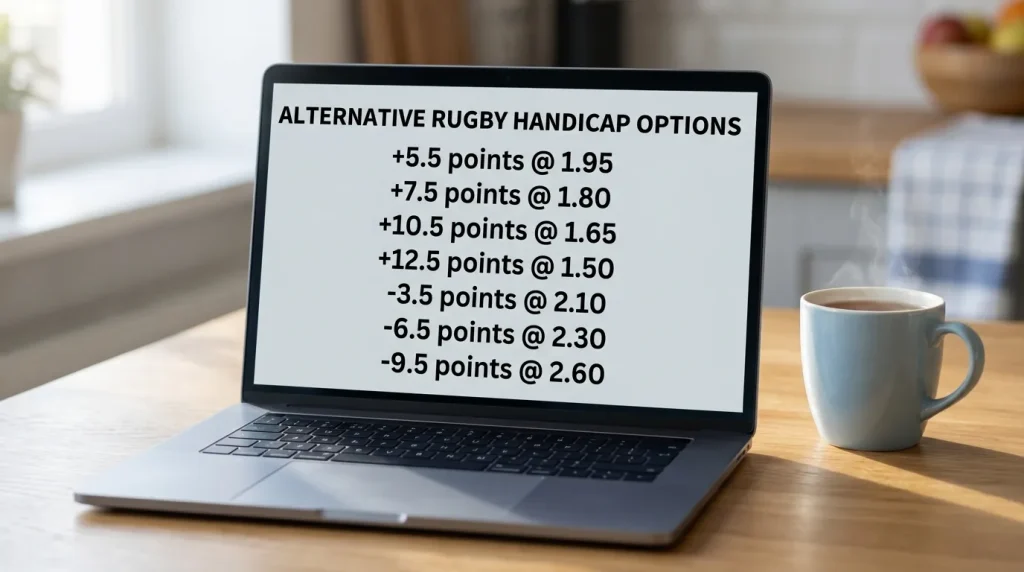
Where alternative handicaps earn their keep is when you have a directional view but not a precise one. You think the favourite wins by a lot, but you are not sure if a lot means 16 or 26. You take the alternative line a few points further out than the main quote, accept the shorter price, and you have priced your view rather than the book’s.
Common pitfalls UK punters fall into on rugby handicaps
I have lost money on rugby handicaps in every way it is possible to lose money on them. Let me save you some of the rounds.
Pitfall one is treating the handicap as a separate event from the win market. The favourite wins more matches than they cover. A line is set roughly where the trader thinks 50 per cent of outcomes fall on each side, which means the underdog covers the spread in something close to half their fixtures even when they almost never win outright. If you bet a handicap because you “fancy” the favourite, you are betting the win market with extra steps and worse value.
Pitfall two is ignoring the bonus point. A four-try bonus point in rugby union, or a try-difference rule in league, can keep a losing side pushing late into the match for reasons that have nothing to do with covering your handicap. A favourite leading by 14 with five minutes left will often empty the bench, take field position over points and let a soft try slip. That is your minus 14.5 evaporating in stoppage time, and it has happened to me more times than I will admit.

Pitfall three is misreading conditions. Wind, rain and a tight referee compress scoring. A handicap built in a model that did not see the Met Office forecast is a handicap waiting to be taken on the underdog side. UK rugby is played in November and February for a reason no Australian visitor ever understands. Check the weather before you back the favourite to cover by twenty.
Pitfall four is chasing the alternative handicap because the price is bigger. The shorter the price, the more often it lands. The longer the price, the more often it does not. The alternative handicap is not a value generator on its own. It is a tool, and you have to bring your own view to it.
If you want to combine a handicap with another market on the same fixture, the natural next step is the rugby bet builder, where you can pair the handicap with a try-scorer or a total-points line and watch the price stack up. That is where handicap betting stops being a stand-alone bet and starts being a building block.
Where the handicap takes you next
Once you read handicap lines fluently, you start to see them everywhere. The Champions Cup quarter-final at home, the Six Nations Saturday night that everyone has written off, the URC midweek game where one side is missing internationals. The line tells you what the book thinks. Your edge is in disagreeing with conviction, sized by stake, priced by alternative lines.
Rugby handicaps reward patience. They punish punters who treat them as glorified win bets. Spend a season reading the lines, tracking how they settle against actual margins, and the .5 starts to make sense as a tax on certainty rather than a trick.
What does a -10.5 handicap mean in a rugby match?
A handicap of minus 10.5 means the team you are backing must win the match by 11 points or more for the bet to settle as a winner. The 10.5 is subtracted from their final score; if they still finish ahead, you win. The half-point removes any chance of a push, so the bet either wins or loses outright.
Why are international rugby handicaps usually wider than club ones?
International fixtures pair teams that meet only once or twice a year and often sit at very different points in the world rankings, so projected margins are larger. Club competitions like the Premiership average around eight tries per game with sides who play each other home and away, which compresses expected margins and produces tighter handicap lines.
Can a handicap bet push if the line is a whole number?
Yes. If the line is set at a whole number — say minus 10 — and the favourite wins by exactly that margin, the bet pushes and your stake is returned. UK sites default to half-point lines on rugby specifically to avoid pushes, but whole-number lines still appear on alternative handicaps and on smaller markets.
Articles
Written by the editors at Rugby Betting Sites.
