
Mobile Rugby Betting Apps — What UK Punters Actually Use Live
 Available in US
The Saturday I realised the desktop bet was the slow bet
Several years ago I placed an in-play bet on my laptop during a Premiership match and watched the price move twice between clicking “place bet” and the confirmation screen appearing. The bet went through at a worse price than displayed. The next live bet I placed on the same operator’s app from my phone settled instantly at the displayed price. The difference was not imagination — it was the underlying architecture of mobile-first betting platforms, optimised for exactly the moment-to-moment decisions that in-play betting requires.
The shift from desktop to mobile betting has changed how I work. Live streaming, real-time odds movement and same-screen bet placement have produced engagement metrics roughly 25 percent stronger than the previous desktop-dominant era. As one industry executive put it, “Mobile-first product development has been the single most important shift in the betting market over the past decade, and the gap between mobile-optimised and legacy desktop experiences has widened correspondingly.” For rugby specifically — where in-play windows are short, scoring events are decisive and the action flows quickly — the mobile app is now the default working tool rather than the alternative.
What separates the good apps from the rest
The genuinely good UK rugby betting apps share a set of features that the mediocre ones lack. Speed of loading, particularly during in-play. Speed of bet placement, with confirmation in under two seconds. Live streaming embedded in the app rather than requiring a separate window. Cash out that updates in real time and accepts at the displayed value. Bet builder construction that responds smoothly to selections being added and removed. Push notifications you can configure rather than blanket marketing dumps.

The mediocre apps have one or more of these features but not all. The bad ones are simply mobile-responsive versions of the desktop site, with all the friction of clicking through web pages on a small screen. Knowing the difference matters because the friction compounds over a season. An app that costs you a second per bet on 200 live bets adds up to lost opportunities and worse prices.
The in-play speed question
Live betting on rugby happens in windows. A try scored, a yellow card shown, a penalty kicked — each event triggers price adjustments that last seconds rather than minutes. The app that lets you see the new price, evaluate it, place the bet and get confirmation inside that window is the app that lets you actually bet in-play. Apps that take three to five seconds per step are not in-play tools, they are post-event tools that happen to be operational during matches.

The speed varies meaningfully across operators. I have tested most of the major UK apps during live fixtures and the gap between the fastest and slowest is genuinely several seconds per bet placement. For someone betting in-play with any frequency, choosing the operator on speed alone is a defensible strategy — the slower apps lose money through missed prices regardless of how good their other features are.
The live streaming integration
Live streaming integrated into the betting app changes the in-play experience entirely. Watching the match in the app, with the betting controls on the same screen, removes the need to context-switch between television and phone. The picture quality is usually adequate rather than excellent — bookmaker streams are not broadcast-grade — but the synchronisation with the betting line is the genuine feature, since the stream lag and the line update typically run together.
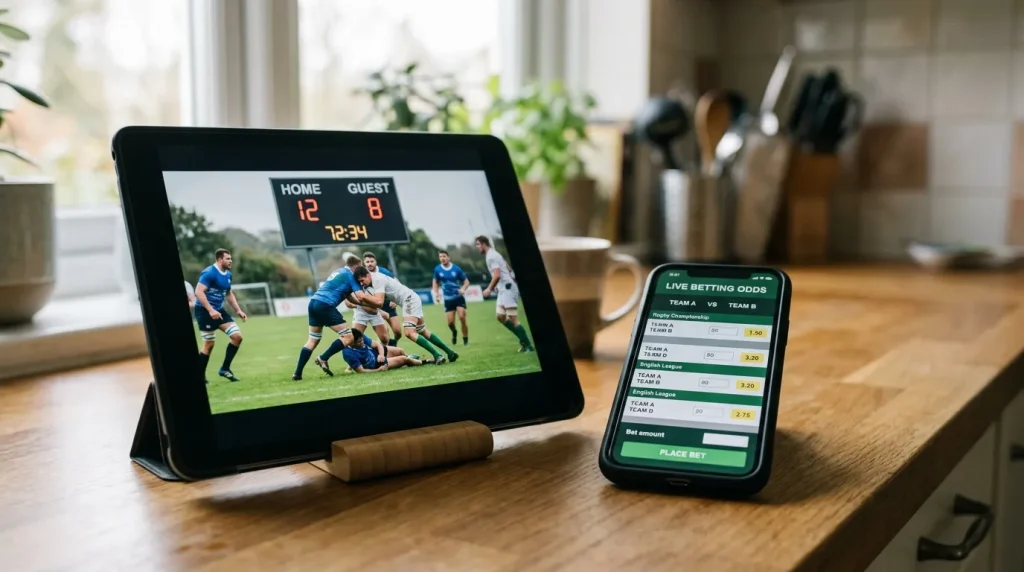
Geographical and rights restrictions mean not every match is available on every operator’s stream. UK punters generally get good coverage of Premiership, European competitions and international matches, with thinner availability for some URC fixtures and women’s rugby. Checking what is streamed before committing to an operator for a specific tournament is worth doing — the app may be excellent for one tournament’s coverage and limited for another’s.
Push notifications and the discipline question
Push notifications are useful when configured carefully and destructive when left on defaults. Score updates and team news for matches you have bet on are useful. Promotional notifications about boosted prices and welcome offers for matches you have not bet on are not. The discipline is configuring the app so that the notifications you receive serve your betting rather than the operator’s marketing.
I keep push notifications on for score updates and personal account changes only, with all promotional notifications turned off. The settings usually live in account preferences and the granularity varies by operator. The apps that let you turn marketing off cleanly while keeping operational notifications on are the apps that respect customer attention. The ones that bundle everything together as “all notifications” are the ones to avoid leaving notifications enabled on at all.
Bet builder construction on mobile
Bet builder workflows on mobile have improved dramatically over recent years. The best apps let you tap selections, see odds update in real time as you build, modify or remove selections with single taps, and place the resulting bet with the same speed as a single. The mediocre apps treat bet builder construction as a multi-step process with reloads between steps, which makes complex bet builders impractical in the time windows where you would want to construct them. The mechanics of bet builder construction work best on the apps that have invested in this workflow specifically.

The depth of bet builder markets available on mobile usually mirrors desktop, but the discovery is different. Browsing 50 available markets on a phone screen is awkward compared to scrolling on desktop. The apps that organise bet builder markets sensibly — by category, by popularity, by recent action — make the construction process workable. The ones that present them as an undifferentiated list make it tedious.
Cash out responsiveness
Cash out is the feature that depends most heavily on app quality. A good cash out implementation updates the offered value continuously, accepts at the displayed value reliably, and processes the acceptance instantly. A poor implementation shows stale values, fails to accept when prices move, and processes acceptances slowly enough that the customer is uncertain whether the cash out succeeded.

The variability across operators on cash out is genuinely large. I have used apps where cash out works essentially perfectly across hundreds of executions and apps where the experience is unreliable enough that I stopped using cash out on that operator altogether. The feature is enough of a differentiator that some bettors choose their primary operator based on cash out quality specifically, and the choice is defensible given how much late-match value the feature can capture or lose.
Safer gambling tools inside apps
UKGC licensed apps are required to provide the same safer gambling tools available on desktop — deposit limits, time limits, reality checks, self-exclusion, account closure. The mobile implementation matters because mobile sessions are often the higher-risk context for impulse betting. Push notifications during a match, the always-available app on your phone, the casual brief sessions throughout the day — these are exactly the patterns that benefit most from the discipline tools being one tap away.
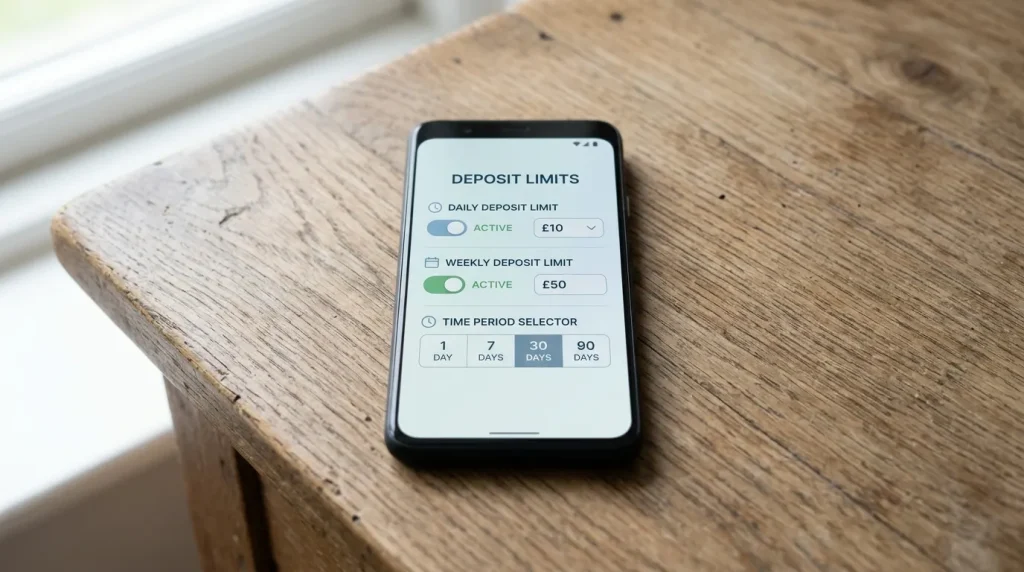
The better apps surface safer gambling tools prominently in account settings. The worse ones bury them in deep menus that require multiple taps to reach. The difference is signalling — operators that put the tools front-and-centre are signalling commitment to customer protection in a way that operators burying them are not. The signal is worth taking seriously when choosing an operator, particularly for customers who know they will use the apps during active matches.
Performance on older phones and slow connections
The marketing for betting apps generally features high-end phones on fast connections. The real-world experience often involves older devices and slower networks, particularly when betting from venues with patchy reception or from home Wi-Fi competing with everything else on the network. The apps that handle these conditions gracefully — degrading speeds without breaking, queuing bets that arrive late, handling intermittent connections — are usable in a wider range of circumstances than the apps that require ideal conditions.
Testing the app in the actual conditions you will use it matters. An app that works perfectly on Wi-Fi at home but freezes on mobile data at a venue is not a good in-play tool for live attendance. The friction reveals itself only in the conditions it shows up under. Spending a season with an operator and noting where their app fails is part of the routine of identifying the right primary operator for your specific betting context.
The biometric login question
Biometric login — fingerprint or face recognition — is now standard on most UK betting apps. The convenience is genuine, but the security implications are worth thinking about. Anyone with physical access to your unlocked phone has access to your betting account through biometric login. For shared households or for people whose phones are sometimes used by others, the password-only option preserves a layer of protection that biometric removes.
I use biometric login on apps where my balance is modest and password-only on apps where I keep more substantial funds. The friction of typing a password occasionally is worth the additional security layer for accounts that hold meaningful money. The convenience of biometric is genuine for casual everyday use and the trade-off is a matter of personal preference rather than a clear answer either way.
The app as the primary betting tool
For most UK rugby bettors now, the app is the primary tool and the desktop site is a backup. The shift has been gradual but complete, and the apps have matured to the point where the experience is genuinely first-class on the leading operators. Choosing the right primary app — for speed, for streaming, for bet builder workflow, for cash out reliability, for safer gambling integration — is one of the more impactful decisions a bettor makes, and the decision is worth taking seriously rather than defaulting to whichever app you installed first.
The pattern I have settled on uses one primary app for speed-critical in-play, a second app for streaming coverage that the primary lacks, and a third for tournament-specific markets that one operator prices particularly well. The setup distributes activity across operators in ways that suit the various tools each app does well, and it reflects the reality that no single operator’s app is the best at everything. The market is competitive enough that switching between specialised tools is sometimes the right answer rather than committing fully to a single provider.
Are rugby betting apps faster than desktop betting sites?
Yes, generally meaningfully so for in-play betting. The mobile-first apps from major UK operators load faster, place bets faster, and integrate live streaming and cash out more responsively than the equivalent desktop experiences. The gap matters most during in-play moments where second-level price movements affect outcomes.
Do UK rugby betting apps include live streaming?
Most major operators offer live streaming of Premiership, European competitions and international rugby through their apps, with varying coverage of secondary competitions like URC and women"s rugby. Streaming is usually free for funded account holders but requires some operators to have an active balance or recent betting activity.
Are the safer gambling tools different on mobile apps?
No, UKGC licensed operators are required to provide the same safer gambling tools on mobile as on desktop. Deposit limits, time limits, reality checks and self-exclusion are all available through the apps. The difference is how prominently each operator surfaces these tools — the better apps put them at one or two taps from the main account screen.
Articles
Written by the editors at Rugby Betting Sites.
