
Cash Out in Rugby Betting — When to Take the Money
 Available in US
Why cash out exists and how the book takes its cut
The first time I saw the cash-out button on a UK betting app I treated it like a magic trick. Bet running, score going my way, button glowing green with a number that was bigger than my stake. Press it, money lands, no need to sweat the last twenty minutes. I cashed out a £20 bet at £43 on an England-Italy match in 2017 and felt like a genius. Then I watched England score twice more in stoppage time and the bet I had cashed out would have settled at £67. I have not felt clever about cash-out since.
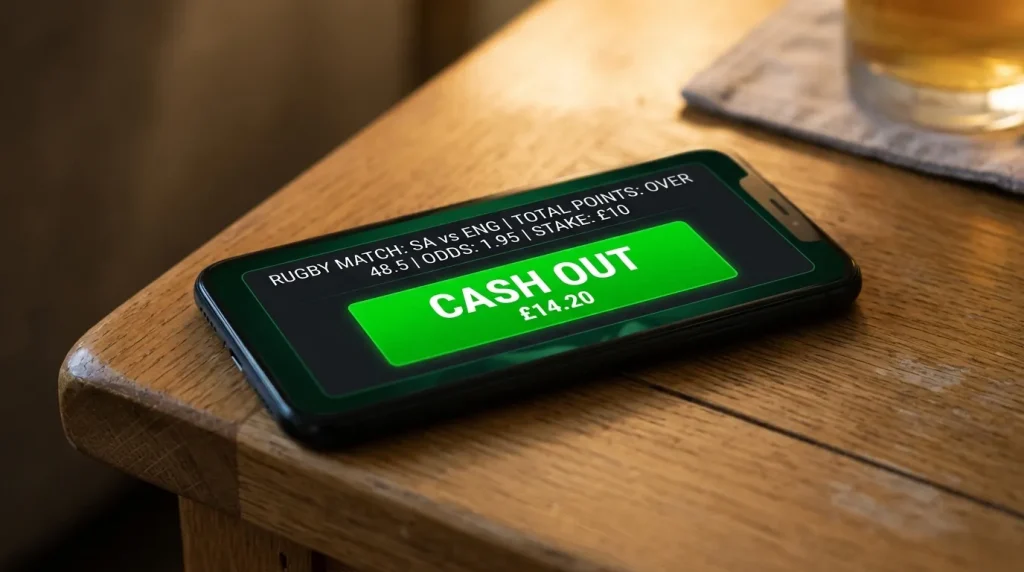
Cash out is a tool the bookmaker offers you to settle a live bet before the final whistle. The number on the button is the bookmaker’s calculation of what your bet is currently worth, minus their cut. That last part is the bit punters forget. Cash out is not the implied lay price. It is the implied lay price with the book’s margin baked into it, which is why the cash-out figure is always a touch less than the number you would compute yourself if you were watching the market closely.
How a cash out offer is calculated mid-match
The cash-out number is generated by a pricing engine that reads the live odds on your bet’s remaining outcomes and computes how much it would cost the book to lay off your position right now. If your bet is on England to win a match where England are currently 1/5 to win in-play, the implied probability of your bet landing is high, so the cash-out figure is close to your full payout. If the same bet were live at 5/2 — England behind, struggling, perhaps a man down — the cash-out figure would be a fraction of your potential return.

The book’s margin sits in the gap between the cash-out figure and the theoretical lay price. On a single-match win bet, that gap might be 3 to 6 per cent. On a multi-leg accumulator or a bet builder, it tends to be larger because the book has to lay off multiple correlated positions simultaneously. The longer the bet — multi-game accas, ante-post outrights — the wider the cash-out cut, because the book is taking on more uncertainty in the lay-off.
What this means in practical terms is that cash out is more economically attractive on simple bets than on complex ones. A live match-result bet has a relatively clean cash-out value. A four-leg bet builder has a cash-out value that includes layers of correlation discount and pricing uncertainty. The button still works on both. The first one gives you fair value. The second one gives you an offer you should think harder about.
When taking the cash out is the right call
There are three situations where cash out is the rational choice, and they are easier to define than the moments when it is the wrong call.
The first is when the cash-out figure represents better expected value than the remaining run of the bet. If you have backed the favourite at 4/9 pre-match, the favourite is leading by 14 with twenty minutes to go, and the cash-out button is offering you 92 per cent of your potential return, the question is whether the remaining 8 per cent is worth the risk of losing the lot to a comeback. For most fixtures it is not. The favourite leading by 14 in the seventieth minute wins more than 92 per cent of the time, but not by a huge margin, and the 8 per cent uplift is not large enough to justify the variance.
The second is when something has changed about the match that you did not factor into the original bet. A red card to your side, an injury to the key player you were backing, a weather change that affects the style of play — these are real-time information shifts. Cashing out at a partial payout in response to new information you did not have when you placed the bet is a defensible strategic move. It is not weakness. It is risk management.
The third is the safer-gambling case. If you are watching a bet for the wrong reasons — chasing a loss, betting because you cannot stop, feeling anxious about the result — the cash-out button is a way to exit. Grainne Hurst, chief executive of the Betting and Gaming Council, called the safer-gambling tools UK sites now offer “the industry’s ongoing commitment to raising standards and ensuring the millions of people who enjoy a regular flutter do so in a safe and responsible environment,” and cash-out fits that frame in a way the bookmaker rarely advertises. Settle the bet, close the app, walk away.

The wrong reason to cash out is fear. If the bet is going to plan, the cash-out figure is tracking the expected value, and nothing material has changed, taking the money before the whistle is a trade of expected value for emotional comfort. Sometimes the trade is worth it. Often it is not. Track your cash-out decisions for a season and you will find out which side of that line you are on.
Partial cash out and auto cash out triggers
Most UK sites now offer partial cash-out, which lets you take some of the money off the table and let the rest run. If your full cash-out is £100, you can cash out 30 per cent for £30 and leave 70 per cent of the bet live, settling at a smaller return if the bet wins.
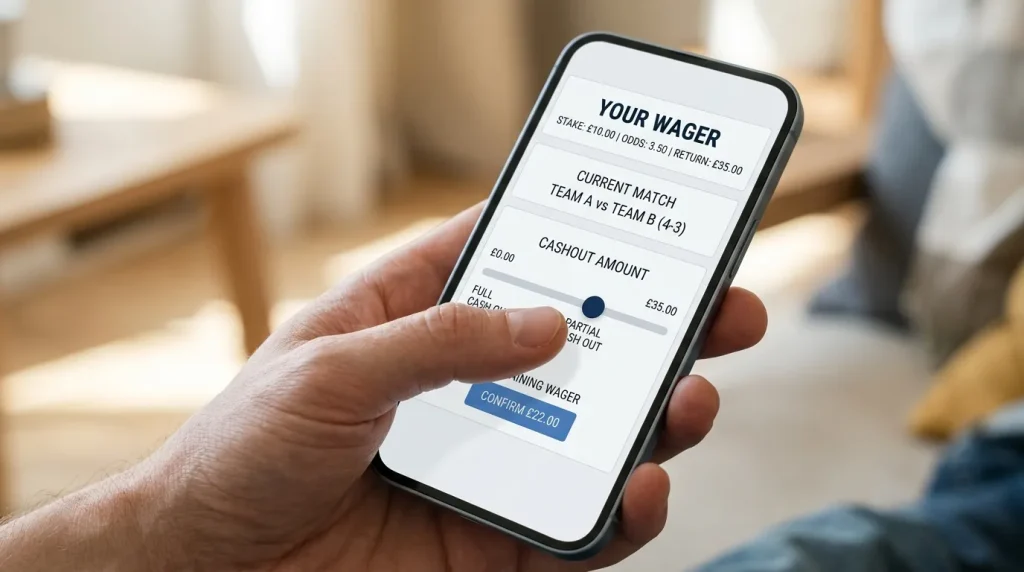
The mechanics of partial cash-out are not free. The book charges its margin on the cashed portion, and the remaining stake is recalculated against the original odds rather than the current live price. The effect is similar to a one-sided lay — you have reduced your exposure without fully closing the position — but the per-pound cost is higher than a full cash-out at the same moment, because the book has to handle two ledgers instead of one.
Auto cash-out is the rule-based version. You set a trigger figure — say £75 — and the system cashes out automatically when the live cash-out value crosses that threshold. Auto cash-out is useful when you cannot watch the match, when you do not trust yourself to press the button at the right moment, or when you want to lock in a minimum return regardless of how the second half plays out. The downside is that it executes at the trigger value and does not wait for the cash-out figure to climb higher. If you set it at £75 and the value climbs to £90 before settling at £100, the auto cash-out triggered at £75 and you collected £75.
Some sites let you set both a take-profit and a stop-loss trigger. Take-profit at £75, stop-loss at £20: whichever crosses first, the bet settles at that cash-out value. This is the cleanest implementation and the closest a UK site comes to giving you proper position-management tools. Where it is offered, it is worth using.
Cash out on a rugby accumulator
Cash-out on an accumulator is the same idea as on a single bet, with extra complication because the lay-off involves multiple matches at multiple stages of completion.
If your four-leg rugby acca has three legs settled as winners and the fourth still running, the cash-out figure reflects the remaining match’s current state. If the fourth match has not yet kicked off, the cash-out figure is based on the pre-match odds of the fourth leg. If it is twenty minutes into the second half with your team leading, the figure climbs sharply because the implied probability of the leg landing has risen.
The wide margin on acca cash-out means it is rarely a great deal. A four-leg acca worth £400 if all legs land might be offered for £230 with three legs in and the fourth live but uncertain. The bookmaker’s lay-off cost on that last leg is high relative to its pre-match price, and the cash-out figure reflects that. You can take it. You can also let it run. The variance is large in both directions.
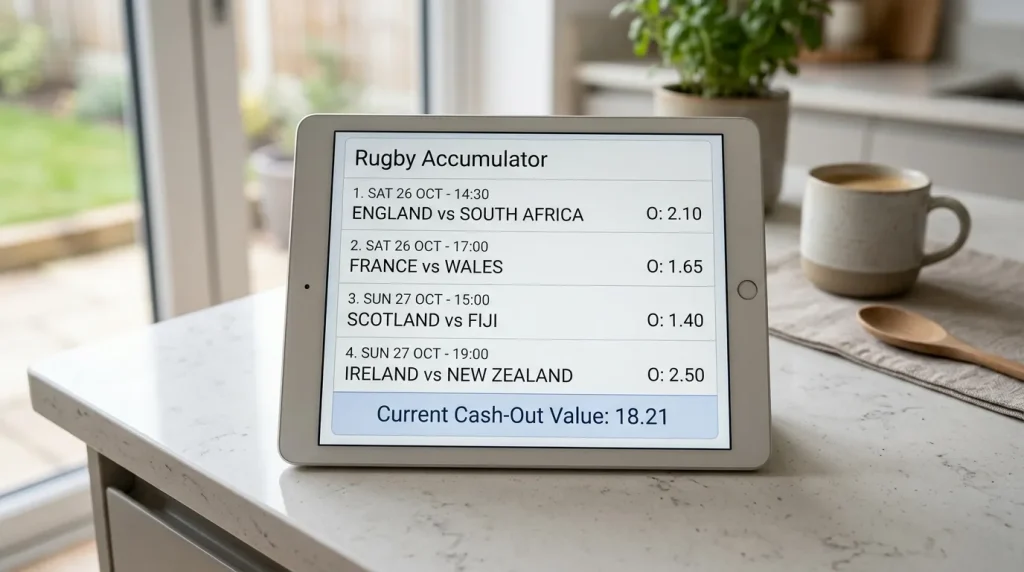
Where acca cash-out is most useful is when one leg has gone wrong. If two legs land, one leg is well-placed and the fourth leg has just lost a man to a red card, the cash-out button gives you a way to extract something from a bet that has lost a meaningful piece of its expected return. Whether that something is enough to justify cashing depends on the size of the figure and the remaining match dynamics. As a rule, the smaller the cash-out figure relative to your stake, the more sense it makes to let the bet run, because at that point you are already on for a small loss or a small return and the variance is asymmetric in your favour.
If you want to back multi-match slips with a clean structure rather than the patched-together logic of partial cash-outs, the deeper read is on rugby accumulator betting, where the stacking and insurance dynamics are covered properly.
The discipline cash-out demands
Cash-out is one of the few tools UK sites give punters that genuinely changes the shape of a bet after it has been placed. The danger is treating it as a comfort blanket rather than a strategic lever. The discipline I have settled on, after enough mistakes, is to decide before the bet runs what cash-out figure I would accept and at what point in the match I would take it. Write it on a slip of paper if you have to. Stick to the rule. The button is there to be pressed at a predetermined level, not at a panicked impulse.
Is a cash out offer always less than the implied lay price?
Yes. The cash-out figure is the implied lay price with the bookmaker"s margin subtracted. On a simple single-match bet the gap is typically 3 to 6 per cent. On a bet builder or accumulator the gap is wider because the lay-off involves more positions and more correlation.
Can a UK book remove cash out late in a rugby match?
Yes. Cash-out can be withdrawn for any market the trader decides to stop offering it on, and it routinely disappears in the closing minutes of close matches or during TMO suspensions. The button will grey out and the option will not return. This is published in the terms of every UKGC site and is a normal operational behaviour.
Does cash out apply to bet builders on rugby?
Most UK sites now offer cash-out on bet builders, but the offer is more conservative than on single bets. The book has to compute the lay-off cost on multiple correlated legs, so the margin baked into the cash-out figure is larger. Cash-out also tends to be removed sooner on bet builders as the match progresses.
Articles
Prepared by the Rugby Betting Sites editorial staff.
