
Rugby Odds Formats — Fractional, Decimal and American
 Available in US
The odds format that finally made me stop calculating in my head
For three years I bet exclusively in fractional odds because that is what UK books defaulted to and changing the display felt unnecessary. Then I sat next to a sharp Australian bettor at a Lions tour reception, and watched him price selections in decimal at roughly twice the speed I could. The conversion was instant for him because the decimal number was the multiplier — the total return per unit staked, no mental arithmetic required.
I switched the next morning and have never gone back. Most of the resistance to decimal odds among UK bettors is purely cultural. Fractional looks more traditional, feels more British, and conveys a kind of bookmaker authenticity. Decimal is objectively more useful for almost every actual decision you make about a bet. This article is the case for choosing your format deliberately rather than by default, and the maths underneath each of the three you will encounter.
Fractional odds and the British inheritance
Fractional odds are the historical UK standard, inherited from on-course bookmaking traditions where prices were chalked up as ratios — 5/2, 11/4, 6/1, 100/30. The first number represents profit, the second represents stake. A 5/2 price returns five pounds profit for every two pounds staked, plus the original stake. A 6/1 returns six pounds profit per one pound staked.
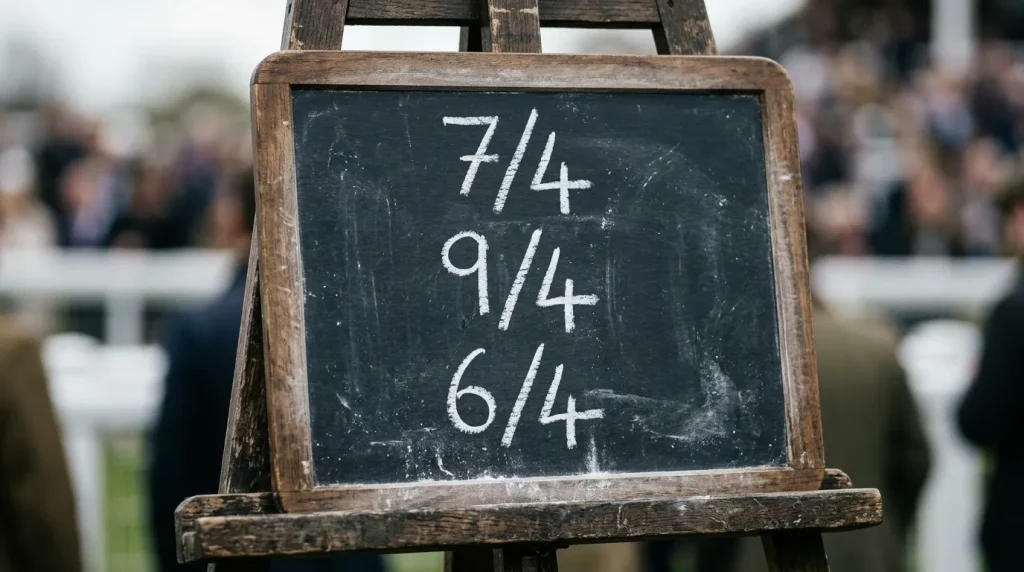
The format is intuitive once internalised, particularly for the standard fractions you see most often. 6/4, 7/4, 9/4, 5/2, 3/1, 4/1 — these become familiar reference points. The awkwardness shows up at unusual prices. Is 13/8 better than 7/4? Is 11/10 a bigger payout than 21/20? The answers exist but require deliberate thought, and the friction is real if you are scanning a slate quickly.
Decimal odds and why they win on usability
Decimal odds present the total return per unit staked. A 2.50 price means a £1 stake returns £2.50 total — £1 stake back plus £1.50 profit. A 6.00 price returns £6 for every £1. The number is the multiplier, full stop, no fraction parsing.
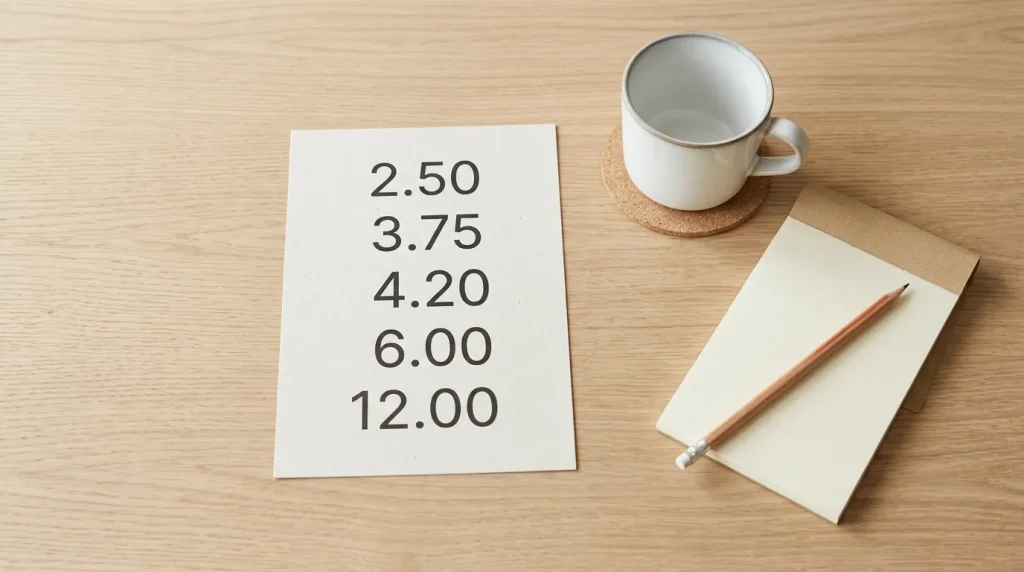
The advantage compounds when you compare prices across operators or markets. Sorting decimal prices is trivial — bigger number is longer odds. Sorting fractional prices requires conversion in your head. Calculating returns on non-standard stakes — a £17 punt at 9/4, say — is straightforward in decimal and fiddly in fractional. The format also handles short prices cleanly. A 1.20 decimal is obviously a heavy favourite; the 1/5 fractional equivalent requires conversion to make the same point.
American odds and when you encounter them
American odds use plus and minus formatting. Favourites are quoted as the amount you must stake to win 100 units — minus 175 means staking 175 to win 100. Underdogs are quoted as the amount you would win from a 100-unit stake — plus 220 means staking 100 to win 220.
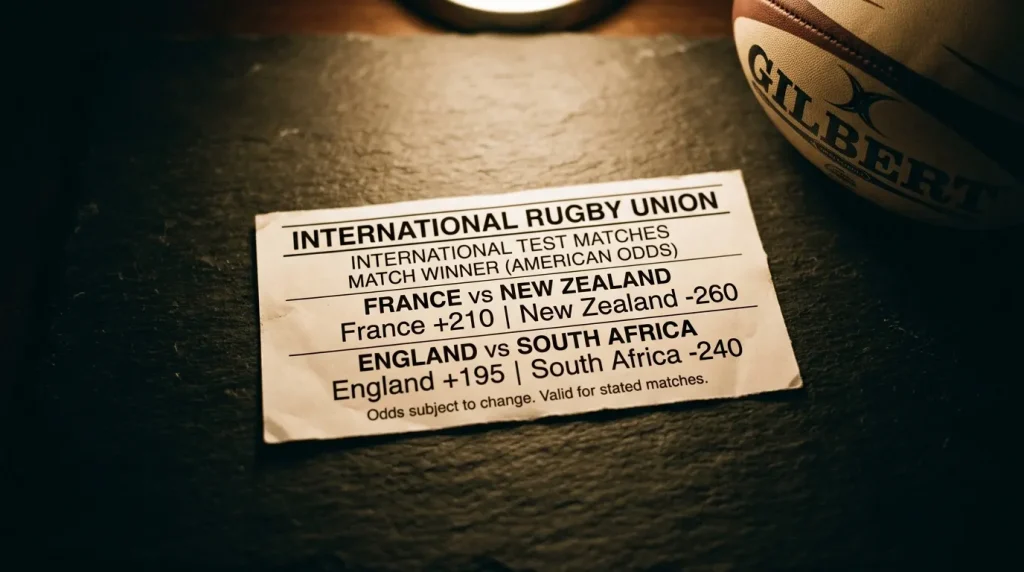
The format is standard in US markets and increasingly visible on platforms with international product ranges. UK bettors mostly encounter it on international rugby fixtures via American-facing operators or content. The conversion to fractional or decimal is straightforward but the formatting itself is genuinely the worst of the three for everyday use — it requires mental adjustment depending on whether the price is plus or minus, and the unit of measurement changes accordingly.
Converting between formats without paper
The conversions are simple enough to do mentally with practice. Fractional to decimal — divide the fraction, add one. 5/2 becomes 2.5 plus 1 equals 3.50. Decimal to fractional — subtract one, express as a fraction. 3.50 minus 1 is 2.5, which becomes 5/2. American positive to decimal — divide by 100, add one. Plus 250 becomes 2.5 plus 1 equals 3.50. American negative to decimal — divide 100 by the absolute value, add one. Minus 200 becomes 100/200 plus 1 equals 1.50.
You should not need to do these in real time. Every UK regulated platform lets you set the display format in account settings, and the setting persists across sessions. Pick one format, stick with it, and let the platform do the conversion display. The conversion knowledge is for understanding what you are looking at when you encounter another format on a competing site or in international coverage. It is not something you need fluent on a Saturday afternoon.
Implied probability and the format-agnostic skill
Whatever format you display, the actually useful number is implied probability — the percentage chance the bookmaker is pricing into the selection. In decimal, implied probability is 1 divided by the price. A 2.50 decimal implies 1/2.50 equals 40 percent. A 4.00 implies 25 percent. A 1.50 implies 67 percent. In fractional, the same calculation requires converting to decimal first, which is why decimal is the working format for serious price analysis even among bettors who display fractional in their slip.

The reason implied probability matters is that it is the bookmaker’s view of the selection’s likelihood. Your bet is essentially a disagreement with the book — you think the selection happens more often than the implied probability suggests. The size of that disagreement is your potential edge, and you cannot evaluate it without converting odds into probability.
The vig and why prices never add to 100 percent
Add up the implied probabilities of every outcome in a market. A two-way market — like a handicap with no draw — might price the two sides at 1.91 each, implying 52.4 percent on each. That totals 104.8 percent, with the 4.8 percent overhang being the bookmaker’s margin. In a three-way market like a Six Nations match outcome including the draw, the overhang is typically larger because the draw is rare and the operator builds margin into both sides.
This is the bookmaker’s structural edge — the overround that ensures profitability across the long run regardless of which outcome lands. Comparing the overround across operators on the same market tells you which book is offering sharper prices. A market priced at 103 percent total is sharper than one at 108 percent. The same matchup across multiple books can have meaningfully different overrounds, and consistently choosing the sharper one is one of the more straightforward edges available to the diligent. For a primer on building actual betting decisions from this foundation, the beginner walkthrough connects these calculations to practical staking.
Price ladders and ticks
Prices move in standardised increments called ticks. Fractional moves up the standard ladder — 6/4, 13/8, 7/4, 15/8, 2/1, 11/5, 9/4, 5/2 — with each step roughly a 4 to 6 percent change in implied probability at the middle of the price range. Decimal moves in finer increments at short prices and coarser increments at long prices, reflecting the diminishing impact of each unit at higher prices.
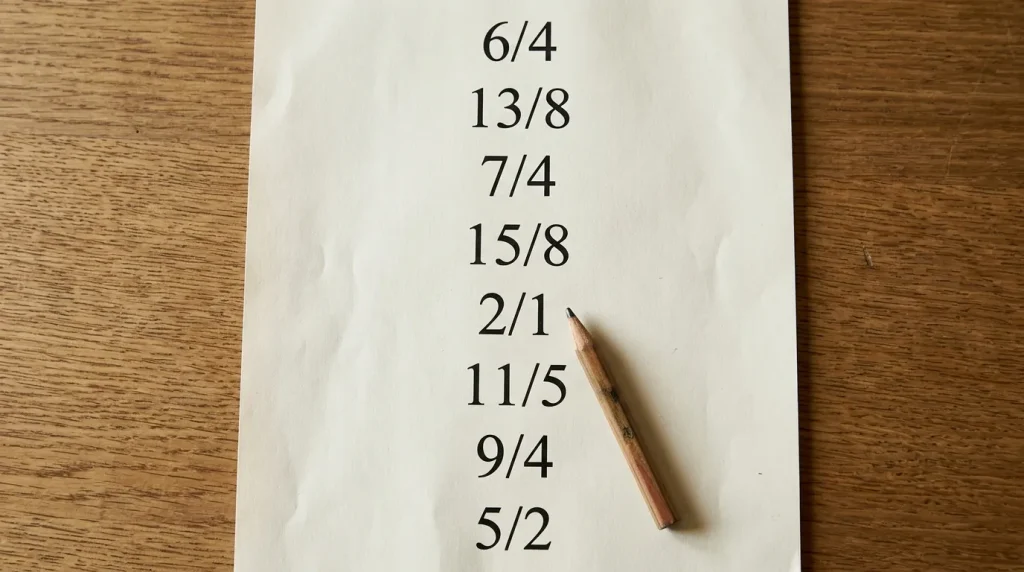
Understanding the ladder matters because it tells you how much a price movement actually means. Six Nations 2025 had a £18 million prize fund, the kind of stakes that move markets meaningfully — and a single tick movement on a match outcome reflects real information. Two ticks suggests a substantive view change. Three or more usually means there is news the market has reacted to, often team news or weather. Watching ticks across a fixture week tells you where the market thinks the meaningful information is arriving.
Rounding and where books cheat the format
Not all decimal prices round honestly. A book might display 2.50 where the true price computes to 2.52, pocketing the difference as additional margin. Across thousands of bets, these small roundings add to a meaningful operator edge over and above the headline overround. Comparing the same market on multiple books often reveals slight discrepancies, and the sharper operators round in the customer’s favour as a competitive feature.
The same dynamic operates in fractional, where the display granularity is coarser by definition. A true 9/5 price might be displayed as either 7/4 or 9/4 depending on rounding direction, and the customer-facing line can be a notably different probability from the underlying calculation. The exercise of mentally converting back to decimal and probability is a useful sanity check on whether the displayed line is fair.
The format choice that works for me
I use decimal for all my own analysis and pricing notes, fractional for casual reference when I am scanning a UK book’s slate, and convert American mentally only when forced to by an international source. The decimal preference for working purposes is straightforward — it converts to probability with a single division, it sorts intuitively, and it handles non-integer stakes cleanly. The fractional fluency is a nice-to-have for conversation in UK rugby contexts where fractional remains the cultural default.
What I would not do is leave the choice on default without thinking about it. Most platforms default to whatever the customer’s geography suggests, which means UK bettors default to fractional and never reconsider. The five seconds spent in account settings to flip to decimal can save hours of mental arithmetic across a year of serious betting, and the conceptual benefits — clearer probability, easier comparison, intuitive sorting — accrue indefinitely. Pick a format because it serves you, not because it is what the screen showed when you opened the account.
Which odds format is best for UK rugby bettors?
Decimal is objectively the most useful for everyday analysis because the price is the total return multiplier and converts to implied probability with a single division. Fractional remains the cultural default in UK books and is easy enough for casual reference. American is rarely needed and is the least efficient of the three for UK use.
How do I convert fractional odds to decimal?
Divide the fraction and add one. 5/2 becomes 2.5 plus 1 equals 3.50. 11/4 becomes 2.75 plus 1 equals 3.75. The decimal price tells you the total return per unit staked, including the original stake.
What does an overround tell me about a betting market?
The overround is the sum of all implied probabilities in a market minus 100 percent — it is the bookmaker"s margin. A two-way handicap priced at 103 percent total has a tighter overround than one at 108 percent, meaning the customer is getting more competitive prices. Comparing overrounds across books on the same market identifies who is pricing sharpest.
Articles
Prepared by the Rugby Betting Sites editorial staff.
